Specs & engineering
Your pallets keep breaking in the same place. Here is why.
Nine times out of ten a failed pallet has cracked in the same three inches of wood. It is not bad luck and it is not cheap lumber.
Request a quote
Talk to the people who wrote this
Same form, same inbox. Technical questions get answered whether or not there is an order attached.
In short
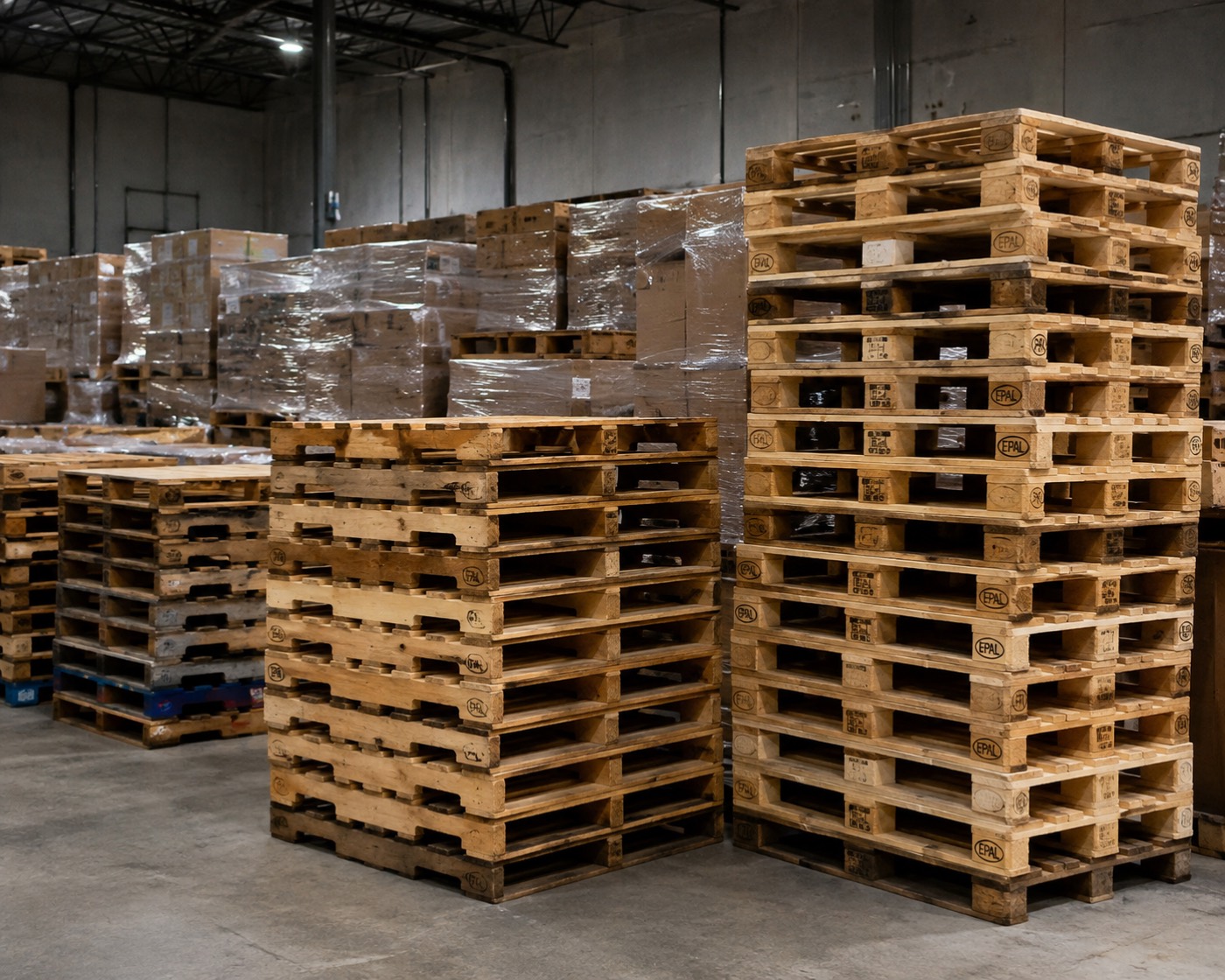
Most stringer pallets fail at the notch — the nine-inch cut in the lower edge of the stringer that lets a forklift enter from the side. Cutting the notch removes roughly 40% of the stringer's depth at the point where bending stress is already high, and every fork entry loads that reduced section.
The fix is rarely better wood. It is a shorter span, a deeper stringer, block construction, or driver technique — in roughly that order of cost-effectiveness.
What a notch does to a stringer
A stringer is a beam. Its resistance to bending goes up with the *square* of its depth, which is why a 3½-inch stringer is dramatically stiffer than a 2½-inch one rather than just 40% stiffer.
Now cut a notch. A standard GMA notch is 9 inches long and 1½ inches deep, taken out of the bottom edge. The stringer at that point is no longer 3½ inches deep; it is 2 inches deep. Square that relationship and the notched section has roughly a third of the bending resistance of the full section.
That would be tolerable if the notch were somewhere quiet. It is not. It sits under the load path, and it is exactly where a fork tine lands when a driver enters from the 40-inch side.
Why it fails when it fails
Wood does not usually fail suddenly under a static load it can carry. It fails from an accumulation of three things.
- Repeated bending. Each lift flexes the notched section. Wood fibres do not recover perfectly, and micro-checking accumulates along the grain.
- Impact. A fork entering at speed hits the notch shoulder. That is a shear load applied sideways to a section already reduced in depth.
- Moisture cycling. A pallet stored outdoors swells and shrinks. The notch is end grain on two faces, so it takes on and loses water faster than the rest of the stringer, and the differential movement opens splits.
The failure itself is almost always a split running from the notch corner along the grain toward the end of the stringer. Once that split exists, the pallet has effectively become a two-way pallet with a hinge in it.
The four fixes, cheapest first
1. Shorten the span
If the pallet is racked, the notch is bridging open air. Adding rack decking, wire mesh or a third front-to-back rail removes the bending problem entirely. This is almost always cheaper than upgrading every pallet in the fleet, and it fixes the deck sag at the same time.
2. Change the entry habit
If your drivers routinely enter from the 40-inch side because that is how the racking faces, you are loading the notch every single time. Where the layout permits entry from the 48-inch side, the forks pass under the stringers rather than through them, and the notch never sees the tine. This is a free fix and it is frequently available.
3. Deepen the stringer
A 4-inch stringer notched to the same depth retains substantially more section than a 3½-inch one. On a custom build this is a small material cost for a large strength gain, and it is the change we recommend most often for heavy repeat-use fleets.
4. Move to block construction
Nine blocks with perimeter runners have no notch at all — the fork enters between the blocks, through a gap rather than through a cut. Block pallets carry more, last longer under repeat handling and give true four-way entry. They also weigh more and cost more. For a fleet cycling dozens of times, they win.
What to do with the ones already cracked
A cracked stringer is repairable, once. A companion piece glued and nailed alongside the original along its full length restores most of the original strength, which is why a repaired pallet grades B rather than A.
What it does not survive is a second crack in a second stringer. At that point the pallet is beyond economical repair and goes to dismantling, where the deck boards and the uncracked stringer are recovered.
If you are seeing a high rate of notch failures on newly delivered stock, tell us. That is a specification conversation, not a warranty conversation, and it usually ends with a different pallet rather than a credit note.
Takeaways
- The notch removes about 40% of stringer depth at the highest-stress point.
- Bending resistance scales with depth squared, so that 40% costs roughly two thirds of the strength.
- Rack decking and entry direction are free or cheap fixes; deeper stringers and block construction are the paid ones.
- A cracked stringer can be companion-repaired once, and never grades A again.
Questions
Asked and answered
Is a notched pallet weaker than an unnotched one?
At the notch, considerably. An unnotched two-way stringer pallet is stronger in bending than the same pallet with four-way notches cut into it. The trade is handling flexibility for strength, and it is usually the right trade.
Can a cracked stringer be repaired?
Yes, once. A companion stringer glued and nailed along the full length restores most of the original strength. A pallet with two cracked stringers is beyond economical repair and should be dismantled.
Written by
Dale Whitmer
Yard Manager
Runs the grading line and the repair bay. Has graded more pallets than he can estimate and still argues about deck coverage.
Disagree with something here? That is genuinely useful to us — several of these articles exist because a customer told us we had it wrong. Use the form at the top of the page or write to the yard directly.
Terms used here
Definitions live in one place so they cannot drift. Full list in the pallet glossary.
- Block pallet
- A pallet built on nine blocks with perimeter runners, giving true four-way entry and higher capacity than a stringer pallet.
- Deck board
- A horizontal board forming the load-bearing surface of a pallet.
- Dismantling
- Cutting a pallet apart to recover usable deck boards and stringers, usually on a band saw.
- Entry
- How a forklift or pallet jack can get into the pallet: two-way, partial four-way or full four-way.
- Four-way entry
- Fork access from all four sides. Full four-way also admits a pallet jack from all four sides; partial four-way does not.
- Notch
- A cut in the lower edge of a stringer allowing fork entry from the side. Two per stringer on a GMA pallet.
- Runner
- A lengthwise support member under a load or a skid deck, providing fork clearance.
- Static load
- The weight a pallet can hold at rest on a flat supporting surface. The highest of the three ratings.
More in Specs & engineering
- Marking pallets so you can find them again7 min
- Why an AS/RS rejects a pallet a forklift would not notice7 min
- Designing a pallet for automation8 min
- Reclaimed hardwood usually beats new pine7 min
- Blue stain is not rot, and rejecting it costs you money5 min
- The cheapest part of a pallet decides how long it lasts6 min
Keep reading
Related notes
Deck coverage is not deck strength
Customers ask for more deck boards when they want more strength. Sometimes that works. Often they have bought the wrong upgrade.
Specs & engineeringBlock or stringer: the honest decision
Block pallets are better in almost every engineering sense and worse in the one that decides most purchase orders.
Specs & engineeringCan you rack a used pallet? The honest answer
This is the question we are asked most often and the one where a supplier is most tempted to give a comfortable answer.