Products · export
Heat-treated ISPM-15 pallets
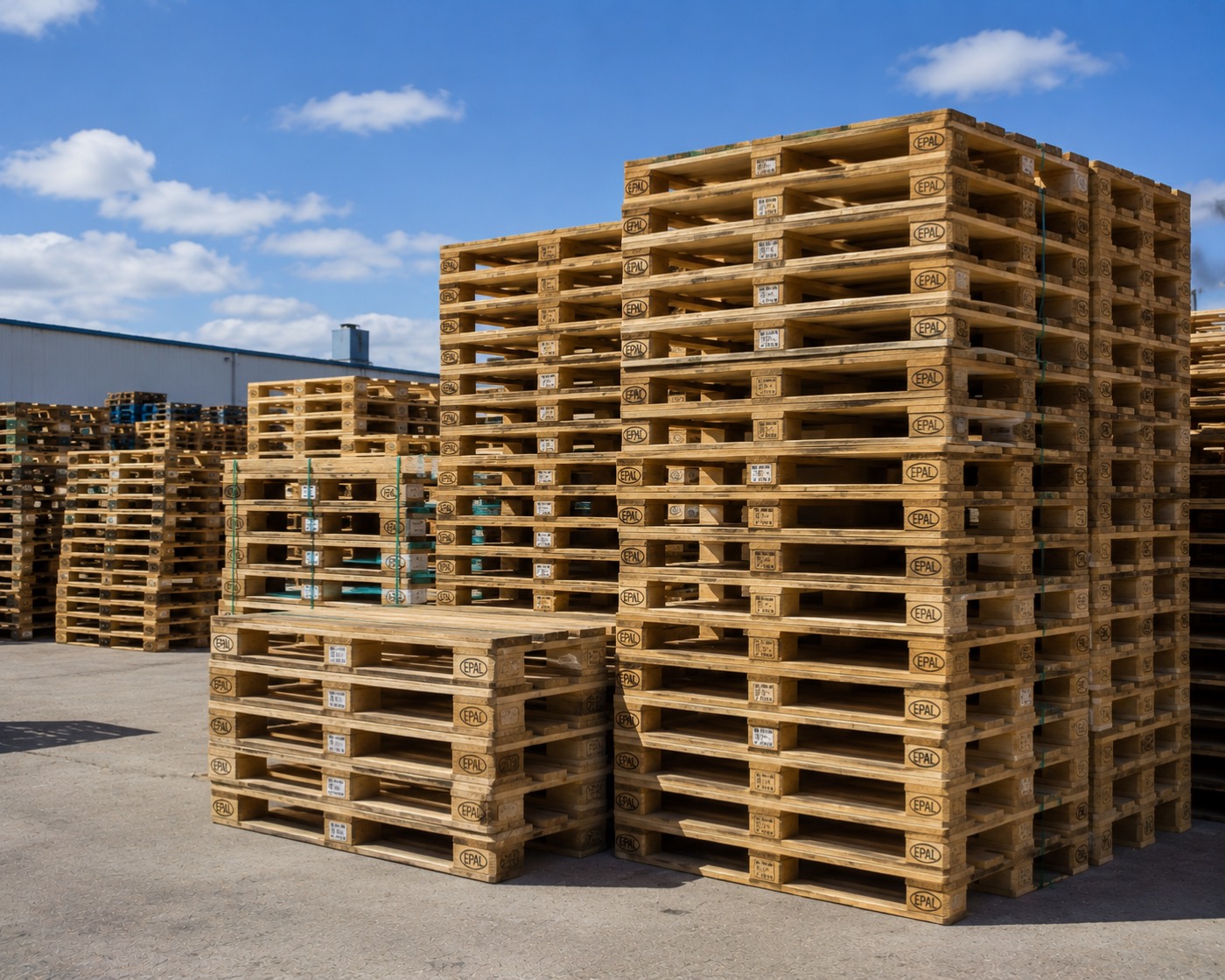
Wood packaging crossing a border needs a stamp, and the stamp needs to be real. We treat and mark on site, which means your export load leaves with compliance already on it instead of waiting for a third party.
Request a quote
Tell us what you need
Send this and a real person in the Columbus yard reads it. Most quotes go out the same business day.
In short
ISPM-15 heat-treated pallets are wood pallets heated until the core of every board reaches 56°C and holds it for at least 30 continuous minutes, then marked with a registered IPPC stamp. That treatment and mark is what allows wood packaging to cross an international border without being fumigated, quarantined or destroyed at the port.
We run treatment on site in Columbus and stamp before dispatch. Both new builds and qualifying reclaimed pallets can be treated. Fully explained in ISPM-15 explained.
What the standard actually requires
ISPM-15 is an International Plant Protection Convention standard adopted by more than 180 countries. It exists because wood packaging is an extremely efficient way to move bark beetles, longhorn borers and nematodes between continents.
The requirement is deliberately simple: solid wood packaging material thicker than 6 mm must be debarked and then either heat treated to 56°C core temperature for 30 continuous minutes, or fumigated with methyl bromide. Heat treatment is now overwhelmingly the preferred route, and methyl bromide is banned or restricted in many jurisdictions.
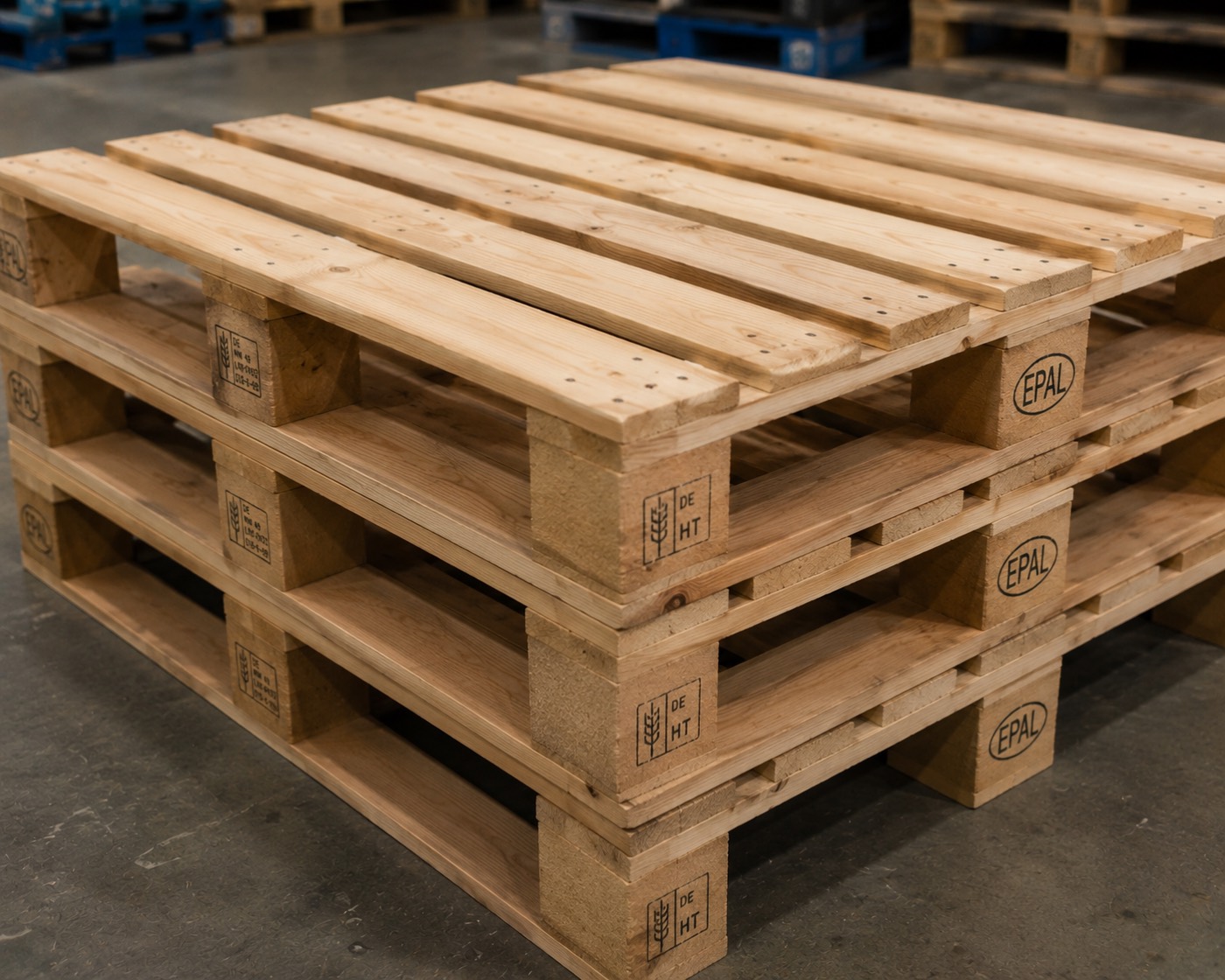
The mark must include the IPPC logo, the ISO country code, the registered facility number and the treatment code HT. A mark without a real registration behind it is not compliance — it is a counterfeit, and customs officers know what they look like.
What does not need heat treatment
Paying for treatment you do not need is a surprisingly common leak in packaging budgets.
- Domestic shipments inside the United States need no ISPM-15 mark at all
- Canada and the United States are mutually exempt for bilateral trade in most cases
- Engineered wood — plywood, OSB, particleboard, corrugated — is exempt because manufacturing already destroys pests
- Plastic and metal pallets are entirely outside the scope; see plastic pallets
- Wood thinner than 6 mm is exempt
If a supplier is charging you for HT stock on domestic lanes, that is money leaving the building for nothing.
Heat treatment versus kiln drying — not the same thing
This confusion causes real shipment holds, so it is worth being precise.
Kiln drying (KD) removes moisture. It is about dimensional stability and mold prevention. A kiln-dried pallet is a better pallet, but kiln drying alone does not confer ISPM-15 compliance.
Heat treatment (HT) is a phytosanitary process defined by core temperature and hold time. It kills organisms. It does not necessarily produce dry wood.
A pallet can be KD without being HT, HT without being KD, or both. Only the HT mark satisfies customs. If your paperwork says KD and your destination is outside North America, you have a problem that will surface at the port rather than at the dock.
How we run and document treatment
Loads are stacked for airflow, probed at the coldest predicted point in the charge, and held above 56°C core for a minimum of 30 minutes with a margin. Charge records — date, temperature trace, hold duration, quantity — are retained and available to you on request.
Stamping happens on two opposite sides of the pallet, on the stringers, in a position that stays visible when the pallet is loaded. We stamp after treatment, never before, because a pre-stamped pallet that fails a charge is a compliance failure waiting to happen.
Reclaimed pallets can be treated provided they are debarked, structurally sound and free of visible contamination — see recycled pallets for grading. This is usually the lowest-cost route to export-compliant stock.
Planning your export packaging
Three practical habits prevent almost every ISPM-15 hold we have seen.
- Segregate treated stock physically. An untreated pallet stored beside treated stock will eventually get loaded by mistake.
- Check every component. Dunnage, blocking, bracing and crates all fall under ISPM-15. A compliant pallet with an untreated timber brace on top will still be rejected. See crates, boxes and skids.
- Order treatment into the schedule, not onto the end of it. Treatment is a batch process; a same-day request costs more and risks the sailing.
What the mark contains, element by element
A compliant IPPC mark has four required elements and a number of things it must not have. Being able to read one is genuinely useful, because a bad mark is easier to spot than most people assume.
- The IPPC symbol — a stylised ear of wheat. Not decorative. A mark without it is not compliant.
- The ISO country code — `US` for the United States.
- The registered facility number, unique to the treatment provider.
- The treatment code — `HT` for heat treatment, `MB` for methyl bromide, `DH` for dielectric heating.
It must be legible, permanent, and applied to at least two opposite sides. It must not be in red or orange, which are reserved for hazard marking.
What a compliant mark does not contain: a date, a batch number, or a company logo built into the stamp. Marks carrying those deserve a closer look.
Planning treatment into a schedule
The most common operational failure with heat treatment is not compliance — it is timing. Treatment is a batch process, not a per-pallet one.
A charge has to be built, brought up to temperature, held above 56°C core for the full thirty minutes with a margin, and cooled. The hold is half an hour; the whole cycle is several hours, and charges are scheduled rather than run on demand.
So a same-day treatment request either costs more or does not happen. Build it into the schedule as a step with its own lead time, the way you would treat painting or curing.
Practically: order treated stock with the pallets rather than sending pallets for treatment afterwards, and give one to three working days.
Keeping treated stock compliant once it is yours
Compliance does not end at delivery. Three things will invalidate it inside your building.
Repair with untreated wood. Replacing a deck board with untreated lumber invalidates the mark. The pallet must be re-treated and re-marked, or the mark removed. If you repair in house, either keep treated lumber for the purpose or take repaired units out of the export pool.
Mixed storage. Treated and untreated stock stored together will eventually be confused. Segregate physically — a different bay, ideally a different part of the building — and consider banding treated stock in a distinguishing colour so the difference is visible from across the yard.
Obscured marks. A mark hidden by the load, painted over or worn away is treated as no mark. Check placement stays visible when loaded.
The five real-world failure modes are worked through in five ISPM-15 holds we have watched happen.
Spec sheet
ISPM-15 treatment specification
| Standard | ISPM-15 (IPPC), revised annex 1 |
| Core temperature | 56°C minimum |
| Hold time | 30 continuous minutes minimum |
| Bark | Debarked wood only |
| Mark contents | IPPC logo, US country code, facility number, HT code |
| Mark placement | Two opposite sides, on stringers, visible when loaded |
| Eligible stock | New builds and qualifying reclaimed pallets |
| Records | Charge temperature trace retained and available on request |
| Not covered | Plastic, metal, engineered wood, material under 6 mm |
Reference
What needs treatment and what does not
| Material or route | ISPM-15 required? | Note |
|---|---|---|
| Solid wood pallets, international | Yes | Debarked, HT to 56°C/30 min, marked two sides |
| Solid wood crates and skids, international | Yes | Base, frame, slats and internal blocking all count |
| Dunnage, blocking, bracing | Yes | The most common failure — see dunnage |
| Cable drums and reels, solid wood | Yes | |
| Domestic US shipments | No | Paying for treatment here is pure cost |
| US ↔ Canada | Largely exempt | Mutual recognition; confirm with your forwarder |
| Plywood, OSB, particleboard | No | Manufacturing already destroys pests |
| Corrugated, hardboard, veneer | No | Engineered wood is outside the standard |
| Wood thinner than 6 mm | No | |
| Plastic and metal pallets | No | Entirely outside the standard |
| Presswood / moulded pallets | No | Engineered wood — a real advantage on air freight |
Reference
Heat treatment vs kiln drying vs fumigation
| Heat treatment (HT) | Kiln drying (KD) | Methyl bromide (MB) | |
|---|---|---|---|
| Purpose | Kill pests | Remove moisture | Kill pests |
| Defined by | 56°C core, 30 min | Target moisture content | Gas concentration and time |
| Satisfies ISPM-15 | Yes | No | Yes, where permitted |
| Improves stability | Slightly | Substantially | No |
| Prevents mold | No | Helps considerably | No |
| Availability | Standard | Standard | Banned or restricted in many countries |
A pallet can be KD without being HT, HT without being KD, or both. Only the HT mark satisfies customs.
Avoid these
Mistakes we see
Bracing a compliant load with untreated timber
By far the most common hold. Customs assesses the whole consignment, so one untreated 2×4 grabbed from a scrap rack makes a compliant pallet irrelevant. Order treated blocking with the pallets and remove untreated scrap from the export dock entirely.
Assuming kiln dried means heat treated
Different process, different purpose, different mark. KD removes moisture; HT is a phytosanitary treatment defined by core temperature and hold time. Only HT with a registered mark satisfies customs, and this confusion causes real shipment holds.
Repairing a treated pallet with untreated wood
The mark stays on and the pallet is no longer compliant, which is the worst combination — it looks fine and it fails. Re-treat and re-mark, or remove the pallet from the export pool.
Requesting treatment on the day of loading
Treatment is batched and the full cycle runs several hours. A same-day request either costs a premium or misses the sailing. Plan one to three working days.
Paying for treatment on domestic freight
No ISPM-15 mark is required inside the United States. Treated stock on domestic lanes is money leaving the building for nothing, and it is one of the easiest savings in a packaging audit.
Checklist
Work through this before you order
Before the container is booked
- Every solid wood item on the shipment identified — pallets, crates, dunnage, blocking
- Treatment scheduled, not assumed
- Treated stock physically segregated from untreated
- Untreated scrap removed from the loading area
- Marks legible and positioned to stay visible when loaded
- Treatment records requested if your customer needs them
Ongoing housekeeping
- Treated lumber kept for in-house repairs, or repairs taken out of the export pool
- Distinguishing band or wrap colour on treated stock
- Export dock kept clear of untreated offcuts
- New staff briefed that dunnage counts
- Marks checked during pre-load inspection
Terms on this page
Full list in the pallet glossary
- IPPC
- International Plant Protection Convention, the body that publishes ISPM-15.
- Charge
- One batch of material treated together in a heat treatment chamber, with its own temperature record.
- Debarking
- Removal of bark before treatment. Required, because bark harbours many of the pests the standard targets.
- Phytosanitary
- Relating to plant health. ISPM-15 is a phytosanitary measure — it exists to stop pests moving between countries.
Questions
Before you ask us
How long does an ISPM-15 stamp stay valid?
Indefinitely, as long as the pallet is not repaired with untreated wood. A treated pallet does not expire. However, if a board is replaced the pallet must be re-treated and re-marked, or the old mark removed.
Can you heat treat pallets we already own?
Yes. Bring or send your existing pallets to the Columbus yard and we will inspect, treat and stamp them. Pallets must be debarked, dry enough to heat evenly, and structurally sound.
Does heat treatment change how the pallet performs?
Very little. Heat treatment slightly reduces moisture content and can cause minor surface checking on some species. Strength properties are essentially unaffected at ISPM-15 temperatures.
What happens if a shipment arrives without a valid mark?
The receiving country can order fumigation at your cost, re-export of the entire consignment, or destruction of the packaging. Delays of one to three weeks are typical and the cost usually exceeds the price of the pallets many times over.
Can you provide treatment records?
Yes. Every charge is logged with date, quantity, temperature trace and hold duration, and those records are retained and available on request — which matters when a customer, forwarder or customs authority asks you to substantiate compliance.
How many pallets fit in one treatment charge?
It depends on stacking for airflow rather than on raw volume — material has to be stacked so heat reaches the core of every piece. That is why we build charges rather than filling the chamber, and why treatment is scheduled rather than run on demand.
Does heat treatment weaken the pallet?
Very little. It slightly reduces moisture content and can cause minor surface checking on some species. Strength properties are essentially unaffected at ISPM-15 temperatures.
Can plastic pallets be used to avoid ISPM-15 entirely?
Yes — plastic is outside the standard, which is a genuine advantage for exporters. Whether that justifies the four-to-tenfold cost difference depends on whether the pallet reliably comes back. On a one-way export lane it usually does not.
What if our customer asks for a phytosanitary certificate instead?
That is a different document covering the goods rather than the packaging, issued by a regulatory authority. ISPM-15 marking covers the wood packaging. Some shipments need both, and your freight forwarder is the right party to confirm which.
Keep going
Related pages