Guide · buying
The pallet buying guide
Most pallet buying is done by habit — the same size, the same grade, the same supplier as last year. This is what changes when somebody actually looks.
Request a quote
Tell us what you need
Send this and a real person in the Columbus yard reads it. Most quotes go out the same business day.
In short
Buying pallets well comes down to four decisions: the footprint (driven by your load and your trailer, not by habit), the grade (driven by the application, not by caution), new versus reclaimed (driven by whether appearance and documentation matter), and the supply relationship (scheduled beats ad-hoc, and two-way lanes beat one-way).
Get those four right and the unit price becomes the least important variable in the equation.
Step one: size to the load, not to the habit
The single most expensive assumption in packaging is that your pallet size is correct because it has always been that size.
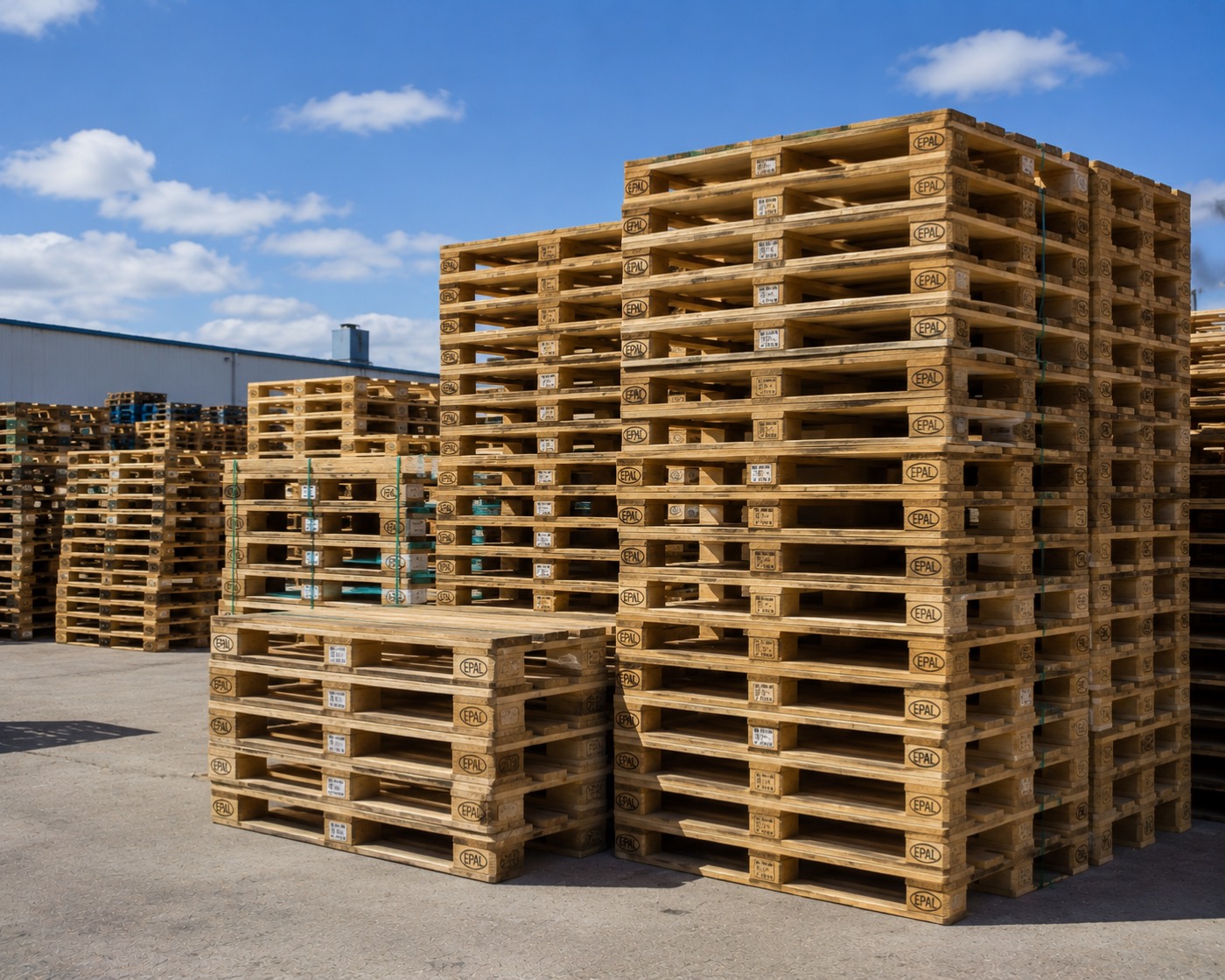
Measure the actual footprint of a full load. If product overhangs the deck, you are losing compression strength precisely at the corners where cartons are strongest, and you will see it as bottom-layer crush. If the deck extends well past the load, you are paying for wood you do not use and wasting trailer cube.
Then check the trailer maths. A 48×40 gives you thirty per floor layer pinwheeled in a 53-foot van; a 42×42 also gives thirty; a 36×36 gives thirty-four. If your product is dense and you weigh out before you cube out, a smaller footprint might let you build a better load. Run your dimensions through the spec bench and see the numbers.
Full reference: the pallet size guide and the standard size chart.
Step two: grade to the application
This is where most money leaks, and it leaks in the direction of caution.
- Racked storage → Grade A with original stringers, plus your own rack engineering sign-off.
- Floor and block stacking → Grade B. Full strength for the job, and substantially cheaper.
- One-way outbound → Grade B, always. The pallet is not coming back. Paying for Grade A is a donation.
- Customer-facing or retail floor → Grade A or new, because appearance genuinely matters here.
- Export → ISPM-15 treated, grade per application.
Most operations run one grade for everything. Splitting into two — A for racking, B for everything else — is usually the largest single saving available, and it takes one afternoon to implement.
Step three: new versus reclaimed, decided honestly
Reclaimed wins on cost by 30–60% and on embodied carbon by an enormous margin. It also frequently wins on raw strength, because the reclaimed pool skews hardwood while new production skews southern yellow pine.
New wins in four specific cases: appearance-critical shipments, audited supply chains needing documented material provenance, footprints the reclaimed market does not carry in volume, and engineered load requirements needing a signed calculation.
If none of those apply to a given lane, that lane should be running reclaimed. The full comparison including where new genuinely wins is at recycled vs new pallets.
Step four: buy the relationship, not the transaction
Three structural moves outperform any price negotiation.
Move to a schedule. A standing weekly or biweekly drop lets a yard plan around you and prices better than sporadic orders. It also removes expedite costs, which are invisible until you add them up.
Ask for a two-way lane. If you both consume and generate pallets, one truck should do both. This removes the outbound freight, the separate collection trip and the disposal cost simultaneously. See freight & logistics.
Consolidate suppliers. Four suppliers at four price points with no volume leverage is common in multi-site operations and always more expensive than it looks. See pallet management programs.
Six questions that expose a bad supplier
- 'What is your written definition of Grade A?' If there isn't one, grade means whatever is on the truck that day.
- 'Do you own the yard or are you brokering?' Neither is wrong, but a broker cannot commit to grade consistency because they do not control the sorting.
- 'What happens if a load does not match spec?' The answer should be immediate and specific, not conditional.
- 'Is the price firm, and for how long?' Lumber moves weekly. A quote without a validity window is not a quote.
- 'Do you buy pallets as well as sell them?' A yard that does both has a cost advantage and can offer two-way lanes.
- 'Can I visit?' A yard that will not show you the grading line is telling you something.
False economies to avoid
- Buying HT-treated stock for domestic lanes. ISPM-15 is only required for international shipment. Paying for it inside the US is pure cost. See ISPM-15 explained.
- Buying green lumber new pallets. Cheap on the invoice, then they shrink, loosen and grow mold in a wrapped load.
- Buying cores for end use. Ungraded pallets are the raw material of a yard, not a finished product. You are buying everything that will fail alongside everything that will not.
- Disposing of pallets you could sell. Paying a hauler to remove an asset is a double loss. See sell us your pallets.
- Chasing the last five cents. Below a certain point, unit price differences are noise against damage rates, freight efficiency and expedite costs.
A worked example: 1,000 pallets a month
Abstract advice is easy to agree with and hard to act on, so here is the same reasoning applied to a real shape of operation.
The starting position. A Central Ohio manufacturer buys 1,000 pallets a month, all new 48×40 GMA, all ISPM-15 treated because one export lane needed it three years ago. A waste hauler removes roughly 600 used pallets a month.
Finding one — the export lane is 8% of volume. Moving the other 920 to untreated stock removes a cost that was buying nothing. Immediate, no operational change.
Finding two — 550 of the 1,000 are one-way outbound. Those move from new to reclaimed Grade B. This is the largest single change and nothing downstream notices.
Finding three — 150 go into racking. Those move to reclaimed Grade A, which is racking-capable with sign-off, rather than new.
Finding four — 300 are appearance-critical or audited. Those stay new. That is the honest residual, and it is 30% rather than 100%.
Finding five — the 600 disposed of are worth money. They become a credit and the disposal invoice disappears. A two-way lane collects them on the delivery visit.
None of the five required a price negotiation. That comes last, and by then it is the smallest item on the list.
Building a specification document
Once you have made the decisions, write them down. A one-page specification prevents drift, survives staff changes and makes quotes comparable.
It should state, per lane or per SKU:
- Footprint, with tolerance if automation is involved
- Grade, with the supplier's written definition attached
- Species or moisture requirement, if any
- Deck coverage requirement, if small items are involved
- Treatment requirement — and explicitly 'none' where none is needed
- Condition requirements: dry, no mold, no unknown staining
- Delivery cadence and packaging (banded stacks of fifteen)
- Rejection process and timeframe
That document is what turns pallet buying from a recurring conversation into a recurring transaction.
Reference
Lane-by-lane specification template
| Lane | Footprint | Grade | Treatment | Notes |
|---|---|---|---|---|
| Racked storage | 48 × 40 | Reclaimed A | None | Rack engineering sign-off required |
| One-way outbound | 48 × 40 | Reclaimed B | None | Largest volume; largest saving |
| Inbound raw material | As received | Cores | None | Sell back what you cannot reuse |
| Retail floor-ready | 36 × 36 or 48 × 40 | New or reclaimed A | None | Appearance is the requirement |
| Export container | 48 × 40 | Per duty | ISPM-15 | Blocking timber treated too |
| Automated line | 48 × 40 ± tolerance | Specify geometry | None | Full bottom deck, no proud fasteners |
| Drums | 48 × 48 | Reclaimed A or new | Per destination | Deck coverage matters |
Avoid these
Mistakes we see
Negotiating price before specification
A supplier who cuts the unit price while your grade is wrong, your cores are being landfilled and your trailers are half empty has made the invoice smaller without reducing the cost.
Treating pallets as one SKU
Most operations run four to six genuinely different pallet requirements and buy one product for all of them. Splitting is free and it is usually the largest saving available.
Buying to the hardest case
Specifying the grade your toughest lane needs and applying it everywhere is the default, and it is expensive. Specify per lane.
Leaving the disposal side out of the analysis
Buying and disposing are the same problem seen from two ends. Analysing only the buying half guarantees you miss the largest finding.
Changing supplier to fix a specification problem
If the grade is wrong for the application, a new supplier will deliver the same wrong grade at a slightly different price.
Checklist
Work through this before you order
The one-page specification
- Footprint per lane, with tolerance where automated
- Grade per lane, with the written definition attached
- Treatment — including explicit 'none' where none is needed
- Condition: dry, no mold, no unknown staining
- Delivery cadence and packaging
- Rejection process and timeframe
- Named owner who can authorise changes
Questions
Before you ask us
How do I know what pallet size I need?
Measure the footprint of a full load, add nothing for overhang, and choose the smallest standard size that fully supports it. Then check how that footprint loads in your trailer. If no standard size fits well, a custom build is usually cheaper than living with the mismatch.
Should I buy new or recycled pallets?
Recycled unless you need appearance consistency, documented material provenance, an unusual footprint, or an engineered load rating. Those four cases justify new; most lanes do not.
How much should I expect to pay per pallet?
Reclaimed 48x40 stock typically lands in the high single digits to low teens depending on grade, volume and delivery distance. New builds run considerably higher and track lumber markets week to week.
Is it cheaper to buy pallets in bulk?
Yes, and the effect is significant. A full truckload of 480 to 560 units always prices better per unit than a partial drop, and a standing schedule prices better than sporadic ordering because the yard can plan around it.
How often should we revisit our pallet specification?
Annually, and immediately after any change to the product, the carton, the racking or the handling equipment. Most bad specifications are simply out of date rather than wrong when written.
Should we run a formal tender?
Only after the specification work is done. Tendering an unexamined specification produces competitive prices for the wrong product, which feels like progress and is not.
Is it worth switching supplier to save a few cents?
Rarely. Switching costs disruption, relearning and usually a period of grade inconsistency while a new yard calibrates to you. Fix the structural items first — they are worth many times the unit price difference.
Keep going
Related pages