Products · specialty
Custom & specialty pallets
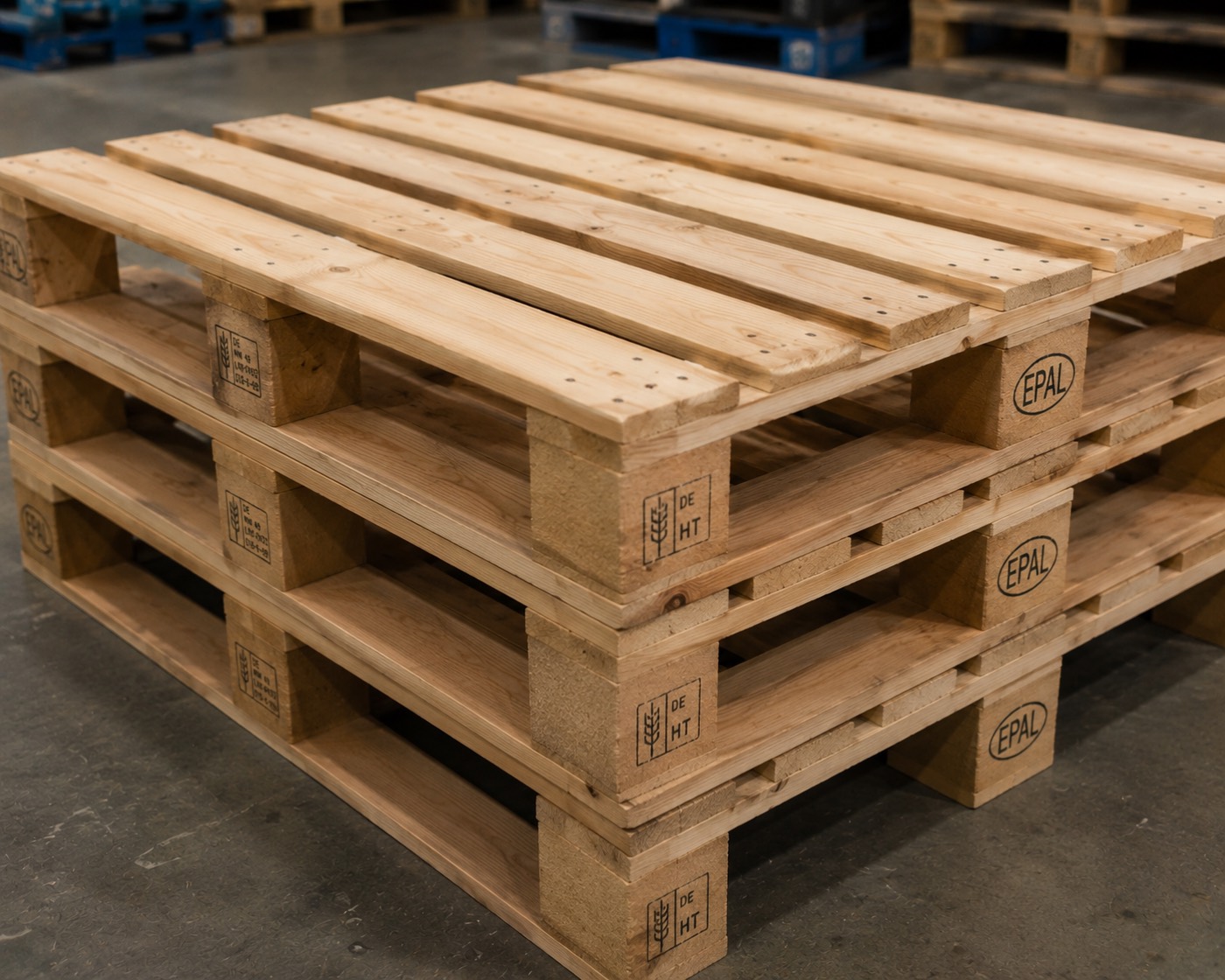
When the load refuses to fit a 48×40, the answer is not a bigger pallet with overhang. It is a pallet drawn around the load. We do that here, starting with a single prototype.
Request a quote
Tell us what you need
Send this and a real person in the Columbus yard reads it. Most quotes go out the same business day.
In short
Custom pallets are built to a footprint, deck configuration and load rating that a standard pallet cannot meet. RePallets Ohio designs and manufactures them in Columbus — oversized and undersized decks, wing and flush tops, notched or block construction, reinforced spans, stencilled identification and export treatment.
Send a sample, a drawing or just the dimensions and weight of what you are shipping. We come back with a cut list, a prototype and a firm unit price.
The four reasons customers end up here
1. Overhang is destroying loads
A load that hangs over the deck edge loses a large share of its compression strength — the corners of a stacked carton carry most of the load, and an unsupported corner is a crushed corner. If you are seeing bottom-layer damage on an otherwise well-packed pallet, the deck is too small.
2. Deck gaps are too wide for the product
Small cartons, bags and pails fall between standard deck boards. Increasing board count from seven to nine or eleven is a cheap fix that eliminates a whole class of damage.
3. The load is genuinely heavy or point-loaded
Machinery, castings, coils and stone concentrate load on a few square inches. That calls for hardwood, closer stringer spacing, double top decks or block construction. See load capacity and ratings.
4. Trailer economics
If your footprint wastes six inches of trailer width, every truck you send is carrying air. Redesigning to a footprint that pinwheels efficiently can remove whole loads from an annual freight bill.
What we can build
- Footprints from 24″ × 24″ up to 96″ × 60″, and longer skids on request
- Wing decks with 3″ overhangs for strap and sling handling
- Double-face reversible decks for two-sided loading
- Nine-block construction for true four-way entry under heavy loads
- Reinforced or doubled stringers for spanning racking
- Chamfered lead boards and lead-in bevels for automated handling
- Notch geometry matched to your existing fleet so old and new mix on the same line
- Stencilling, colour coding, branded stamps and serial marking
- ISPM-15 heat treatment on any of the above
How the design process runs
We do not have a portal, a configurator or a six-week engineering gate. We have a yard, a saw and people who have built a great many pallets.
- Day 0 — you send dimensions, load weight, handling method and any known damage history
- Day 1–2 — we build one prototype and photograph it against your stated load, and send a cut list
- Day 3–5 — you test it, in your building, with your product, on your equipment
- Week 2 — production run, priced firm
The cut list is yours to keep. If you take it elsewhere later, that is your right — we would rather earn the repeat order than trap you in it.
Start on the custom manufacturing page or draw your idea on the spec bench.
Custom does not have to mean new
A surprising share of custom work at our yard is done in reclaimed lumber. When a pallet is dismantled, the recoverable boards and stringers are sorted by length and grade. Building a 52″ × 44″ pallet out of that pool costs materially less than buying new lumber, and for many applications performs identically.
Ask us for the reclaimed-content version of your quote alongside the new-build price. Roughly half of customers take it, and it feeds directly into the numbers in the Repallet Ledger.
How we work backwards from the load
Most people arrive asking for a pallet. We would rather start from the thing the pallet has to carry, because the pallet is a consequence and the load is the constraint.
The sequence we work through:
- Footprint. The deck matches the built load within about an inch. Not the carton, not the spec sheet — a built, wrapped load. Overhang and excess deck are both expensive, for different reasons.
- Load path. Is the weight spread evenly, or concentrated on four machine feet? Even loads care about deck coverage; point loads care about board thickness and stringer position directly beneath.
- Support condition. Floor, block stack or racked. Racked is the hardest case by a wide margin and it drives stringer depth more than anything else.
- Handling. Forklift from which sides, pallet jack, clamp truck, conveyor, robot. This decides entry type and chamfers.
- Cycle count. One trip or fifty. This decides species and fasteners.
- Destination. Domestic or across a border, which decides treatment.
Answer those six and the design is largely determined. Everything after that is refinement.
Design moves that solve specific problems
Bags and pails falling between boards
Increase deck board count from seven to nine or eleven, or go to a plywood deck. Cheapest fix in the catalogue and it eliminates a whole class of damage.
Machinery punching through the deck
Thicker deck boards directly under the feet, hardwood instead of pine, and stringers positioned to sit under the load points rather than at standard spacing.
Racked sag over months
Deeper stringers, or a third front-to-back rail in the rack. Wood creeps under sustained load, so a design that is fine for a week can sag by month six — see racking a used pallet.
Fork damage to deck ends
Chamfered lead boards and wider lead boards. Also worth checking which side drivers actually enter from, because that is often the real fix.
Loads that need slings
Wing deck with a 3-inch overhang, giving something to get a strap under without lifting the load.
Automated handling rejections
A dimensional tolerance rather than a nominal size, full bottom decks, and no proud fasteners. See designing a pallet for automation.
The reclaimed-content option
Roughly half our custom work is built with reclaimed content, and most customers do not know that is an option until we offer both numbers.
When a pallet is dismantled, recovered deck boards and stringers are sorted by species, length and grade. That pool feeds custom builds directly. For a non-standard footprint, reclaimed-content construction commonly lands well below an all-new build, and for the great majority of industrial applications it performs identically — the wood is dry, dimensionally settled and frequently hardwood.
Where an audit trail requires virgin material, we build all-new and document it on the paperwork. Where it does not, we show both numbers and let you choose. The environmental difference is not marginal — model it on the Repallet Ledger.
Spec sheet
Custom build parameters
| Footprint range | 24" × 24" to 96" × 60" standard; longer skids quoted |
| Construction | Stringer (2-way, partial 4-way, full 4-way) or 9-block |
| Deck boards | 3 to 13 boards; flush, wing or double-face |
| Species | SYP, mixed hardwood, oak, or reclaimed-content |
| Fasteners | Helical, ring-shank or screw-shank per cycle expectation |
| Prototype lead time | 48 hours from confirmed dimensions |
| Production lead time | 7–12 working days |
| Minimum run | 250 units (100 on repeat orders) |
| Marking | Stencil, brand, colour code, serial, ISPM-15 stamp |
Reference
Problem to design change
| Symptom | Likely cause | Design change |
|---|---|---|
| Bottom-layer carton crush at corners | Load overhangs the deck | Larger footprint, or re-pattern the load |
| Small items falling through | Deck gaps too wide | 9–11 deck boards, or plywood deck |
| Deck boards punched through | Point loading | Thicker boards, hardwood, stringers under load points |
| Pallet sags in racking over months | Insufficient stringer depth; creep | Deeper stringers, or rack decking |
| Cracks at the notch | Fork entry through the notched side | Change entry side, deepen stringer, or block construction |
| Deck boards shedding | Fastener type or penetration | Helical or ring shank, correct length |
| Pallet jack will not enter | Partial four-way notches | Block construction, or two-way from the open ends |
| Automated system rejects it | Dimensional variation or bottom deck gaps | Tolerance spec, full bottom deck, chamfers |
| Load will not sling | Flush deck, nothing to get a strap under | Wing deck with 3-inch overhang |
Avoid these
Mistakes we see
Copying the existing pallet instead of the load
If the current pallet is the source of the problem, reproducing it faithfully reproduces the problem. Start from the load dimensions, weight and handling, not from what is on the dock today.
Ordering from a photograph
A photograph gives construction type and rough deck coverage. It does not give board thickness, stringer section or notch geometry. One physical sample removes all of that guesswork and usually pays for itself in avoided revisions.
Testing the prototype once
Intermittent faults are the ones that matter and they do not appear in a single pass. Run it repeatedly, and run the awkward cases — the misaligned entry, the slightly overweight load, the pallet that arrives rotated.
Designing for the load but not the rack
A pallet can be perfect on the floor and wrong in your racking, because racking loads it in the least forgiving way possible. Give us the beam spacing along with the load weight.
Assuming custom means all-new lumber
For most industrial applications a reclaimed-content build performs identically and costs meaningfully less. Ask for both numbers.
Checklist
Work through this before you order
Send us this and we can quote
- Outside dimensions of a built, wrapped load
- Total weight, and whether it sits on feet or spreads evenly
- Racked, floor stacked or block stacked — and beam spacing if racked
- Handling: forklift sides, jack, clamp, conveyor, robot
- Expected trips per pallet
- Domestic or international
- Photographs of any current damage
Test the prototype against
- Your actual product at full weight
- Your actual forklift and jack, from every entry side
- Your racking, loaded, left for as long as you can spare
- Your wrapping machine, if you have one
- A deliberately misaligned entry
- A slightly overweight load
Questions
Before you ask us
What information do you need to quote a custom pallet?
Outside dimensions of the load, total load weight, whether it will be racked or stacked, how it is handled (forklift, pallet jack, clamp, automated), and how many times you expect the pallet to be used. Everything else we can propose.
Can you copy a pallet from a photograph?
Partially. A photograph gives us construction type and rough deck coverage, but not board thickness or notch geometry. One physical sample removes all guesswork and usually pays for itself in avoided revisions.
Do custom pallets cost much more than standard?
Per unit, typically 15 to 40 percent more than a standard new 48x40, driven mostly by material volume rather than labour. Against that, custom pallets frequently reduce product damage and trailer waste by more than the price difference.
Is there a minimum order for custom work?
250 units for a first production run and 100 on repeats. Prototypes are quoted individually and the cost is credited against a production order placed within ninety days.
How much more does a custom pallet cost?
Typically 15 to 40 percent above a standard new 48x40, driven mostly by material volume rather than labour. Against that, custom pallets frequently reduce product damage and trailer waste by more than the difference, and a reclaimed-content build narrows the gap considerably.
Can you build a pallet larger than 96 inches?
Yes, by arrangement. Beyond about 96 inches the design usually becomes a skid rather than a pallet, handled with long forks or a crane, and the engineering conversation changes accordingly.
Do you keep our design on file?
Yes. Repeat orders use the same cut list, so the pallet does not quietly drift over three years the way it does when the specification lives in somebody's memory.
Can a custom pallet be heat treated?
Yes. Any solid wood build can be treated and stamped to ISPM-15 for export, including reclaimed-content construction, provided the material is debarked and sound.
Keep going
Related pages