Catalog
Everything that leaves our dock.
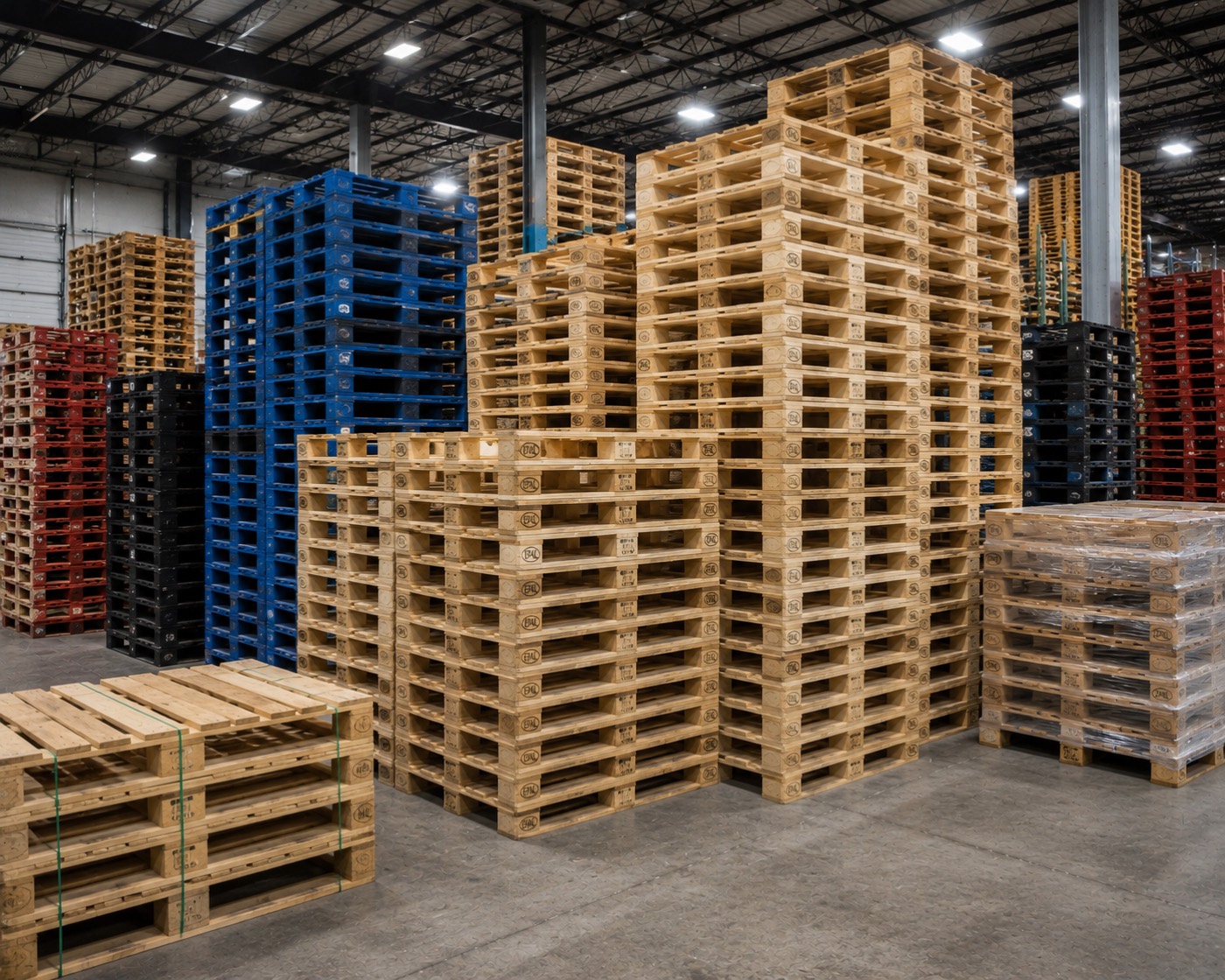
Eight product families, one loading dock, one invoice. Roughly seventy percent of what we ship is reclaimed — not because new is bad, but because for most jobs reclaimed is simply the better buy.
Request a quote
Tell us what you need priced
Mixed orders are normal here. Recycled pallets, collars and a crate on the same truck is a routine Tuesday.
The catalog
Pick a family, or send us the problem and let us pick.
Every page below carries real specifications — dimensions, capacities, materials and the honest limits of each product.
Recycled wood pallets
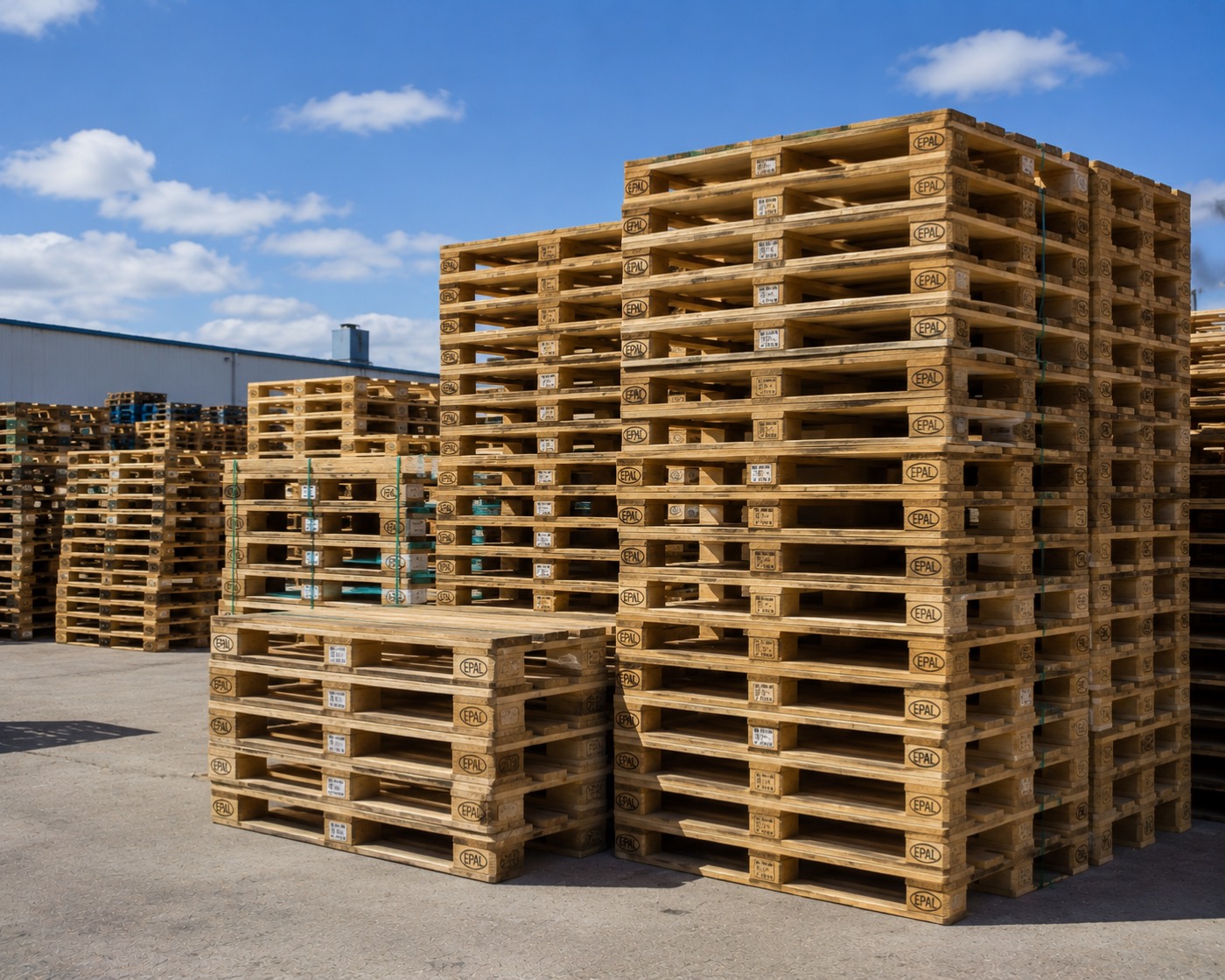
Cores that came back, got fixed and went out again — usually stronger than the green lumber they compete with. This is the product that makes up roughly seventy percent of what leaves our gate.
New wood pallets
Sometimes the reclaimed pool cannot give you what the job needs — an unusual footprint, a guaranteed clean deck, a print with tolerances. Then we build it, on our own line, in Columbus.
Heat-treated ISPM-15 pallets
Wood packaging crossing a border needs a stamp, and the stamp needs to be real. We treat and mark on site, which means your export load leaves with compliance already on it instead of waiting for a third party.
Custom & specialty pallets
When the load refuses to fit a 48×40, the answer is not a bigger pallet with overhang. It is a pallet drawn around the load. We do that here, starting with a single prototype.
Plastic pallets
We are a wood yard that will happily sell you plastic, because pretending wood is right for every application would be a sales position rather than an engineering one.
Pallet accessories
A deck holds a load. A deck with a collar and a lid contains one. Accessories are the cheapest way to upgrade a pallet into a returnable container, and almost nobody uses them properly.
Crates, boxes & skids
When the freight is heavy, valuable, awkward or crossing an ocean, a pallet is only part of the answer. Crates and skids are the other part, and we build both.
Reclaimed lumber, mulch & recovered material
About one in five inbound pallets cannot be saved as a pallet. None of it goes to landfill. This page is what happens to the rest — and it is a product line, not a waste stream.
Not sure which
Three questions decide almost every pallet order.
What does the load actually measure?
Overhang crushes cartons at the corners. Excess deck wastes wood and trailer cube. Measure a full load before choosing a footprint — the size guide has the chart.
Is it racked, stacked, or one-way?
Racking needs Grade A. Floor stacking and one-way shipping do not, and paying for it is the most common leak we find. See grades.
Does it cross a border?
If yes, it needs ISPM-15 treatment. If no, it does not, and buying treated stock domestically is money burnt.
Straight answer
For most Ohio operations, the right order is:
- Grade B reclaimed 48×40 for one-way outbound and floor stacking — the bulk of most fleets
- Grade A reclaimed for racked storage, with your own rack sign-off
- New build only for appearance-critical lanes, audited supply chains and footprints the reclaimed pool cannot supply
- Heat treated only for shipments leaving the country
Cross-reference
Which product for which job
The same load can be carried by three different products at three different costs. This is the shortest route from a problem to the right page.
| Your situation | Start here | Why |
|---|---|---|
| General freight, one-way outbound | Recycled Grade B | The pallet is not returning — grade premium is wasted |
| Racked storage | Recycled Grade A | Original stringers, with your rack engineering sign-off |
| Shipment leaves the country | Heat-treated ISPM-15 | Treated and stamped before it leaves our yard |
| Load does not fit any standard deck | Custom & specialty | Prototype in 48 hours; cut list is yours |
| Wash-down or closed-loop hygiene | Plastic pallets | Only pays back where the pallet reliably returns |
| Load needs containing, not just carrying | Accessories — collars & lids | One SKU replaces three box sizes |
| Machinery, castings, high-value freight | Crates, boxes & skids | Internal blocking prevents most transit damage |
| You have wood to buy rather than sell | Reclaimed lumber & mulch | Deck boards, cut stringers, coloured mulch |
Mistakes we see
Five things that cost buyers money
Specifying Grade A everywhere out of caution
Racking needs it. Floor stacking and one-way shipping do not, and the gap is 20–30%. Splitting grades by application is usually the single largest saving available and it takes one afternoon. See pallet grades.
Paying for ISPM-15 on domestic lanes
Heat treatment is required for international shipment only. Inside the United States it is pure cost. We find this in most audits, usually because one export requirement years ago quietly became the standing specification.
Living with overhang
Cartons carry their strength in the corners. A corner hanging over the deck edge is an unsupported corner, and the damage shows as bottom-layer crush that everybody blames on the carrier.
Buying new to fix a pallet that keeps failing
A failing pallet is usually a specification problem rather than an age problem. Notch cracks point at fork entry direction; shed boards point at fasteners; racked sag points at stringer depth. Fix the cause and reclaimed may serve perfectly well.
Paying a hauler to remove pallets you could sell
A double loss: the disposal fee and the forgone core value. See sell us your pallets.
Questions
Common questions
Which pallet grade should I order for racked storage?
Racked storage needs Grade A reclaimed stock with original stringers, signed off against your own rack engineering. Grade B is fine for floor stacking and one-way outbound freight.
Do I need heat-treated ISPM-15 pallets for domestic shipments?
No. ISPM-15 treatment is only required when wood packaging crosses an international border. Buying treated stock for domestic lanes is money burnt.
What if my load does not fit a 48×40 footprint?
Measure a full load first. Overhang crushes cartons at the corners and excess deck wastes wood and trailer cube. If nothing standard fits, our custom shop prototypes in 48 hours.
Are plastic pallets worth the higher unit price?
Only where the pallet reliably returns. Plastic pays back in closed loops and wash-down hygiene environments; on one-way outbound freight the unit cost never recovers.
Do I get to keep the cut list for a custom build?
Yes. We draw the cut list, prototype it within 48 hours and test it against your real load. The cut list is yours.