Sizes · the standard
The 48×40 GMA pallet
When somebody says 'a standard pallet' in North America, this is the object they mean. It is worth understanding properly, because most pallet decisions are really decisions about this one.
Request a quote
Tell us what you need
Send this and a real person in the Columbus yard reads it. Most quotes go out the same business day.
In short
The 48″ × 40″ GMA pallet is the North American standard, named after the Grocery Manufacturers Association that specified it. Standard construction is seven top deck boards on three notched stringers with a partial four-way entry, weighing 38–52 lb depending on species, with static capacity to roughly 4,600 lb and dynamic capacity to 2,800 lb.
It is also the cheapest good pallet you can buy reclaimed, because the resale pool is enormous. See recycled wood pallets.
Why 48 by 40 and not something sensible
The dimensions look arbitrary until you look at a trailer. A standard US dry van is about 98 inches wide inside. Two 48-inch stringers side by side is 96 inches — a snug fit with two inches to spare. Pinwheeled, a 48 and a 40 together make 88 inches across with room for handling.
The grocery trade standardised on it in the 1960s because it fitted the trailers, fitted the racking then being installed across North American distribution centres, and fitted a comfortable manual reach across the deck. Everything since has been path dependence, and path dependence at this scale is a genuine asset: it is why a reclaimed 48×40 costs less than any other pallet in the country.
Reading a GMA pallet's construction
Stringers and notches
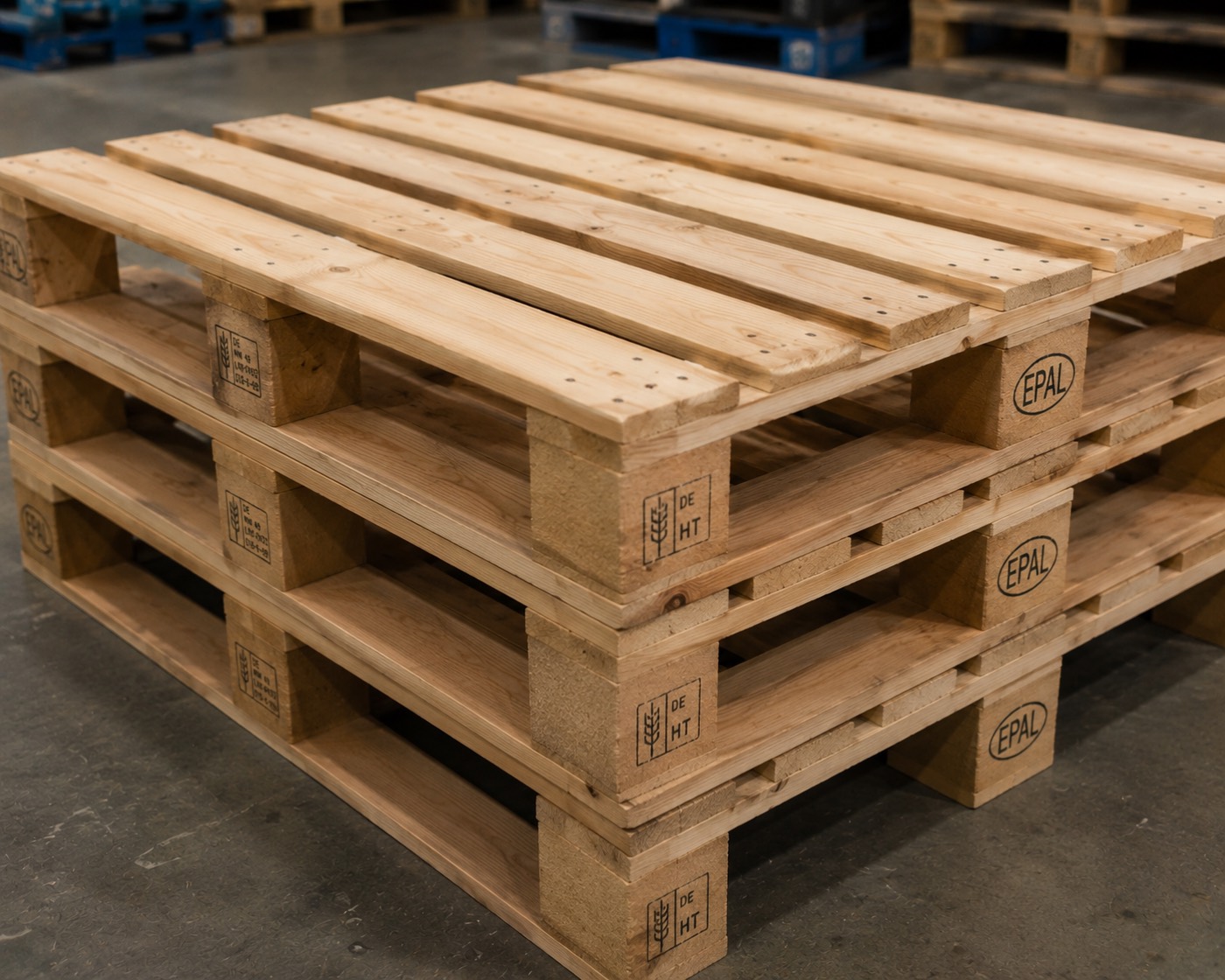
Three stringers run the 48-inch length. Each has two notches cut into the lower edge, allowing a forklift to enter from the 40-inch sides as well as the 48-inch sides. That is what 'partial four-way' means: forks enter from all four sides, but a pallet jack — whose wheels need to roll along the full length — can only enter from the two open ends.
Deck boards
Seven top boards is the classic specification. The two outermost boards, the lead boards, are usually wider because they take the impact of fork entry and carry the corner load. Bottom decks vary from three to five boards; three is common on reclaimed stock and perfectly adequate for floor stacking.
What varies in the wild
Board count from five to nine, stringer thickness, notch geometry, species, and whether bottom deck boards are flush with the stringer ends. If your handling equipment is sensitive to any of these, specify them. See our spec bench to draw the configuration you need.
Grades and what each one is for
- Grade A / #1 — original unrepaired stringers, seven or more top boards, clean. Racking-capable, subject to your own engineering sign-off.
- Grade B / #2 — one repaired or companion stringer, replaced boards, weathered. Full strength for floor and block stacking, and the best value in the yard.
- Combo — an agreed mix, typically 60/40 or 70/30.
- Cores — unsorted, as-received. Bought by processors, not by end users.
Full definitions on pallet grades.
New versus reclaimed, specifically for this size
Nowhere is the reclaimed argument stronger than at 48×40, because the pool is so deep that supply is effectively continuous.
A reclaimed Grade A 48×40 typically costs 30–40% less than a comparable new build. Grade B costs 45–60% less. And because much of the reclaimed pool is mixed hardwood while much new production is southern yellow pine, the reclaimed pallet is frequently the denser and stronger object.
The cases where new still wins — appearance, audit trails, engineered load ratings — are covered in recycled vs new pallets.
Reading a GMA pallet in the yard
Being able to tell what you are looking at is genuinely useful when a load arrives, and it takes about ten seconds per pallet.
Count the top boards. Seven is the classic specification. Five is a lighter build and is common in reclaimed stock. Nine or eleven means somebody specified extra coverage for a reason.
Look at the lead boards. The outermost board at each end should be wider than the inner boards. If it is not, the pallet was built to a price and the fork-strike area is under-specified.
Check the bottom deck. Three boards is common and adequate for floor stacking. Five gives better support on rack decking and conveyors.
Look at the notches. Two per stringer, roughly nine inches wide. Clean notches with no cracks radiating from the corners means the pallet has not been entered badly.
Sight the stringers. A dark line running with the grain is a split. A visibly different piece of wood alongside a stringer is a companion repair — which makes it Grade B regardless of how good the rest looks.
Why the same size varies so much between suppliers
'48×40 GMA' describes a footprint and a general construction, not a specification. Within it, real pallets differ substantially.
- Board count from five to nine on the top deck
- Board thickness from about ½″ to ¾″
- Stringer section, most commonly 1⅜″ × 3½″ but not always
- Species — hardwood, softwood, or a mix within one pallet
- Bottom deck from three to five boards, flush or inset
- Fasteners from smooth shank to ring shank
That variation is why two quotes for '48×40 recycled' can differ by 40% and both be honest. It is also why the grade definition matters more than the size, and why anyone feeding an automated system should specify a tolerance rather than a name.
Spec sheet
48×40 GMA — full specification
| Nominal footprint | 48" (stringer) × 40" (deck board) |
| Metric | 1219 × 1016 mm |
| Overall height | 5" to 5½" |
| Top deck | 7 boards, 5/8" × 3½" nominal, lead boards wider |
| Bottom deck | 3 to 5 boards, partial coverage typical |
| Stringers | 3 × 1⅜" × 3½" × 48", notched |
| Notches | 9" wide × 1½" deep, two per stringer |
| Entry | Four-way partial: forks all sides, jack two sides |
| Deck opening | ½" to 1" typical gap between boards |
| Species | Mixed hardwood, oak, or southern yellow pine |
| Weight | 38–52 lb (hardwood at the top of the range) |
| Static capacity | Up to 4,600 lb evenly distributed |
| Dynamic capacity | Up to 2,800 lb in motion |
| Racked capacity | Up to 1,800 lb unsupported span, Grade A only |
| Per 53′ floor | 26 straight, 30 pinwheeled |
| Full trailer | Approximately 480–560 units |
Reference
48×40 capacity by build
| Build | Static | Dynamic | Racked |
|---|---|---|---|
| Reclaimed Grade A hardwood | 4,600 lb | 2,800 lb | 1,800 lb |
| Reclaimed Grade B hardwood | 4,000 lb | 2,400 lb | Not recommended |
| New SYP, 7-board GMA | 5,000 lb | 2,800 lb | 1,500 lb |
| New hardwood, 7-board | 5,500 lb | 3,200 lb | 2,000 lb |
| New 9-block heavy duty | 6,600 lb | 4,400 lb | 2,800 lb |
Indicative, for evenly distributed loads on sound pallets in ambient conditions. Not a substitute for an engineered rating — see [load capacity](/pallet-sizes/load-capacity).
Reference
Common 48×40 variants you will encounter
| Variant | How to spot it | Suited to |
|---|---|---|
| Standard 7-board GMA | 7 top boards, wider lead boards, 3 stringers notched | General freight |
| 5-board economy | Wide gaps, fewer boards | Light one-way loads |
| 9 or 11-board | Narrow gaps, near-full coverage | Bags, pails, small cartons |
| Wing deck | Deck boards overhang the stringers | Sling and strap handling |
| Unnotched two-way | No notches in the stringers | Heavy loads, single entry direction |
| Block 48×40 | Nine blocks, no stringers | True four-way, racking, automation |
| Double-face reversible | Identical top and bottom decks | Two-sided loading |
Avoid these
Mistakes we see
Ordering '48x40' with no grade or build detail
The footprint is the least variable thing about the pallet. Board count, thickness, species and fasteners all vary within it, which is why two honest quotes can differ by 40%.
Assuming a pallet jack can enter from all four sides
Standard GMA is partial four-way: forks from all sides, a jack from only two. Operations that discover this after a layout change lose a surprising amount of time.
Racking Grade B GMA stock
A companion stringer restores most of the span strength. Racking is the one load case where most is not enough, because the stringer bridges open air under sustained load.
Ignoring lead board width
The outer board takes the fork strike and the corner load. A pallet built with uniform narrow boards will fail at the ends first, and it is visible at receipt if you know to look.
Checklist
Work through this before you order
Ten-second inspection at the dock
- Count the top deck boards
- Check the lead boards are wider than the inner ones
- Sight along all three stringers for splits
- Look for companion repairs — a different piece alongside a stringer
- Check all four notch corners for radiating cracks
- Run a gloved hand over the deck for proud fasteners
- Flip one pallet and check the bottom deck
Questions
Before you ask us
How much does a 48x40 pallet weigh?
Between 38 and 52 pounds. Southern yellow pine construction sits at the lower end, mixed hardwood and oak at the upper end. New pallets built from kiln-dried lumber weigh slightly less than green-built equivalents.
How much weight can a 48x40 pallet hold?
Roughly 4,600 pounds static (sitting on the floor), 2,800 pounds dynamic (being moved by a forklift), and up to 1,800 pounds racked across an unsupported span, Grade A only. Grade B stock should not be racked.
Is a GMA pallet the same as a standard pallet?
In North America, yes, in ordinary usage. GMA refers to the Grocery Manufacturers Association specification for a 48 by 40 inch stringer pallet, and it has become the default meaning of standard pallet.
How many 48x40 pallets fit on a 53-foot trailer?
Twenty-six per floor layer loaded straight, or thirty pinwheeled. A typical full load runs 480 to 560 pallets depending on how high you can safely stack them.
Why is it called a GMA pallet?
After the Grocery Manufacturers Association, which specified the 48 by 40 inch stringer pallet for the grocery trade. The name stuck and in North America it has become the default meaning of standard pallet.
What are the notches for?
They allow a forklift to enter from the 40-inch sides as well as the 48-inch sides, making the pallet partial four-way. They also remove about 40% of the stringer depth at a high-stress point, which is where most stringer pallets fail.
Can a 48x40 pallet be used in Europe?
Physically yes, and it is common on transatlantic freight. It does not fit European racking or trailers as efficiently as the 1200 by 800 Euro pallet, and it needs ISPM-15 treatment and marking to cross the border.
How tall is a standard 48x40 pallet?
Five to five and a half inches overall for a standard build. Deck board and stringer thickness both move it, which matters if you are stacking to a fixed height or feeding an automated system.
Keep going
Related pages