Company · the operation
One working day, eight stops, told in order.
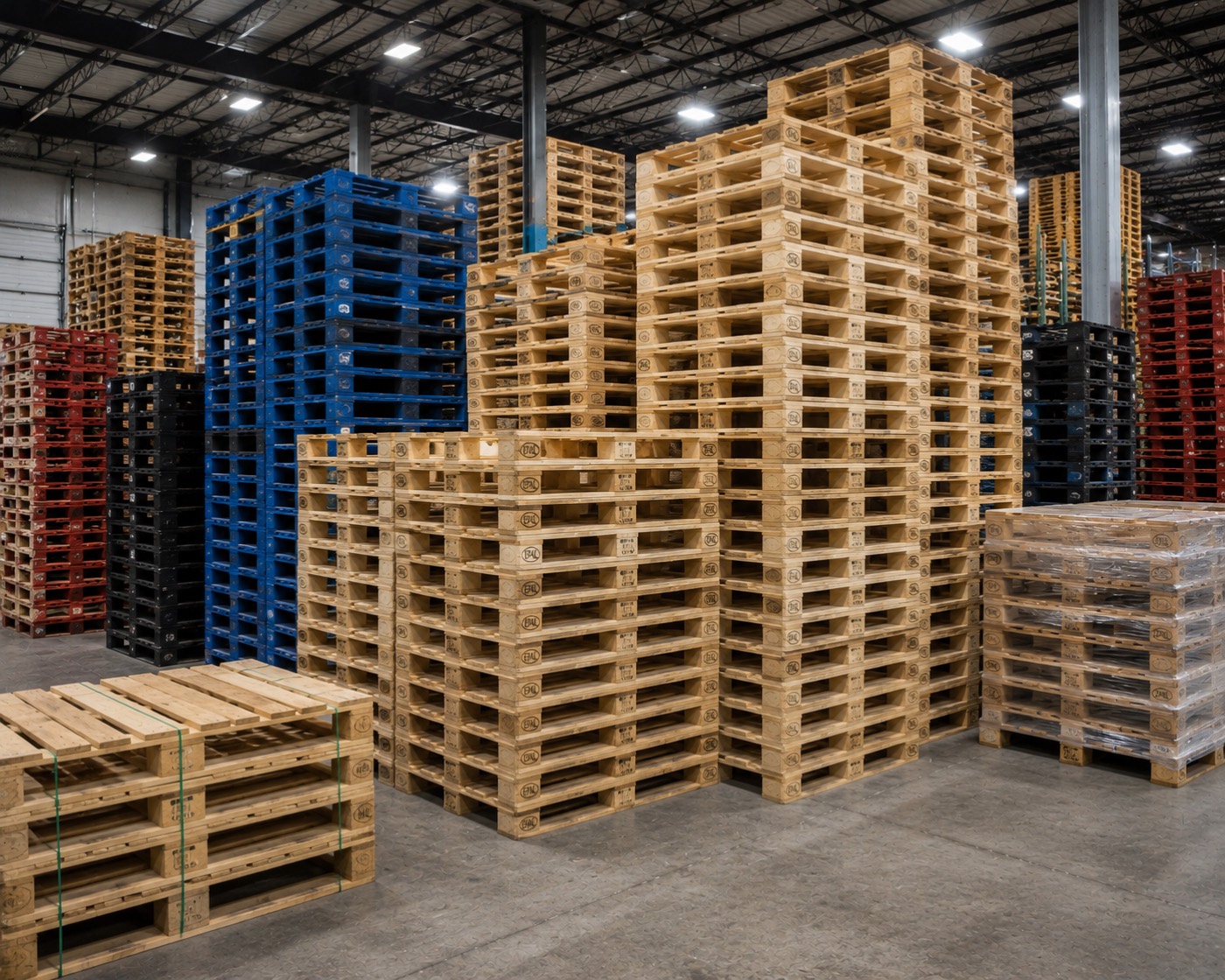
This is the actual route a pallet takes through 7240 S Access Rd, Columbus, OH 43217 — from the moment a trailer backs onto the hard standing to the moment the last six percent leaves as mulch. No stock photography, no aerial drone shot. Just what happens and why.
Request a quote
Come and see it
Visitors are welcome during yard hours. Say so on the form and we will arrange a time.
07:00
The inbound gate
Trailers back onto the hard standing and get unloaded onto the ground, not counted off a manifest. The driver stays. Anything unexpected — a wet stack, a mixed load, a count discrepancy — gets photographed and resolved before anyone signs. Fifteen minutes here removes an entire category of dispute later.
What we look for: moisture, mold, banding and film mixed in, chemical staining, and whether the load matches what was described.
07:40
The size lanes
48×40 GMA splits off first — deepest market, fastest turn. Then the secondary footprints: 42×42, 48×48, 40×48, 48×42. Then genuinely odd sizes, which are routed straight to dismantling because there is no reliable resale market for a lone 53×37.
Sorting before grading matters: a Grade A odd-size is worth less than a Grade B GMA, and handling them identically wastes labour on the wrong item.
08:15
The grading line
This is where the economics of the whole yard are decided. Graders work under natural light because artificial light flattens the shadow that reveals a hairline stringer crack and washes out the grey-green of early mold. Each pallet is turned, sighted along the stringers, checked at the notches, and checked by hand for protruding fasteners.
Output: Grade A, Grade B, repairable, or dismantle. A good grader handles several hundred pallets an hour and is the most valuable person here.
09:30
The repair bay
Roughly four in five inbound cores come through here. Broken deck boards are replaced with full-length lumber — never offcuts, because a short board transfers load unevenly into the stringers and creates the next failure. Cracked stringers get a companion, glued and nailed along the full length.
Protruding nails are pulled, not hammered flush. A hammered nail migrates back out under vibration and shreds a stretch wrap somewhere in Indiana.
11:00
The band saw
What cannot be repaired is dismantled. A good dismantler recovers considerably more usable lumber than a poor one, and that difference lands directly in yard margin. Deck boards and cut stringers are sorted by species, length and condition.
Recovered lumber feeds three places: the repair bay, reclaimed-content custom builds, and direct sale as reclaimed lumber.
13:00
The treatment chamber
Export stock is stacked for airflow, probed at the coldest predicted point in the charge, and held above 56°C core for a minimum of thirty minutes with margin. Charge records — date, quantity, temperature trace, hold duration — are retained.
Stamping happens after treatment, never before. A pre-stamped pallet that fails a charge is a compliance failure waiting to be discovered at a port.
14:30
The stacking bay
Finished stock is banded in fifteens and dated. Dating matters more than people expect: it lets us rotate inventory properly and it lets a customer trace a load back to a specific week if something is wrong with it.
Loads are planned for weight and cube together. A trailer of oak Grade A can weigh out before it cubes out, and finding that at a scale house is expensive.
15:45
The grinder
The last stop, and deliberately the smallest. Ground material is screened, then coloured for landscape mulch or sold as biomass boiler fuel. Nails pass under magnets on the outfeed and are recovered as scrap steel.
A yard that grinds a large share of its intake is a yard that is not sorting and repairing well. Ours takes about six percent of inbound mass.
Where it ends up
Of everything that comes through that gate:
- ~80%leaves as a whole pallet — repaired or as received
- ~14%is dismantled, most of that mass recovered as usable lumber
- ~6%leaves as mulch, biomass fuel or recovered scrap steel
- 0%goes to landfill
Questions
Common questions
Can I visit the yard before placing an order?
Yes, and we would rather you came before a first order than after a disappointing one. Check in at the yard office; hi-vis is required beyond it and we keep spares.
Why do your graders work under natural light?
Artificial light flattens the shadow that reveals a hairline stringer crack and washes out the grey-green of early mold. Daylight is why the grading stays consistent.
How many inbound pallets can actually be repaired?
Roughly four in five inbound cores come through the repair bay. A repaired pallet is worth several times its component lumber, which is what makes the yard genuinely circular.
Do you repair pallets with offcut boards?
Never. Broken deck boards are replaced with full-length lumber, because a short board transfers load unevenly into the stringers and creates the next failure.
Are pallets counted off the manifest or on the ground?
On the ground, with the driver present. Anything unexpected is photographed and resolved before anyone signs, which removes an entire category of dispute later.