Products · reclaimed
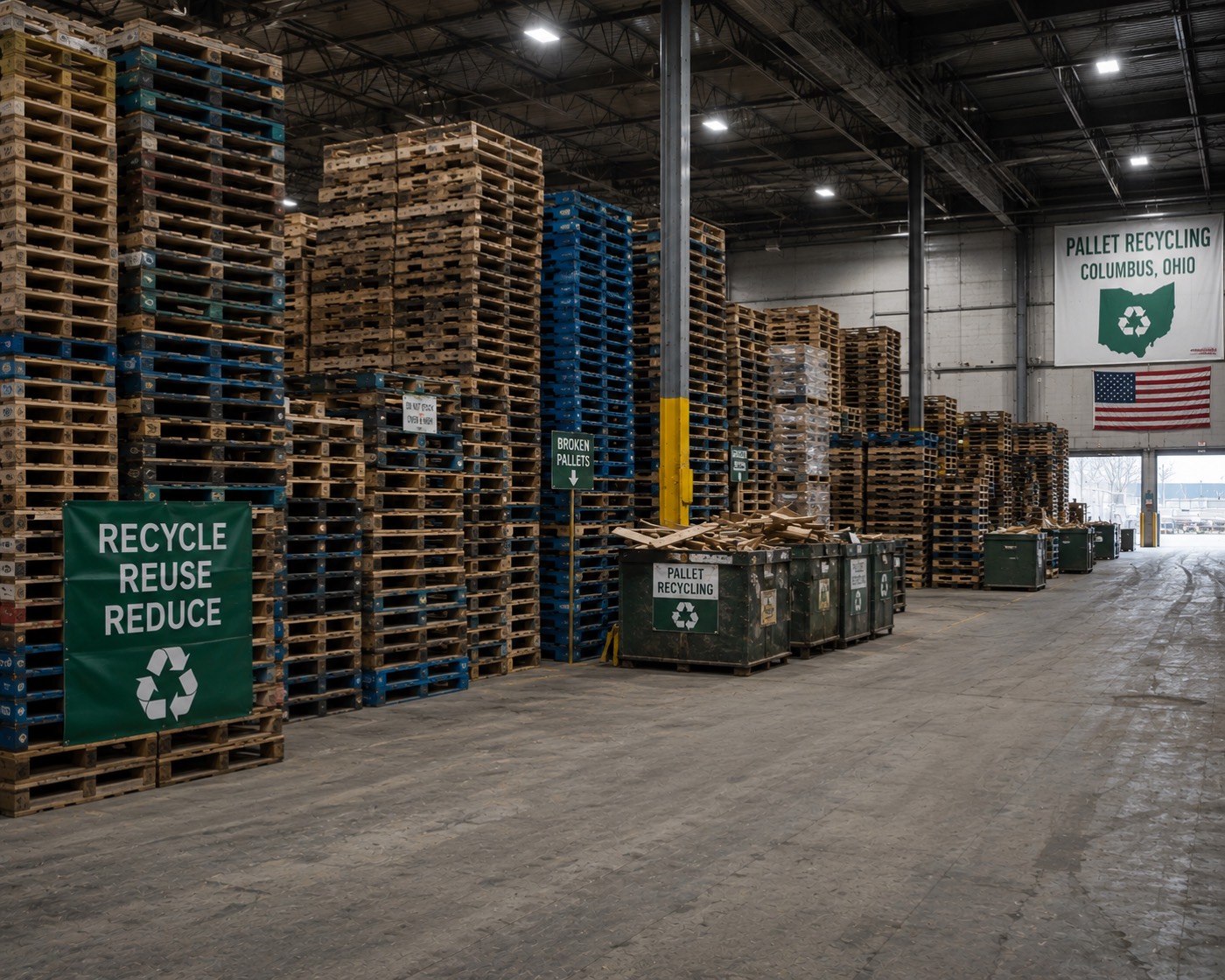
Recycled wood pallets
Cores that came back, got fixed and went out again — usually stronger than the green lumber they compete with. This is the product that makes up roughly seventy percent of what leaves our gate.
Request a quote
Tell us what you need
Send this and a real person in the Columbus yard reads it. Most quotes go out the same business day.
In short
Recycled wood pallets are used pallets that have been collected, inspected, repaired where needed and sorted back into consistent grades. RePallets Ohio stocks reclaimed 48×40 GMA pallets plus more than twenty secondary footprints at our Columbus yard, in Grade A, Grade B and combo. Expect roughly 35–45% below new-build pricing on comparable stock, with delivery across Ohio on our own trucks.
If you rack loads, ask for Grade A with full stringers. If you ship one-way and never see the pallet again, Grade B does the same job for less money.
What we mean by Grade A, Grade B and combo
Pallet grading is not standardised across the industry, which is precisely why cheap pallets keep disappointing people. Here is our definition, written down so you can hold us to it.
Grade A (also called #1)
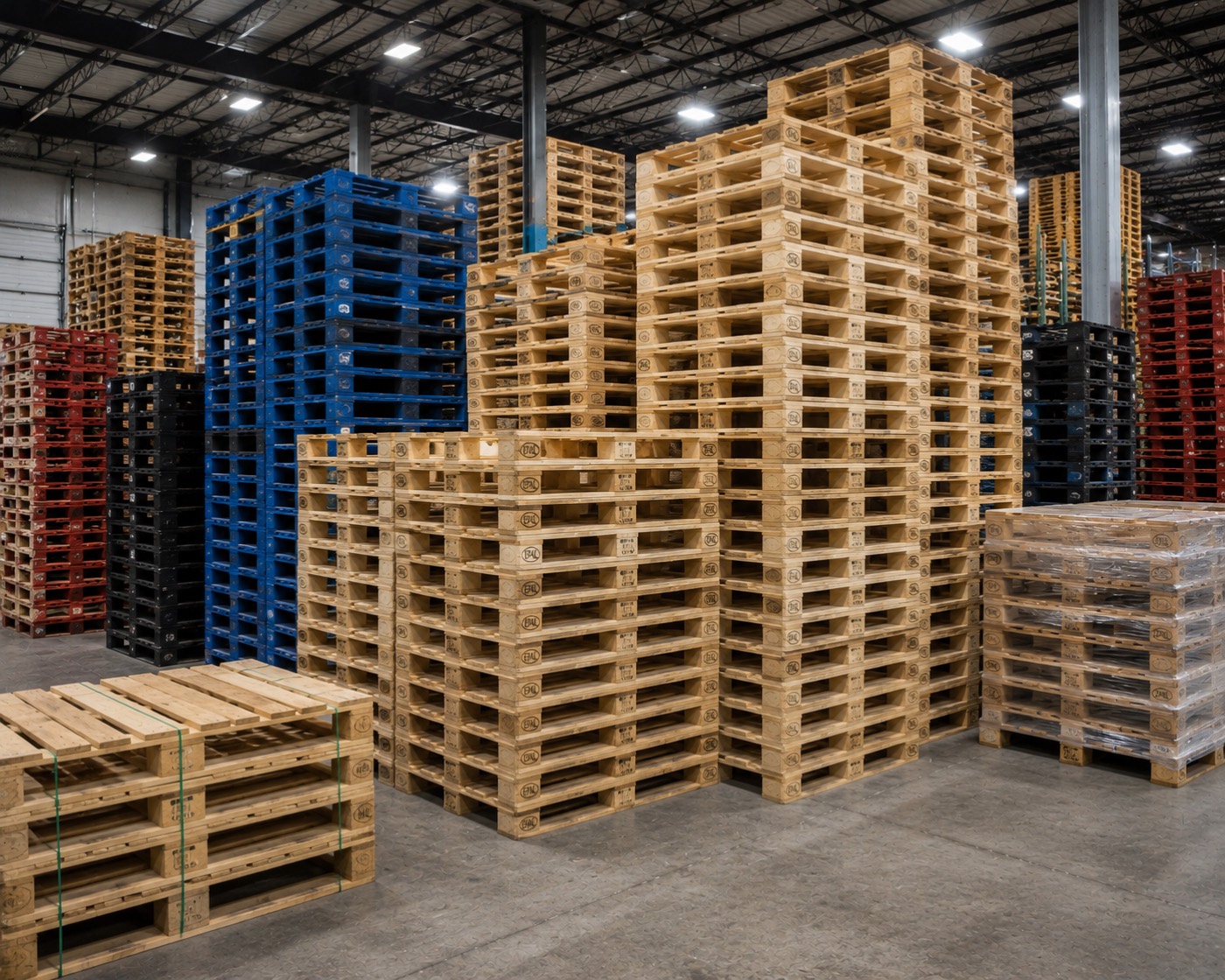
Original stringers, no plugs or companion stringers, seven or more top deck boards with no more than a quarter-inch gap variance, clean or lightly stained, no protruding fasteners. Structurally these behave like a new GMA pallet on a selective racking system. Roughly 30% of our inbound cores end up here.
Grade B (also called #2)
May carry one repaired or companion stringer, may have replaced deck boards, may be visibly weathered or stained. Full strength for floor stacking, block stacking and one-way shipping. This is the workhorse grade and the best value in the yard.
Combo
A deliberate mix, typically 60/40 or 70/30 A to B, priced between the two. Useful when you have a mixed operation and do not want to run two SKUs. We agree the ratio in writing before the load ships.
For the full grading logic including cores and unsorted loads, read pallet grades explained.
Why reclaimed wood outperforms its reputation
There is a persistent belief that used means weak. In wood packaging the opposite is often true, and the reason is moisture.
New pallet lumber is frequently milled from green stock at 25–40% moisture content. As it dries in service it shrinks, cups and loosens around the fasteners. A pallet that has already been through a full seasoning cycle in a warehouse has done its shrinking. It sits at ambient equilibrium, its nails have set, and its dimensions are stable.
That is why an experienced racking engineer will happily specify a well-graded reclaimed hardwood pallet over an unknown new softwood one. What matters is the grade, the species and the deck configuration — not the age.
- Dimensional stability: seasoned wood has already moved
- Proven fasteners: a core that survived twenty round trips is not going to fail on the twenty-first from a nail defect
- Hardwood content: much of the reclaimed pool is oak and mixed hardwood, denser than the SYP used in many new builds
- Lower embodied carbon: roughly 5.2 kg CO₂e avoided per reuse, which the Repallet Ledger will calculate against your own volume
Sizes we hold in reclaimed stock
48×40 GMA is always available. The list below moves with the market, so treat it as a starting point and ask about anything not shown — we source odd footprints constantly and can usually find them within a week.
- 48 × 40 — GMA / grocery standard, the deepest pool in North America
- 42 × 42 — beverage, telecom, paint
- 48 × 48 — 55-gallon drums, four per deck
- 40 × 48 — military and retail, rotated GMA
- 48 × 42 — chemical and coatings
- 36 × 36 — beverage floor displays and retail
- 44 × 44 — drums and chemical
- 48 × 45 — automotive tier suppliers
- 40 × 40, 42 × 48, 45 × 45 and a long tail of odd sizes
Full dimensions, load ratings and trailer counts live in the pallet size guide.
How the stock is prepared before you see it
Every core we sell has been through the same six-step route: counted on the ground, sorted by footprint, graded in daylight, repaired or dismantled, treated if it is going for export, then stacked in fifteens, banded and dated.
Repairs use full-length replacement boards, not offcuts. Companion stringers are glued and nailed, never stapled. Protruding fasteners are pulled rather than hammered flush, because a hammered nail works its way back out under vibration and tears open a shrink wrap two days later.
You can walk the whole line yourself — see inside the yard.
Ordering, minimums and delivery
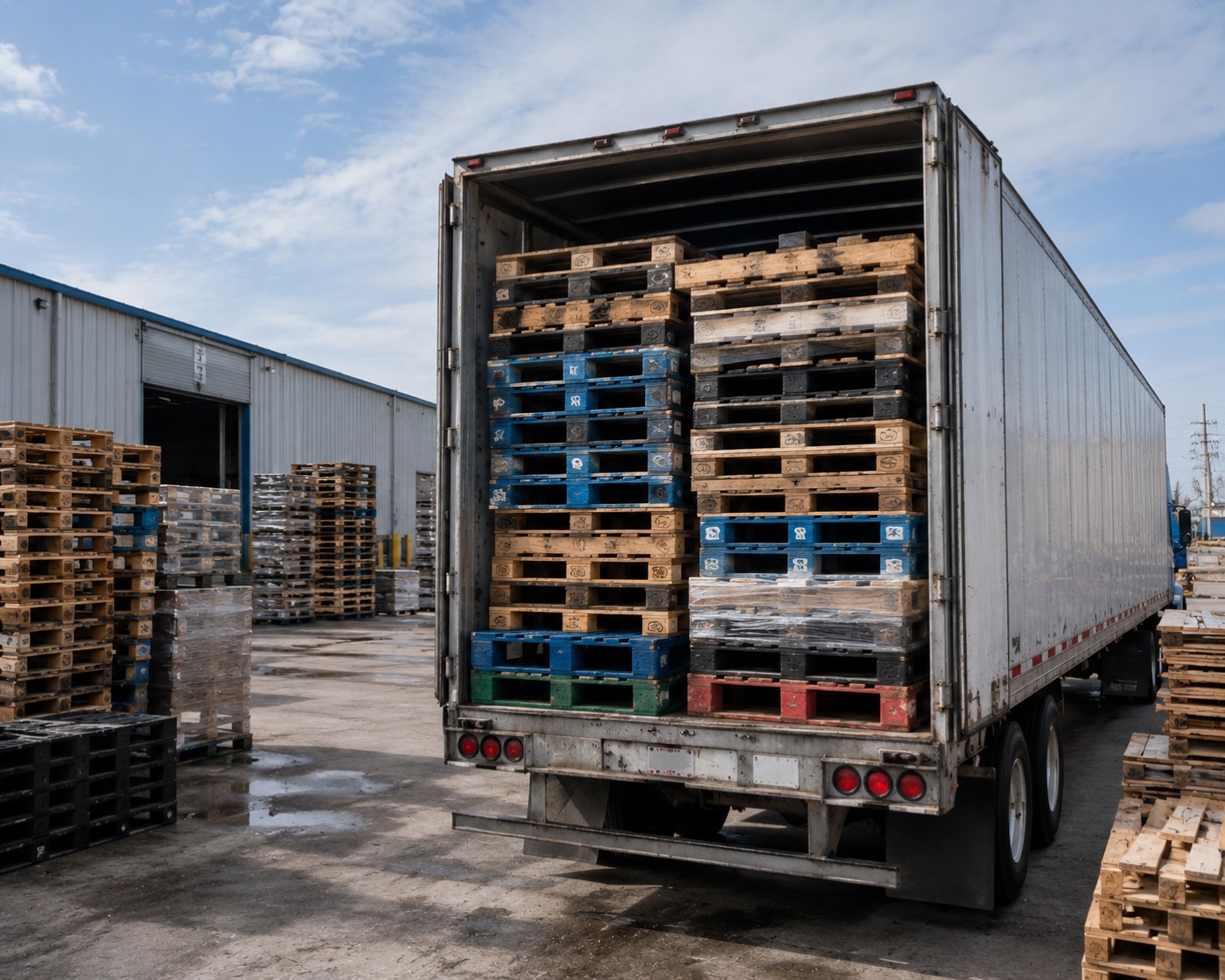
Minimum order is one banded stack of fifteen for pickup, or a partial truckload for delivery inside Central Ohio. A full 53-foot van holds roughly 480–560 48×40 pallets depending on stack height and grade.
We deliver on our own flatbeds and vans daily across Central Ohio and on scheduled lanes to Cleveland, Cincinnati, Dayton, Toledo and Akron. Standing weekly or biweekly drops get priority scheduling and better pricing than one-off orders.
If you also generate used pallets, ask about a two-way lane: we deliver good stock and take your cores away on the same trip. That single change usually removes more cost than any price negotiation. See sell us your pallets.
What arrives on the truck, physically
People order reclaimed pallets and are sometimes surprised by what turns up, so here is the delivery described plainly.
Stock arrives banded in stacks of fifteen, dated on the top unit. Grade A stacks are visibly more uniform than Grade B; Grade B will contain colour variation, stain, replaced boards of a different species and stencil marks from previous owners. That is normal and it is not damage.
Stacks are loaded so they can be taken off with a forklift from the trailer side. If your dock requires a different orientation, say so at order — restacking on arrival costs time nobody planned for.
Every stack has been through the six-step route described below and has been graded within the previous few days. We do not hold stock long enough for it to degrade in our own yard, which is a deliberate inventory policy rather than a happy accident.
How to receive a load properly
Ten minutes at the dock protects you far more than any clause in a purchase order.
- Count on the ground, with our driver present. Not off the manifest. See our reasoning in why we count on the ground.
- Break one stack from the middle of the load, not from the end. The end stack is the one everybody inspects, which makes it the least representative.
- Sight along the stringers of six or seven pallets. Cracks show as a dark line running with the grain.
- Run a gloved hand over two decks. Protruding fasteners are found by touch, not by eye.
- Photograph anything unexpected before the driver leaves.
If something is wrong, tell us that day. We collect and replace or credit — see the terms on terms of service. What we cannot do is resolve a grade dispute three weeks after a load has been broken down and dispersed.
Storing reclaimed pallets so they stay the grade you bought
A Grade A pallet stored badly for one Ohio winter is a Grade B pallet, and a Grade B pallet stored badly is scrap. This is the fastest way to lose the value you just bought.
Indoors is best. Under a roof is next. A properly tarped square stack on runners is acceptable. A half-covered leaning pile on bare ground is the worst of all worlds — it holds water in every deck gap and then prevents it drying, which is precisely what mold wants.
Detail in how to stack pallets outdoors and what an Ohio winter does to a pallet stack.
Spec sheet
Reclaimed 48×40 GMA — typical specification
| Nominal size | 48" length × 40" width |
| Deck height | 5" to 5½" overall |
| Top deck boards | 7 boards, 5/8" nominal (Grade A); 5–7 boards (Grade B) |
| Bottom deck | 3 to 5 boards, partial or full coverage |
| Stringers | 3 stringers, 1⅜" × 3½", notched for four-way entry |
| Entry | Four-way partial (fork entry all sides, pallet jack two sides) |
| Species | Mixed hardwood, oak, or southern yellow pine |
| Weight | 38–52 lb depending on species and grade |
| Static capacity | Up to 4,600 lb evenly distributed |
| Dynamic capacity | Up to 2,800 lb, Grade A |
| Racked capacity | Grade A only, up to 1,800 lb — see load capacity |
| Packaging | Banded stacks of 15, dated |
Reference
Grade comparison at a glance
| Grade A (#1) | Grade B (#2) | Combo | |
|---|---|---|---|
| Stringers | Original, unrepaired | May include one repair | Agreed mix |
| Top deck boards | 7 or more | 5–7 | Mixed |
| Appearance | Clean to lightly stained | Weathered, mismatched | Mixed |
| Racking | Yes, with your sign-off | Not recommended | A units only |
| Floor / block stacking | Yes | Yes | Yes |
| One-way outbound | Overspecified | Ideal | Acceptable |
| Retail customer-facing | Yes | No | A units only |
| Share of our intake | ~30% | ~50% | By agreement |
| Price vs Grade A | Baseline | 20–30% lower | Between the two |
These are our written definitions and they form part of any order. Another yard may use the same words differently — always ask for the spec in writing.
Reference
Reclaimed stock availability by footprint
| Footprint | Availability | Typical grades held | Lead time |
|---|---|---|---|
| 48" × 40" GMA | Permanent line | A, B, combo, cores | Next business day |
| 48" × 48" | Usually in stock | A, B | 1–3 days |
| 42" × 42" | Usually in stock | A, B | 1–3 days |
| 40" × 48" | Usually in stock | A, B | 1–3 days |
| 48" × 42" | Frequently in stock | B, combo | 3–7 days |
| 36" × 36" | Sourced | B | Up to 1 week |
| 44" × 44" | Sourced | B | Up to 1 week |
| 48" × 45" | Sourced | B | Up to 1 week |
| Metric / Euro | Sourced | As found | 1–2 weeks |
| Genuinely odd | Build instead | New or reclaimed-content | 7–12 days |
Availability moves with the market. Treat this as a planning guide and ask rather than assume — we source odd footprints constantly.
Avoid these
Mistakes we see
Specifying Grade A for one-way shipping
The pallet is not coming back. Every dollar of grade premium on a one-way lane is a donation. This is the single most common and most expensive habit we see — moving one-way volume to Grade B typically takes 20–30% off that portion with no operational effect at all. See Grade A vs Grade B.
Buying cores for end use
Unsorted cores are the raw material of a pallet yard, not a finished product. Buying them because the per-unit number looks attractive means buying everything that will fail alongside everything that will not, and doing your own grading for free.
Ordering by price with no written grade
'Used pallets' is not a specification. Without a written grade definition you have no basis for a claim and no way to compare two quotes. Ask for the definition before the number.
Storing the load outdoors uncovered
You can lose a full grade over one Ohio winter. Absorbed water reduces stiffness, freeze-thaw widens existing splits, and spring mold takes stock out of use entirely for anyone handling food or pharmaceuticals.
Racking a repaired pallet
A companion stringer restores most of the original span strength. Racking is the one load case where 'most' is not enough, because the stringer is bridging open air under a sustained load. Use Grade A, with your own rack engineering sign-off — see load capacity.
Checklist
Work through this before you order
Before you order
- Measure a built, wrapped load — not the carton spec
- Decide racked, stacked or one-way for each lane separately
- Confirm whether anything crosses an international border
- Check your dock can take a 53-foot trailer and unload from the side
- Ask for the written grade definition, not just the letter
- State a delivery window you can actually meet
On delivery
- Count on the ground with the driver present
- Break a stack from the middle of the load
- Sight the stringers on six or seven units
- Hand-check two decks for proud fasteners
- Photograph anything unexpected before the driver leaves
- Raise problems the same day
In storage
- Indoors, or under a roof, or properly tarped — never half-covered
- Off the ground on runners or sacrificial pallets
- Stacked square so water sheds rather than sits
- Rotate oldest stock first; date labels are on the top unit
- Keep idle quantity inside your fire-code limits
Terms on this page
Full list in the pallet glossary
- Core
- An unsorted used pallet as received from a generator, before grading. The raw material of a pallet yard.
- Companion stringer
- A repair piece glued and nailed alongside a cracked original along its full length. Caps the pallet at Grade B.
- Lead board
- The outermost deck board at each end, usually wider because it absorbs fork impact and carries corner load.
- Partial four-way
- Notched stringer construction: forks enter from all four sides, a pallet jack from only two.
- Deck coverage
- The proportion of deck area occupied by boards. Seven 3½-inch boards on a 48-inch deck is about 51%.
Questions
Before you ask us
How much cheaper are recycled pallets than new?
On comparable 48x40 stock, reclaimed Grade A typically runs 30 to 40 percent below a new build, and Grade B runs 45 to 60 percent below. The gap widens on odd sizes, because a new odd-size pallet has to be manufactured while a reclaimed one only has to be found.
Are recycled pallets clean enough for food handling?
For secondary and tertiary packaging in dry goods, yes, and most food manufacturers in Ohio run reclaimed wood without issue. For direct food contact, wash-down environments or pharmaceutical handling we would steer you toward plastic pallets or new heat-treated wood instead.
Can recycled pallets be used in racking?
Grade A reclaimed pallets with original unrepaired stringers can be racked, subject to your own rack engineering sign-off. Grade B should be floor stacked or block stacked. If racking is the primary use, say so on the quote form and we will pull stock accordingly.
Do you inspect for nails, mold and chemical contamination?
Every core is inspected by hand under natural light. Protruding fasteners are pulled, visibly moldy or wet stock is rejected at intake, and anything showing chemical staining or unidentified residue is removed from the recoverable stream and ground rather than resold.
How long does a recycled pallet last?
It depends entirely on the duty. A reclaimed Grade B pallet used for one-way outbound shipping does one trip by definition. The same pallet in a closed internal loop, stored indoors and handled carefully, commonly runs for dozens of cycles before needing repair. Storage conditions matter more than initial grade for total life.
Can I mix recycled and new pallets in the same operation?
Yes, and most operations should. The usual split is new for appearance-critical and audited lanes, reclaimed Grade A for racking, and reclaimed Grade B for everything else. The only real risk is handling staff assuming the racking rules apply to every pallet in the building.
Do recycled pallets come with any guarantee?
They are guaranteed to match the written grade definition they were sold under. If a load does not match, tell us and we collect it and replace or credit it. We do not warrant a number of trips, because that depends on your handling, your loads and your storage rather than on the pallet.
What is the difference between recycled, reconditioned and remanufactured?
Recycled is the umbrella term. Reconditioned usually means inspected and repaired back to a defined grade, which is what we sell. Remanufactured means dismantled and rebuilt from recovered components, which produces a pallet to a chosen specification from reclaimed lumber rather than a repaired original.
Are recycled pallets heat treated?
Not by default, and they do not need to be for domestic use. Qualifying reclaimed pallets can be heat treated and stamped for export — it is usually the lowest-cost route to ISPM-15 compliant stock. See our heat treating service.
Can you deliver recycled pallets to a site with no forklift?
It needs planning. Banded stacks of fifteen weigh several hundred pounds and cannot be handled manually. Sites without a forklift usually need a truck with a tail lift and a pallet jack, smaller stack heights, or delivery to a nearby facility. Tell us at quotation rather than at delivery.
Keep going
Related pages