Reclaimed · grade choice
Grade A vs Grade B: which one do you actually need?
The most expensive habit in pallet buying is specifying Grade A everywhere out of caution. Here is the lane-by-lane version of that decision.
Request a quote
Tell us what you need
Send this and a real person in the Columbus yard reads it. Most quotes go out the same business day.
In short
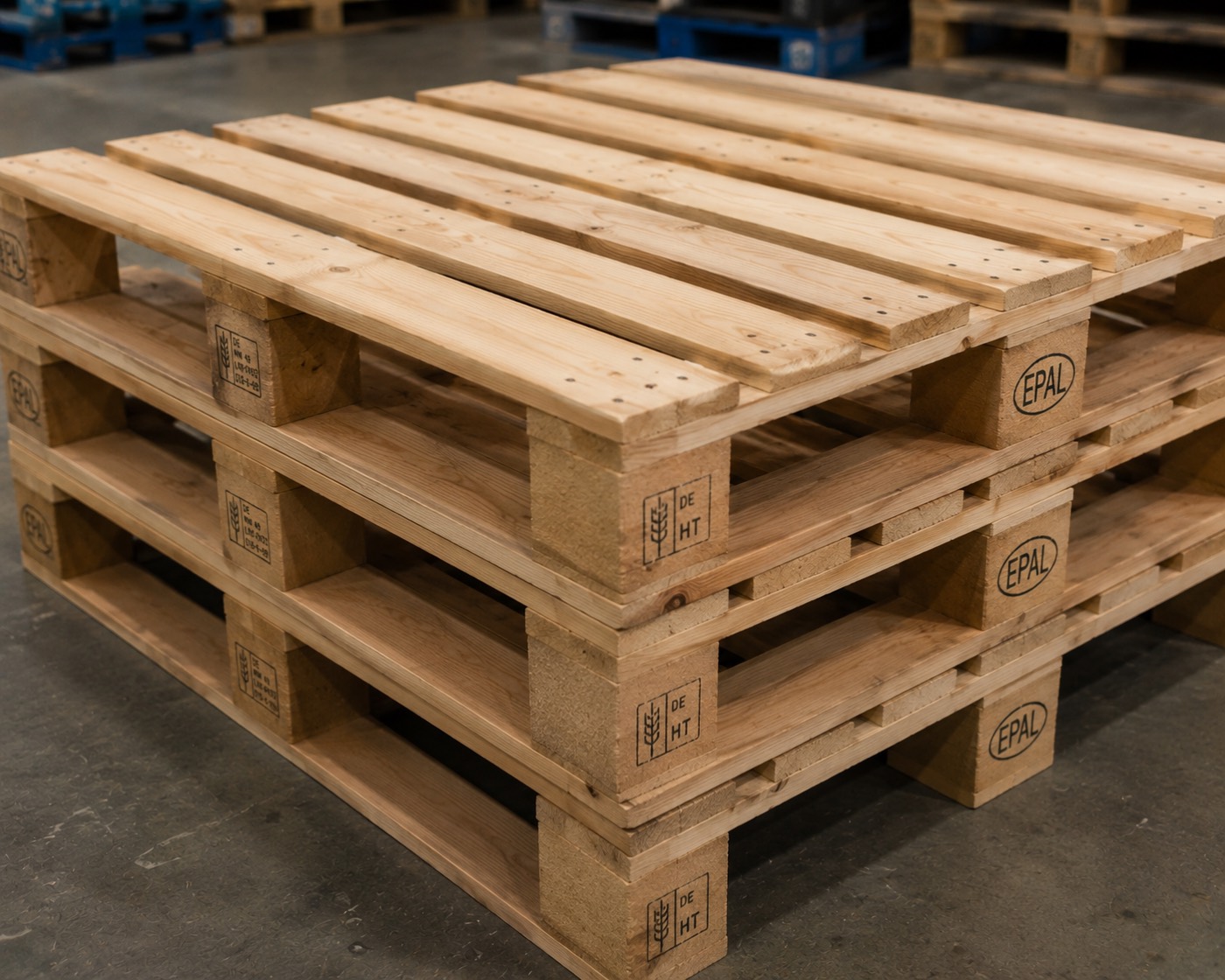
Grade A reclaimed pallets have original unrepaired stringers and seven or more top deck boards; they are the only reclaimed grade suited to racking. Grade B may carry one repaired or companion stringer and replaced boards; it is full strength for floor stacking, block stacking and one-way shipping and costs roughly 20–30% less.
If a lane does not involve racking or a customer seeing the pallet, it should almost certainly be running Grade B.
The structural difference, precisely
The distinction is almost entirely about the stringers, because the stringer is the spanning member and spanning is the hardest thing a pallet does.
A Grade A pallet has three original, uncracked, unrepaired stringers. Load transfers through continuous grain from one end to the other. A Grade B pallet may have a stringer that is plugged at the end, or fitted with a companion piece glued and nailed alongside it. Done properly this restores most of the original strength — but 'most' matters when a pallet is spanning open air in a rack with two thousand pounds on it.
Deck boards are the secondary difference. Grade A carries seven or more with consistent spacing; Grade B may have five to seven with replacements. For floor stacking that difference is cosmetic. For small cartons or bagged product it is not, because product falls through wide gaps.
Lane by lane
- Selective racking → Grade A, plus your own rack engineering sign-off. Never Grade B.
- Drive-in or push-back racking → Grade A, and consider a new build with a rated capacity.
- Floor stacking / block stacking → Grade B. No benefit whatsoever from Grade A.
- One-way outbound → Grade B. The pallet is not coming back; every extra dollar is a gift.
- Inbound raw material → Grade B or cores, whatever is cheapest.
- Retail floor-ready / customer-facing → Grade A or new. Appearance genuinely matters here.
- Export → Grade per the above, plus ISPM-15 treatment.
- Automated handling → Neither, necessarily. Specify a dimensional tolerance instead of a grade.
The saving, quantified
The Grade A to Grade B gap runs roughly 20–30% on comparable 48×40 stock. An operation moving 1,000 pallets a month with 60% of that volume on one-way outbound lanes is buying 600 Grade A pallets a month that could be Grade B.
Over a year that is a meaningful five-figure number for a change that has no operational effect at all — no line change, no equipment change, no retraining. It requires only that somebody separate the lanes once.
If you want the rest of the list, eleven ways to cut pallet spend covers the other ten.
How to run the split without disrupting anything
The objection to splitting grades is always operational: two SKUs, two stacks, staff picking the wrong one. Here is how operations that have done it handle that.
- Physically separate the stacks and label them at eye level, not on the top pallet where nobody looks.
- Colour-band one grade. A coloured band on Grade A is visible from across a warehouse and removes the need to inspect.
- Locate them by use. Grade A near the racking operation, Grade B near the outbound dock. Most staff pick what is nearest, so make the nearest one correct.
- Write one line into the picking instruction. 'Racked loads use banded stock' is enough.
- Review after a month. If Grade A consumption is higher than the racked volume, something is being taken from the wrong stack.
This takes an afternoon to set up and it is the largest single saving available to most operations.
Reference
Grade A vs Grade B, point by point
| Grade A | Grade B | |
|---|---|---|
| Stringers | Original, unrepaired | May include one companion or plug |
| Top deck boards | 7 or more | 5–7, may include replacements |
| Bottom deck | Generally complete | May have missing boards |
| Appearance | Clean to lightly stained | Weathered, mismatched, stencilled |
| Racking | Yes, with sign-off | No |
| Floor and block stacking | Yes | Yes — no disadvantage |
| One-way outbound | Overspecified | Correct choice |
| Customer-facing | Yes | No |
| Share of intake | ~30% | ~50% |
| Relative price | Baseline | 20–30% lower |
Avoid these
Mistakes we see
Splitting grades without separating stacks
If both grades are in the same place, staff will take whichever is on top. Physical separation is the whole mechanism.
Labelling the top pallet
Nobody looks at the top of a stack. Label at eye level on the upright or the floor.
Not reviewing consumption afterwards
If Grade A usage exceeds your racked volume, the split is not being followed and the saving is not being made.
Checklist
Work through this before you order
Implementing a grade split
- List every lane and mark which genuinely rack
- Order the two grades separately
- Separate the stacks physically
- Label at eye level; colour-band one grade
- Locate each grade near its point of use
- Add one line to the picking instruction
- Review consumption after one month
Questions
Before you ask us
Can Grade B pallets go in racking?
We do not recommend it. A companion or plugged stringer restores most but not all of the original span strength, and racking loads a pallet in the least forgiving way possible.
How much cheaper is Grade B?
Roughly 20 to 30 percent below Grade A on comparable 48x40 reclaimed stock. The gap is fairly stable because both grades come from the same inbound stream.
Will customers notice a Grade B pallet?
On an industrial lane, no. Grade B is weathered and mismatched but structurally sound. On a retail floor-ready display where the pallet is visible to a shopper, yes, and there Grade A or new is the right answer.
What about combo grades?
Combo is an agreed blend, typically 60/40 or 70/30 A to B, priced between them. It suits operations that would rather not manage two SKUs. Always agree the ratio in writing.
Can we start with a trial?
Yes, and it is the sensible way. Run one one-way lane on Grade B for a month alongside your existing Grade A lanes and compare damage and handling incidents. The data usually settles it.
Will the two grades look obviously different?
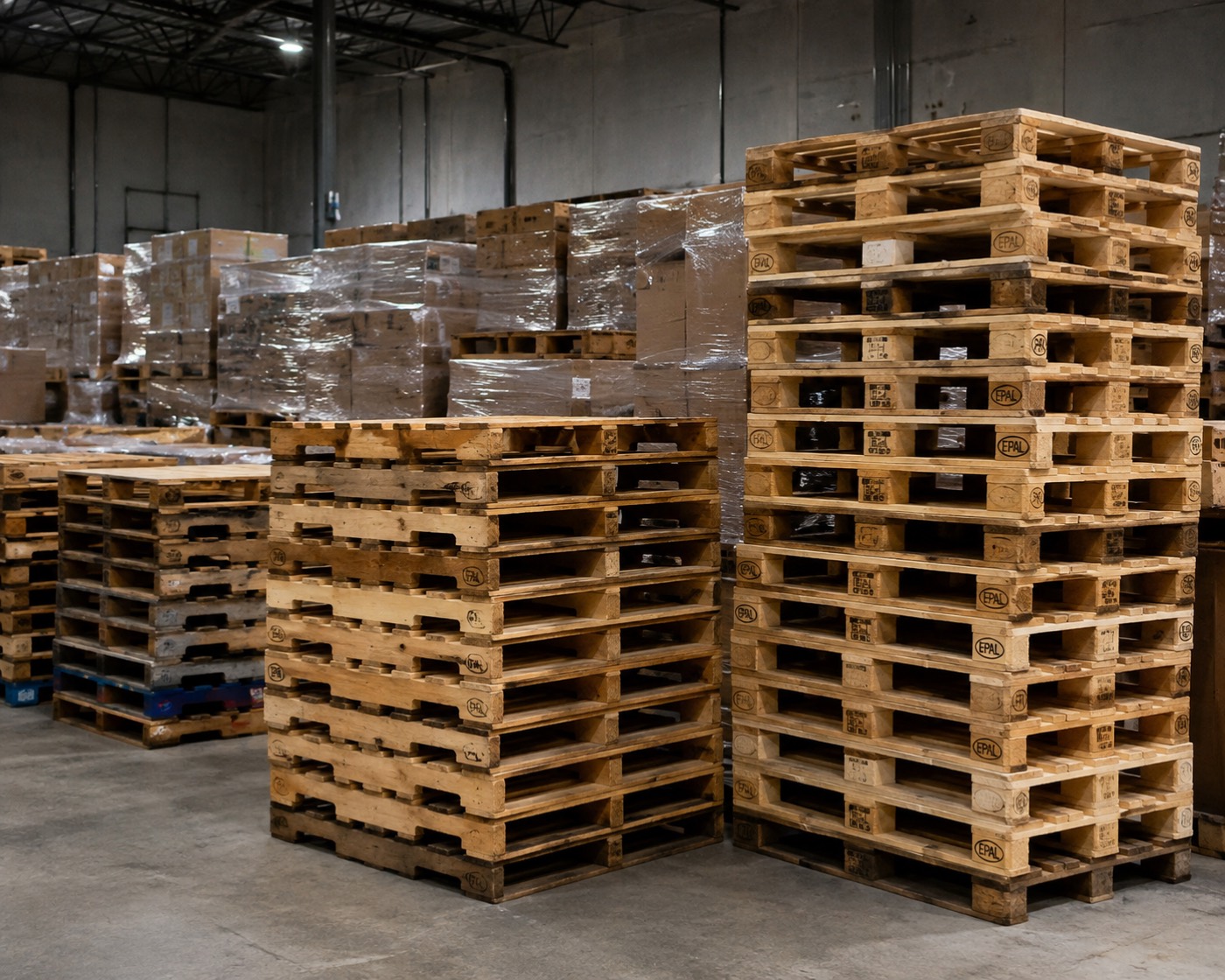
Grade A stacks look noticeably more uniform. Grade B shows colour variation, replaced boards and previous stencils. That visible difference is useful — it makes the split self-enforcing.
Keep going
Related pages