Services · build
Custom manufacturing
A prototype on your dock in two days, a cut list you own, and a production run priced firm. No engineering gate, no portal, no six-week discovery phase.
Request a quote
Tell us what you need
Send this and a real person in the Columbus yard reads it. Most quotes go out the same business day.
In short
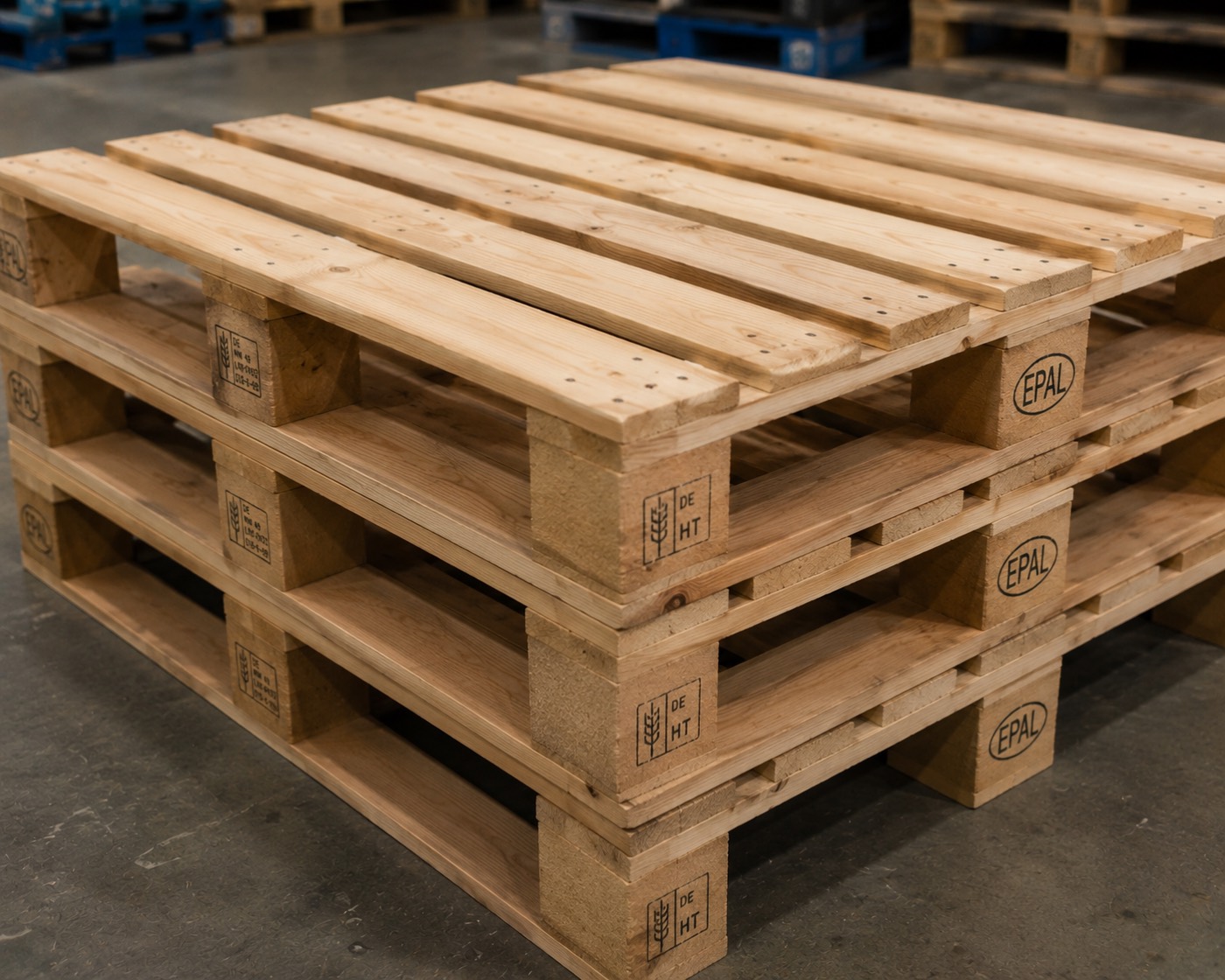
Custom manufacturing at RePallets Ohio covers pallets, skids, crates, collars and blocking built to a specific footprint and load rather than to a catalogue. We prototype within 48 hours of confirmed dimensions, test against your real product, then run production in five to twelve working days.
Builds can be all-new lumber, all-reclaimed, or a blend — and we quote both so you can see the difference. Product detail at custom & specialty pallets.
The process, honestly described
- You tell us the load, not the pallet. Outside dimensions, weight, handling method, racking or stacking, cycle expectation, damage history. We would rather design from the problem than copy a pallet that may itself be wrong.
- We prototype. One unit, photographed under your stated load, with a written cut list. 48 hours from confirmed dimensions.
- You test it. In your building, on your equipment, with your product. This step is not optional and we will push back if you try to skip it.
- We revise once, usually. Most designs need one adjustment. Deck gap, stringer position, chamfer.
- We produce. Five to twelve working days depending on volume and material. Priced firm.
- We hold the spec. Repeat orders use the same cut list. Your pallet does not quietly drift over three years.
What we can manufacture
- Pallets from 24″ × 24″ to 96″ × 60″, stringer or nine-block
- Skids and rub-rail skids for machinery mounting
- Crates and plywood boxes to 20 ft
- Collars, lids and top caps to custom footprints
- Blocking, bracing and dunnage kits, treated if needed
- Display and floor-ready bases where appearance matters
- Reinforced spans, double-face decks, wing decks, chamfered lead boards
- Stencilling, branding, colour coding and serial marking
Reclaimed-content manufacturing
This is the part that distinguishes a yard from a mill. When we dismantle pallets, recovered deck boards and stringers are sorted by length, species and grade. That pool feeds custom builds directly.
For a custom footprint, reclaimed-content construction commonly lands well below an all-new build, and for the great majority of industrial applications it performs identically — the wood is dry, settled and frequently hardwood.
Where an audit trail requires virgin material, we build all-new and document it. Where it does not, we will always show you both numbers. The environmental difference is not marginal: see the Repallet Ledger.
Quality control on a production run
Dimensional checks at the start, middle and end of each run against the approved cut list. Fastener pattern and penetration checked per batch. Moisture content verified on kiln-dried material at dispatch.
Deviations get reported to you rather than shipped and hoped for. If a run goes out of tolerance we stop it, which is occasionally inconvenient and always cheaper than the alternative.
What we build besides pallets
The build shop is not limited to decks and stringers, and customers frequently do not think to ask.
- Skids and rub-rail skids for machinery that will be bolted down or dragged
- [Crates, plywood boxes and export packaging](/products/crates-and-boxes) up to about 20 feet
- Collars, lids and top caps to custom footprints, matched to a custom pallet
- Blocking, bracing and dunnage kits, cut to your load and treated if needed
- Display and floor-ready bases where appearance matters
- Separator boards, battens and cross members for layered or coiled product
- Racking-compatible bases designed around your beam spacing rather than around a standard
If it is a wooden thing that holds up freight, it is probably in scope. If it is not, we will say so rather than trying.
Quality control on a production run
A custom design is only useful if unit 900 matches unit 1. The checks are unglamorous and they are what makes a cut list worth holding.
- Dimensional checks at the start, middle and end of each run, against the approved cut list
- Fastener pattern and penetration verified per batch
- Moisture content verified at dispatch on kiln-dried material
- Squareness on the diagonals, which matters disproportionately for anything going into automation
- First-off approval on repeat runs, so drift between orders is caught immediately
Deviations get reported rather than shipped and hoped for. If a run goes out of tolerance we stop it, which is occasionally inconvenient and always cheaper than the alternative.
Reference
Timeline for a new design
| Stage | Elapsed | What you do | What we do |
|---|---|---|---|
| Brief | Day 0 | Send load dimensions, weight, handling, cycles | Ask at most one clarifying question |
| Prototype | Day 1–2 | — | Build one unit, photograph under load, issue cut list |
| Test | Day 3–5 | Test in your building, on your equipment | Stand by for the revision |
| Revision | Day 6–7 | Confirm changes | Adjust and reissue the cut list |
| Production | Week 2–3 | Confirm quantity and date | Run, QC, band and deliver |
| Repeat | Later | Reorder against the cut list | Same spec, first-off approval |
Avoid these
Mistakes we see
Approving a prototype without testing it under load
A pallet that looks right and has not carried your product is an untested assumption. Test it with the real load, on the real equipment, repeatedly.
Changing the load after the design is fixed
Packaging changes ripple. If the carton or the tie-and-stack pattern is under review, resolve that before locking the pallet design.
Ordering a first run larger than necessary
250 units is enough to prove a design in service. A first run of 3,000 turns a design revision into a write-off.
Not telling us about the racking
A pallet can be perfect on the floor and wrong in your rack. Beam spacing and load duration change the stringer design more than the load weight does.
Assuming custom means new lumber
Roughly half our custom work uses reclaimed content at a real discount and identical industrial performance. Ask for both numbers.
Checklist
Work through this before you order
The brief we need
- Built load dimensions and weight
- Whether the load is point-loaded or evenly spread
- Racked, floor stacked or block stacked — plus beam spacing
- Handling equipment and entry sides
- Expected trips per unit
- Domestic or export
- Any current failure mode, with photographs
- Whether reclaimed content is acceptable
Questions
Before you ask us
What is the minimum production run?
250 units for a first run of a new design and 100 on repeats. Prototypes are quoted individually and credited against a production order placed within ninety days.
Do you charge for the prototype?
Yes, at cost, and it is credited against the production order. Free prototypes get treated as disposable and nobody tests them properly.
Can we take the cut list to another supplier?
Yes. It is your design and we do not hold it hostage. We would rather earn a repeat order on price, quality and delivery than by locking up a drawing.
How fast can you turn a rush order?
Prototypes in 48 hours, small production runs occasionally within a week. We price rush work at a fair premium rather than a punitive one, and we tell you if the date is not realistic.
Can you reverse-engineer a pallet we already use?
Yes. Send one physical sample or a dimensioned drawing. A sample is far better than a photograph because it gives board thickness and notch geometry, which a photograph cannot.
How firm is the production lead time?
Seven to twelve working days for a standard run, and we commit to a date rather than a range. If lumber availability threatens it, you hear before the date rather than after.
Do you charge for design work?
The prototype is quoted at cost and credited against a production order placed within ninety days. There is no separate design fee — the design work is part of building the prototype.
What if the design does not work?
That is what the prototype stage is for, and most designs take one revision. If it cannot be made to work we say so rather than iterating indefinitely at your expense.
Keep going
Related pages