Company · position
Reuse is the only part of the waste hierarchy nobody measures.
Recycling gets the headlines and the logo on the box. Reuse quietly does more good and gets no credit, largely because it produces no dramatic photograph of a shredder. This page is our position, and the arithmetic behind it.
Request a quote
Ask us for your diversion numbers
Programme customers get quarterly reporting drawn from actual collection records, not estimates.
Answer first
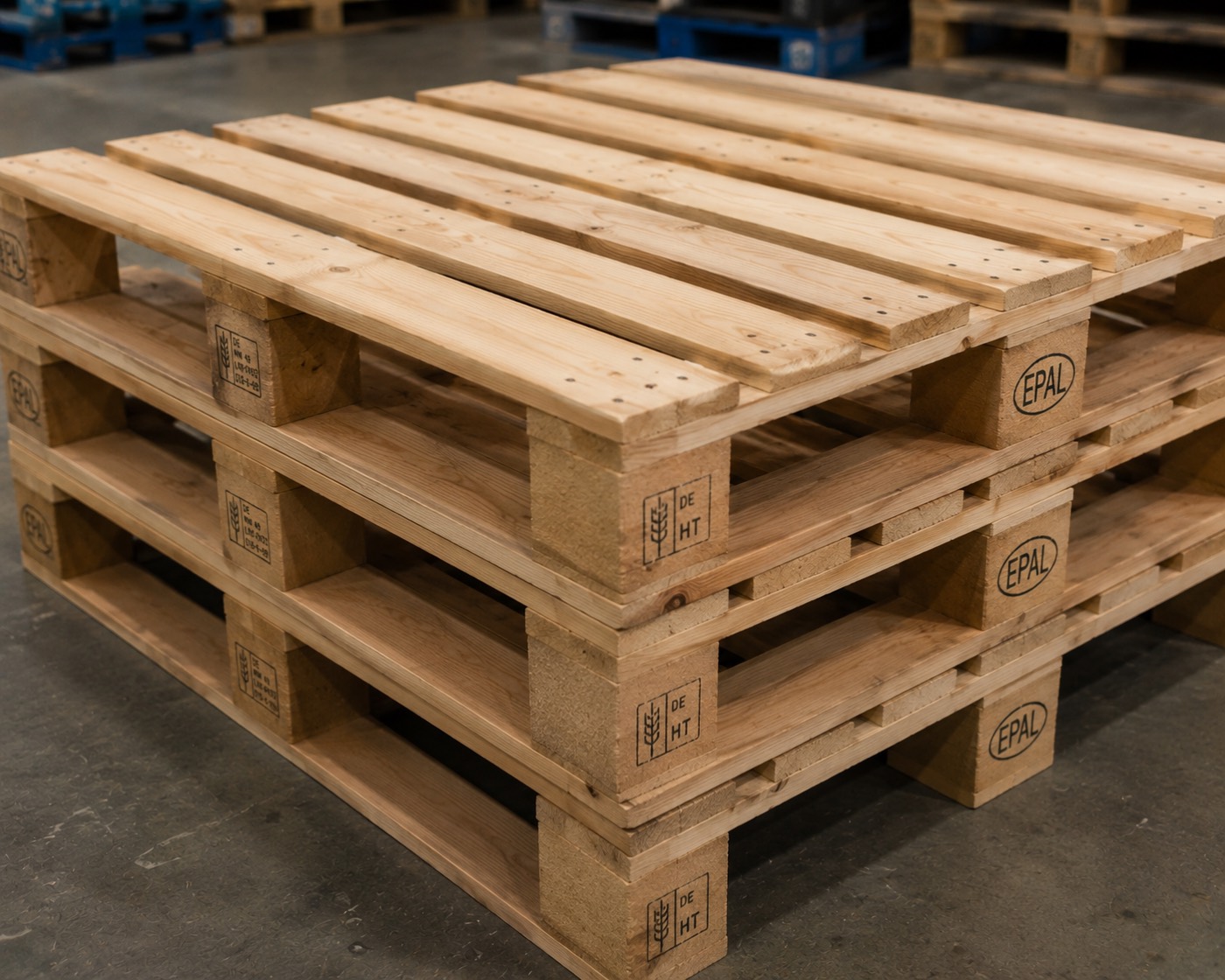
Roughly 94% of the mass entering our Columbus yard leaves as a pallet or a pallet component. The remaining 6% leaves as landscape mulch, biomass fuel or recovered scrap steel. No pallet wood has gone to landfill from this yard in three years.
Every environmental figure on this site is calculated from coefficients published in full on the methodology page. We would rather give you a smaller number you can defend than a larger one you cannot.
The hierarchy
Six steps, and why the order is not negotiable
The waste hierarchy is not a slogan. It is an ordering by how much energy and value each outcome retains, and every step down destroys something the step above kept.
- Reuse. No processing energy at all. The pallet is inspected and goes straight back out. Everything retained.
- Repair. One board and four nails — roughly two percent of the object replaced. Almost everything retained.
- Remanufacture. Dismantle and rebuild from recovered components. The lumber keeps working; the original object does not.
- Recycle to material. Grind for mulch or fibre. Structural value gone, material value retained.
- Energy recovery. Burn for heat. Material value gone, energy recovered.
- Landfill. Everything lost, plus decomposition emissions.
Any recycler can move a customer from step six to step five and describe it as a sustainability programme. Getting to step one is the actual work, and it is the work that shows up as money on your side of the ledger as well as carbon.
Why wood is the right material to be arguing about
Wood is renewable, it stores carbon for as long as it stays in solid form, and at end of life it re-enters the biological cycle rather than persisting. A pallet that is reused twenty times keeps its stored carbon locked up for twenty times as long, which is a genuine and frequently overlooked benefit.
The comparison people reach for is plastic, and it is worth being fair about. A plastic pallet in a tightly controlled closed loop, cycling many dozens of times with low loss, can be defensible. A plastic pallet on a one-way lane is an environmental and financial mistake wearing the clothes of a durable product.
What we do not claim
We do not claim carbon neutrality. We run trucks, a grinder and a heat-treatment chamber, and all three burn fuel. We have not purchased offsets to describe that away.
We do not claim our mulch is suitable for edible gardens, because our inbound stream is screened but not guaranteed free of treated or painted wood. See reclaimed lumber and mulch.
And we do not claim that a reclaimed pallet is right for every application. Four specific cases genuinely need new material, and they are set out plainly in recycled vs new pallets.
The Repallet Ledger
Put your own numbers in it.
Nobody should take a supplier's environmental claim on faith. Set your real volume, see the result, then check every coefficient we used.
- CO₂e avoided per year
- 32.8 t
- Kept out of landfill
- 144.9 tons
- Standing trees not felled
- 330
- Saved vs. buying new
- $42,840
- Board feet still working
- 77,490
- Car-mile equivalent
- 81,900
Coefficients are published in full — read the methodology. Figures are planning estimates, not a verified inventory.
Questions
The honest version
Is a wood pallet actually sustainable?
A reused wood pallet is one of the most sustainable pieces of industrial packaging in existence. Wood is a renewable material that stores carbon while in service, and reuse avoids the felling, milling, kilning and freight that a new pallet requires. The sustainability problem is not the pallet; it is discarding it after one trip.
Why do you say reuse beats recycling?
Because recycling destroys structural value to recover material value. Grinding a repairable pallet into mulch recovers the fibre and throws away the object. On the waste hierarchy, reuse sits two steps above recycling for exactly this reason, and any recycler who does not repair first is operating at the wrong step.
How much carbon does reusing a pallet actually save?
Roughly 5.2 kg CO2e per reuse compared with manufacturing a new equivalent. That is a planning figure drawn from published pallet life-cycle studies, and the full derivation is on our methodology page so it can be checked and argued with.
Can you provide diversion data for our ESG report?
Yes. We supply per-collection and period summaries covering tonnage collected, the reuse-repair-grind split, landfill tonnage and estimated CO2e avoided, using coefficients we publish openly rather than hold as proprietary.