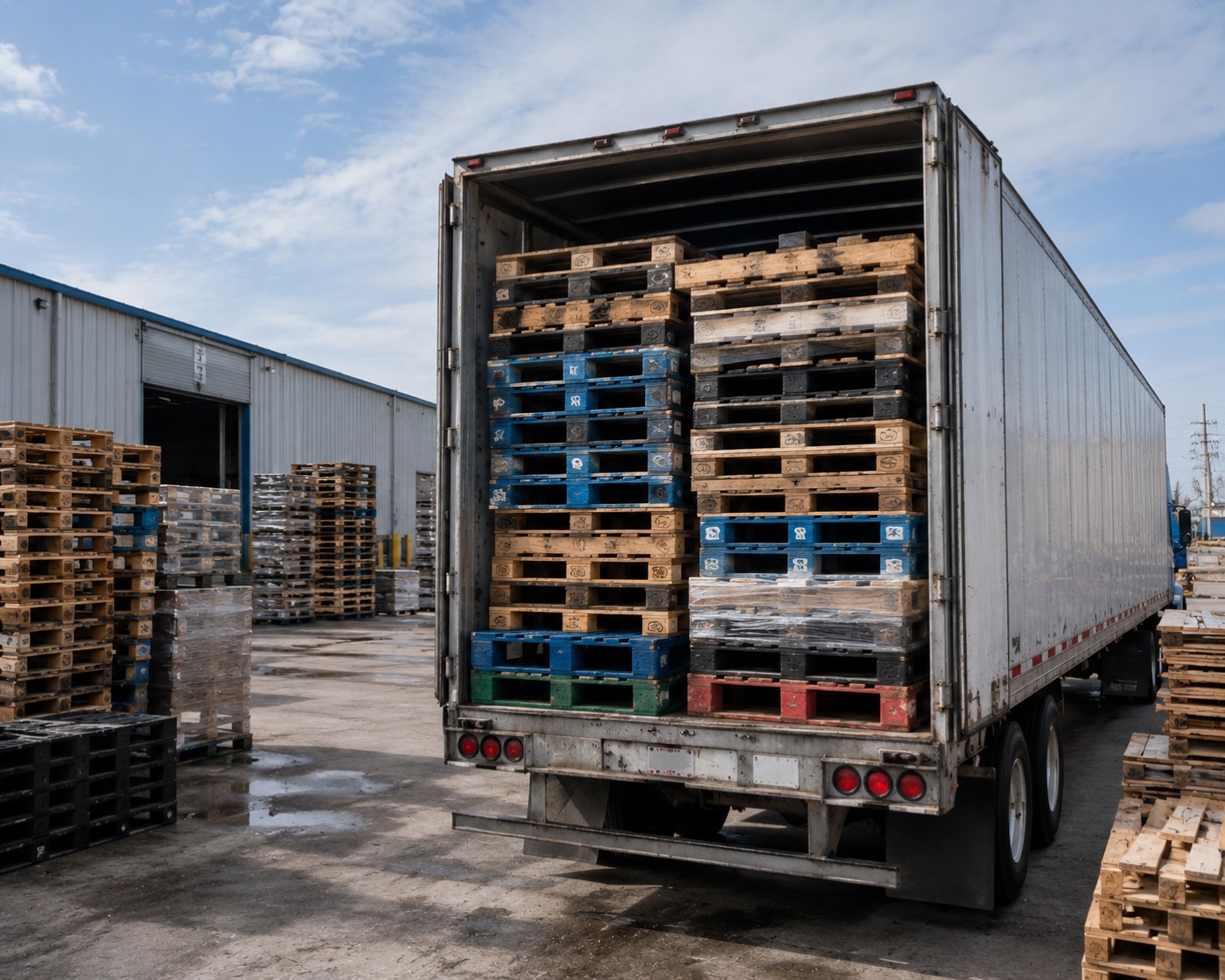
Comparison
Recycled vs new pallets, honestly
We sell both, and we sell more reclaimed. That is a bias worth declaring before you read a comparison written by a pallet yard — so here is the version that includes where new wins.
Request a quote
Tell us what you need
Send this and a real person in the Columbus yard reads it. Most quotes go out the same business day.
In short
Recycled pallets cost 30–60% less than new, carry a fraction of the embodied carbon, and — because the reclaimed pool skews hardwood while new production skews softwood — are frequently stronger. New pallets win on appearance consistency, documented material provenance, unusual footprints and engineered load ratings.
For most industrial lanes, reclaimed is the correct answer. For four specific situations, it is not. Both cases are set out below.
Cost: the gap and why it exists
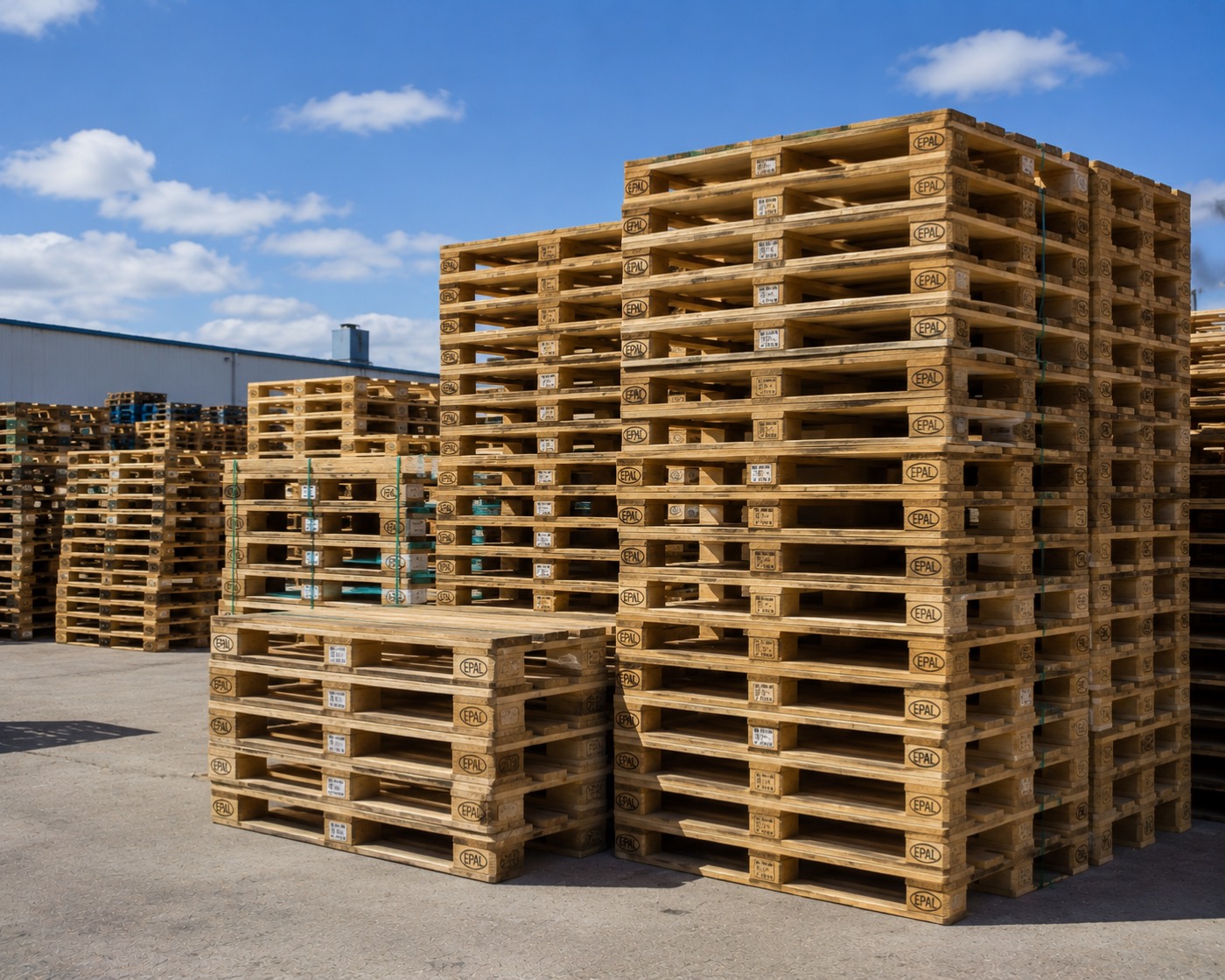
A reclaimed Grade A 48×40 typically costs 30–40% less than a comparable new build. Grade B costs 45–60% less. The gap widens sharply on odd footprints, because a new odd-size pallet must be manufactured while a reclaimed one merely has to be found.
The reason is straightforward: the expensive part of a pallet is the lumber, and reclaimed pallets contain lumber that has already been paid for once. What you pay for is collection, sorting, grading, repair and freight — real costs, but a fraction of standing timber, felling, milling, kilning and distribution.
This also makes reclaimed pricing more stable. New pallet pricing tracks lumber futures week to week; reclaimed pricing tracks collection volumes, which move far more slowly.
Strength: the counterintuitive part
The instinct is that used means weaker. In wood packaging that is often wrong, for two reasons.
Species. Much of the North American reclaimed pool, and especially the Ohio and Appalachian pool, is mixed hardwood — oak, gum, maple. Much new production is southern yellow pine. Hardwood is denser, resists point loading better and holds fasteners better. A reclaimed hardwood Grade A pallet frequently out-tests a new pine one.
Seasoning. New pallets are often built from lumber at 25–40% moisture. As that dries in service the wood shrinks, cups and loosens around the nails. A reclaimed pallet has completed that process on somebody else's time and now sits at ambient equilibrium.
The honest caveat: reclaimed strength is variable and new strength is specified. If you need a number you can put in a document, that is what new gives you.
See wood species and load capacity.
Where new genuinely wins
Appearance-critical shipments
Retail floor-ready displays, showroom deliveries, anything a customer sees. Reclaimed pallets are stained, mismatched and marked, and no amount of grading changes that.
Audited supply chains
Pharmaceutical, aerospace and some food programs require documented material provenance. A reclaimed core has no traceable origin, and that is not a fixable problem.
Footprints outside the pool
If your load is 52 × 44, the reclaimed market does not contain enough of them to supply you reliably. Building is cheaper than hunting. See custom pallets.
Engineered load requirements
When a specific rated capacity must be certified for a specific design, that requires a controlled build. Reclaimed cannot deliver it.
Carbon: the difference is not marginal
Reusing a pallet avoids roughly 5.2 kg CO₂e compared with manufacturing a new equivalent — the felling, milling, kilning and distribution that reuse skips entirely.
At 750 pallets a month with 70% reclaimed sourcing, that is about 33 tonnes of CO₂e a year avoided, plus roughly 120 tons of wood kept out of the waste stream. Those are not rhetorical numbers; you can generate them for your own volumes on the Repallet Ledger, and every coefficient is published on the methodology page.
It is worth being precise about why reuse beats recycling here. Recycling a pallet into mulch recovers material value and destroys structural value. Reusing it retains everything. On the waste hierarchy, reuse sits two steps above recycling for exactly this reason.
The answer most operations land on
Not all-new, and not all-reclaimed. A split.
Run new on the appearance-critical and audited lanes — typically 20–30% of a fleet. Run reclaimed everywhere else. Most operations that do this exercise discover they had been buying new for lanes where nobody would ever have noticed.
We will quote both against your actual lane list. Send it through the quote form.
The variability question, answered fairly
The strongest honest argument for new pallets is not strength. It is variability, and it deserves to be stated properly rather than waved away.
A new pallet is built to a specification. Every unit in a run has the same board count, the same species, the same fasteners and the same dimensions within a tolerance. If you need to state a capacity in a document, or feed a machine, that repeatability is the product.
A reclaimed pool contains pallets built by many manufacturers over many years. Grading controls structural condition, and it controls it well — but it does not make a Grade A pallet from 1998 dimensionally identical to a Grade A pallet from 2019.
So the honest framing is not 'reclaimed is weaker'. It is 'reclaimed is good on average and variable in detail; new is predictable'. Which of those matters depends entirely on what the pallet has to do.
Where variability is the constraint, there are two answers short of buying new: grade to a dimensional band as well as a structural grade, or split the fleet so only the constrained lanes get new. Most operations find the constrained lanes are a minority.
Total cost of ownership, not unit price
Both sides of this argument get made on unit price, and both are incomplete. The comparison that settles it includes four terms.
- Purchase price, delivered.
- Trips achieved, honestly measured rather than assumed.
- End-of-life value. A reclaimed pallet is not worth nothing at the end — we buy cores back. That term is routinely omitted and it materially favours owned reclaimed stock.
- Damage attributable to the pallet. Rare, but when it happens a single crushed pallet of finished goods can exceed a month of pallet spend.
Run all four and reclaimed wins comfortably on open-loop and one-way lanes, narrows on high-cycle closed loops, and loses on the four cases below.
Reference
Direct comparison
| Factor | Recycled | New |
|---|---|---|
| Unit cost (48×40) | 30–60% lower | Baseline |
| Lead time | Often next day | 5–8 working days |
| Typical species | Mixed hardwood, oak | Southern yellow pine |
| Dimensional stability | High — already seasoned | Varies with moisture content |
| Appearance consistency | Variable | Uniform |
| Strength per unit | Often higher (hardwood) | Predictable, spec'd |
| Embodied carbon | Minimal | Full cradle-to-gate |
| Material provenance | Not traceable | Documentable |
| Odd footprints | Limited pool | Built to order |
| Engineered rating | Not available | Available |
Reference
Decision matrix
| If your requirement is… | Choose | Why |
|---|---|---|
| Lowest cost per trip, one-way | Reclaimed Grade B | Pallet is not returning; grade premium is wasted |
| Racked storage | Reclaimed Grade A | Original stringers; with your rack sign-off |
| Documented material provenance | New | Reclaimed cores have no traceable origin |
| Appearance in front of a customer | New or reclaimed A | Reclaimed stock is stained and mismatched |
| A certified load rating | New, engineered | Requires a controlled build |
| An unusual footprint at volume | New or reclaimed-content build | Reclaimed pool cannot supply reliably |
| Tight dimensional tolerance | New, or graded to a band | Variability is the constraint, not strength |
| Lowest embodied carbon | Reclaimed | Skips harvest, mill, kiln and primary distribution |
| Maximum strength per dollar | Reclaimed hardwood | Reclaimed pool skews hardwood; new skews SYP |
Avoid these
Mistakes we see
Deciding once for the whole fleet
The answer differs by lane. Deciding once and applying it everywhere guarantees you are wrong somewhere, usually expensively.
Treating reclaimed as a downgrade
For most industrial duty it is not. Reclaimed hardwood is frequently denser and more dimensionally settled than new softwood.
Omitting end-of-life value from the comparison
Cores are worth money. Leaving that term out of a total-cost comparison systematically favours new by an amount nobody notices.
Buying new to solve a variability problem without measuring it
Grading to a dimensional band is cheaper than buying new and works for many systems. Measure the envelope your equipment actually needs first.
Checklist
Work through this before you order
Deciding, lane by lane
- Does anything cross an international border?
- Does an auditor need traceable material provenance?
- Will a customer see the pallet?
- Does a machine handle it, and to what tolerance?
- Is the footprint in the reclaimed pool?
- Does it get racked, and for how long?
- Does it come back, and if so how many times?
Questions
Before you ask us
Are recycled pallets as strong as new ones?
Often stronger, because the reclaimed pool skews toward hardwood while new production skews toward southern yellow pine, and because reclaimed wood has already completed its seasoning. The trade-off is variability: new pallets have specified, repeatable strength.
How much cheaper are recycled pallets?
Roughly 30 to 40 percent below new for Grade A, and 45 to 60 percent for Grade B on comparable 48x40 stock. The gap is larger on unusual footprints.
Can recycled pallets be used for export?
Yes, if they are heat treated and stamped to ISPM-15. Qualifying reclaimed pallets can be treated, and it is usually the lowest-cost route to export-compliant stock.
Are recycled pallets clean enough for food handling?
For secondary and tertiary packaging of dry goods, generally yes, and most Ohio food manufacturers use them. For direct food contact or wash-down environments, plastic or new heat-treated wood is the better answer.
Is there any application where reclaimed is unsafe?
Reclaimed stock graded correctly is not unsafe; using the wrong grade for the duty is. The genuine exclusions are applications needing certified ratings, documented provenance or direct food contact — and those are exclusions of documentation, not of safety.
How do we test whether reclaimed will work for us?
Run one lane on it for a quarter and measure damage rate, handling incidents and any equipment rejections against the lane you did not change. That is a cheap experiment and it settles the argument with your own data.
Do customers object to reclaimed pallets?
Almost never on industrial freight, where nobody sees the pallet. On retail floor-ready displays they do, legitimately, which is why that lane is one of the four where new wins.
Keep going
Related pages