Field notes
Inside pallet recycling
Written from the yard floor rather than from a brochure. This is the route a pallet takes between arriving on a trailer and leaving as something useful.
Request a quote
Tell us what you need
Send this and a real person in the Columbus yard reads it. Most quotes go out the same business day.
In short
Pallet recycling is a sorting operation before it is a processing operation. Inbound cores are counted, sorted by footprint, graded by condition, then routed: reusable pallets go straight back out, repairable ones go to the repair line, and the remainder are dismantled for component lumber and ground for mulch and biomass. Fasteners are magnet-recovered as scrap steel.
At our Columbus yard, roughly 94% of inbound mass leaves as a pallet or a pallet component. Nothing goes to landfill.
1. Intake and count
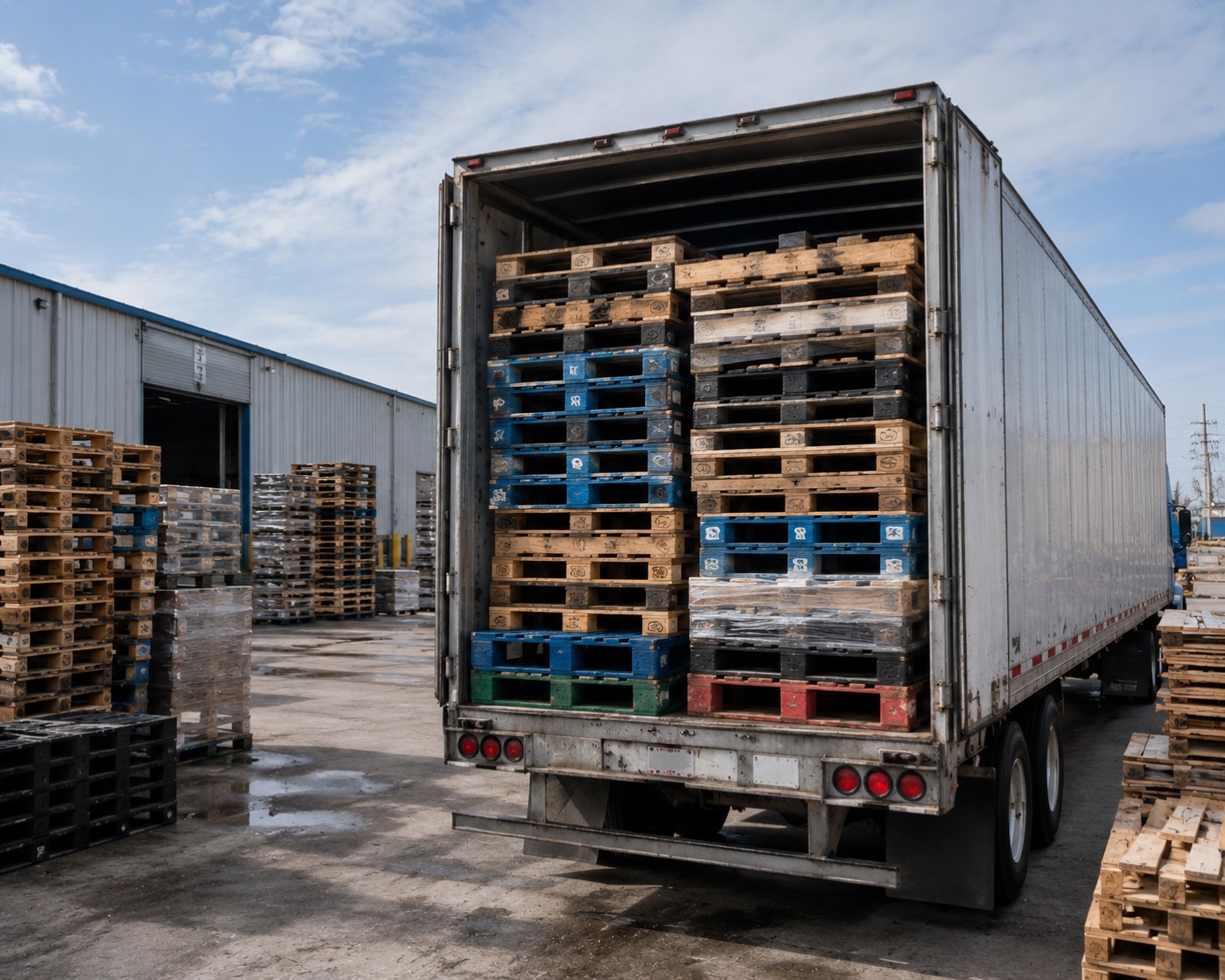
Every inbound trailer is counted on the ground rather than accepted on paperwork. This sounds like distrust; it is not. Pallet counts are genuinely difficult to get right on a moving load and discrepancies are almost always honest.
Counting on the ground with the driver present, photographing anything unexpected, and resolving it before anyone signs removes an entire category of dispute. It costs fifteen minutes and it has saved a great many relationships.
Loads are also assessed for contamination at this point — wet stock, mold, general waste mixed in, chemical staining. Contaminated material is a cost rather than an asset, and pricing it honestly at intake is better than discovering it later.
2. Sort by footprint
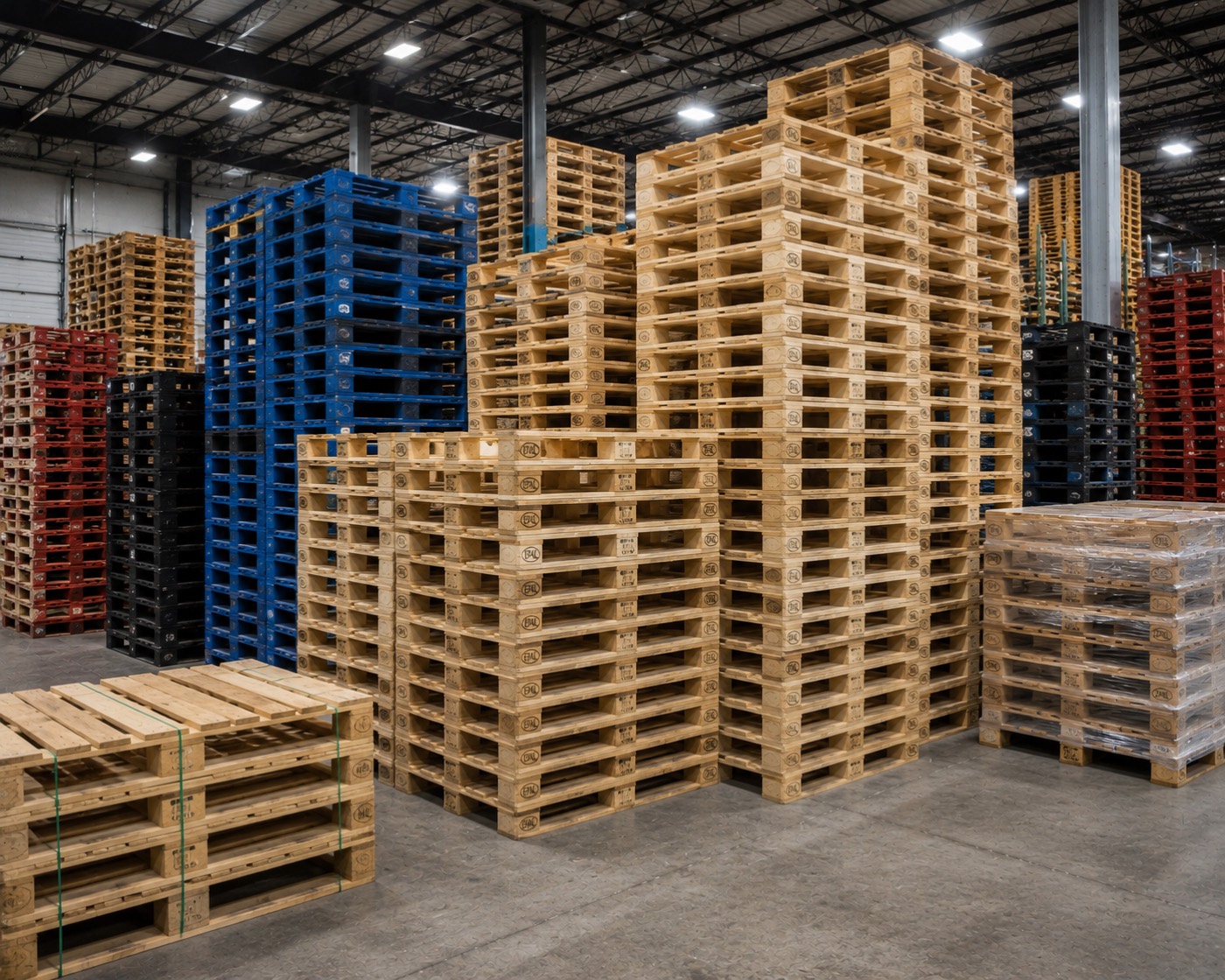
48×40 GMA splits off first, because it is the deepest market and the fastest-moving stock. Then the secondary sizes — 42×42, 48×48, 40×48, 48×42 and the rest of the standard chart. Then genuinely odd sizes, which are routed to dismantling because there is no reliable resale market for a lone 53×37.
Sorting by size before grading matters because the two decisions interact: a Grade A odd-size pallet is worth less than a Grade B GMA, and processing them the same way wastes handling on the wrong item.
3. Grade in daylight
Graders work under natural light, and this is not a preference. Artificial overhead light flattens the shadows that reveal a hairline stringer crack and washes out the grey-green tint of early mold. Under daylight both are obvious.
Each pallet is turned, sighted along the stringers, checked at the notches — the most common failure point — and checked by hand for protruding fasteners. The output is Grade A, Grade B, repairable, or dismantle.
A good grader handles several hundred pallets an hour and is the single most valuable person in a pallet yard. The economics of the entire operation rest on the accuracy of that judgment.
4. Repair
Roughly four in five inbound cores are repairable, and repair is where the environmental case is actually won. A pallet that gets one board replaced retains essentially all of its embodied carbon and all of its structural value.
Broken deck boards are replaced with full-length lumber. Cracked stringers get a glued and nailed companion along the full length. Damaged stringer ends are cut back and plugged. Protruding fasteners are pulled, not hammered flush.
Everything is re-graded afterward, and a repaired pallet grades B rather than A. Detail on pallet repair & refurbishing.
5. Dismantle
What cannot be repaired goes to the band saw. The cut separates deck boards from stringers with minimal damage to either — a good dismantler recovers considerably more usable lumber than a bad one, and the difference shows up directly in yard margin.
Recovered deck boards and cut stringers are sorted by species, length and condition. They feed three destinations: repair stock for the repair line, custom builds with reclaimed content, and direct sale as reclaimed lumber.
Anything with rot, contamination or heavy fastener damage goes to grinding.
6. Grind, screen, colour
The grinder is the last stop and the smallest one. Ground material is screened for size, then either coloured for landscape mulch or sold as biomass boiler fuel.
Grinding is genuinely the last resort. It recovers material value and destroys structural value, which on the waste hierarchy is two steps down from reuse. A yard that grinds a large share of its intake is a yard that is not sorting and repairing well.
Nails pass under magnets on the way out and are recovered as scrap steel — forty to eighty fasteners per pallet. It is a small revenue line and an important one, because steel in mulch damages customer equipment and closes badly.
What the numbers look like
Across a typical month at our yard:
- ~80% of inbound cores leave as whole pallets, repaired or as-is
- ~14% are dismantled, with the majority of that mass recovered as usable lumber
- ~6% of inbound mass leaves as mulch, biomass fuel or scrap steel
- 0 tons to landfill
Those figures are what feed the coefficients behind the Repallet Ledger, and the calculation is published in full on the methodology page.
What the yard looks like at each stage
The process reads cleanly on a page and looks like a working yard in practice. Both are worth understanding.
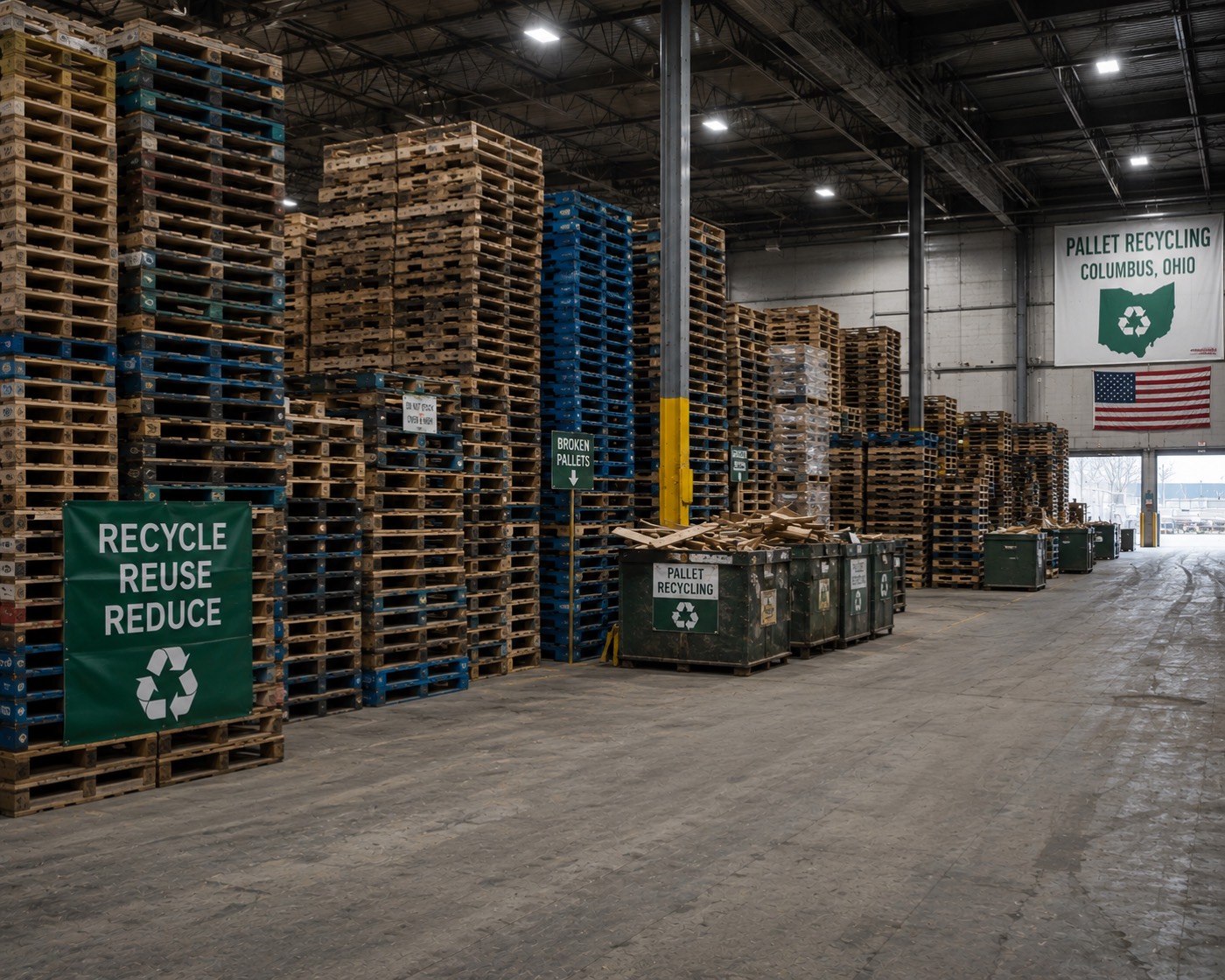
Inbound hard standing. Trailers back on and unload to the ground. This area is deliberately oversized, because a queue here backs up into the road and a rushed unload is where counts go wrong.
Size lanes. Physical lanes, not a conveyor. 48×40 has the largest lane because it is the largest flow; odd sizes have a small one that routes directly to dismantling.
Grading positions. Outdoors under cover, positioned for natural light. Each position keeps physical reference pallets for the borderline cases — the pallet that is just barely Grade A, the deck gap that is just barely too wide. Written specifications drift in interpretation; a physical object does not.
Repair bay. Benches, nail guns, a band saw for cutting companions, and a stock of sorted replacement boards recovered from dismantling.
Treatment chamber. Charges built for airflow, probed at the coldest predicted point.
Stacking and banding. Fifteens, banded, dated.
Grinder and screen. The smallest area, deliberately.
Throughput, and why sorting is the bottleneck
People assume the grinder or the repair line limits a pallet yard. It is almost always grading.
Grading is a judgement made per pallet and it cannot be batched. A grader handles several hundred an hour; a grinder handles tonnes. So the shape of the operation is set by how many accurate judgements can be made per hour, and everything else sizes around that.
This has two consequences worth knowing as a customer.
Sorted inbound loads are genuinely worth more, because they remove work from the constrained step. A load pre-separated by footprint and condition arrives partly graded.
Grading accuracy is where a yard's margin lives. Grade too generously and customers get pallets that fail. Grade too conservatively and you dismantle inventory worth five times its lumber value. The line is narrower than it looks and it is the reason we use reference pallets rather than a rulebook.
Reference
Where a pallet ends up, by intake condition
| Condition at intake | Route | Output |
|---|---|---|
| Sound, standard footprint, clean | Grade and resell | Grade A or B pallet |
| One damaged deck board | Repair bay | Grade B pallet |
| One cracked stringer | Repair bay — companion | Grade B pallet |
| Two cracked stringers | Dismantle | Deck boards, one stringer, grind |
| Sound but unmarketable footprint | Dismantle | Recovered lumber |
| Rot or delamination | Grind | Mulch or biomass |
| Wet or moldy | Reject at gate, or grind | Biomass |
| Chemically contaminated | Reject at gate | Declined |
Avoid these
Mistakes we see
Judging a recycler by its landfill number
Zero landfill with a 90% grind rate is technically true and practically poor. Ask what proportion leaves as whole pallets.
Sending mixed loads and expecting sorted-load prices
Sorting is the constrained step. A load that arrives partly sorted removes work from it, and that is why sorted loads are worth more.
Assuming grinding is the efficient outcome
It is capital-efficient and value-destructive. Reuse and repair are labour-intensive and value-preserving, which is why the industry drifts downward without deliberate effort.
Checklist
Work through this before you order
Questions for any pallet recycler
- What proportion of inbound pallets leave as whole pallets?
- Do you operate a repair line?
- What is your landfill tonnage, and is it measured or targeted?
- Where specifically does ground material go?
- How is any published CO₂e figure calculated?
- Can I visit and see the grading line?
Questions
Before you ask us
What happens to pallets that cannot be repaired?
They are dismantled on a band saw. Usable deck boards and stringers are recovered for repairs, custom builds and resale as reclaimed lumber. The remainder is ground for landscape mulch and biomass fuel, and fasteners are magnet-recovered as scrap steel.
How much of a pallet can actually be recycled?
Effectively all of it. At our yard roughly 94 percent of inbound mass leaves as a pallet or pallet component, and the balance leaves as mulch, fuel or recovered steel. Nothing is landfilled.
Is grinding pallets into mulch a good outcome?
It is the last resort, not the goal. Grinding recovers material value but destroys structural value, which sits two steps below reuse on the waste hierarchy. A yard grinding a large share of its intake is not sorting well.
How do you keep nails out of mulch?
Ground material passes under magnets before screening, recovering the forty to eighty fasteners each pallet contains. Steel in mulch damages customer equipment, so this step is treated as quality control rather than as a revenue line.
How long does a pallet spend in the yard?
Usually days rather than weeks. We deliberately do not hold reclaimed stock long, because a pallet sitting in our yard degrades exactly as it would in yours. Fast turnover is an inventory policy, not an accident.
What is the hardest part of the process?
Grading, by a considerable margin. It cannot be batched or automated reliably, it sets the value of every pallet, and consistency between graders takes weeks of working side by side to establish.
Is any of this automated?
The grinding and screening are. The sorting and grading are not, because the judgement involved — a hairline stringer crack, early mold, a marginal repair — is still made better by a person under natural light.
Keep going
Related pages