Guide · compliance
ISPM-15 explained
Every year, shipments sit at ports because of a piece of wood nobody thought about. This is the guide we wish our customers had read first.
Request a quote
Tell us what you need
Send this and a real person in the Columbus yard reads it. Most quotes go out the same business day.
In short
ISPM-15 is an international standard requiring solid wood packaging thicker than 6 mm to be debarked and heat treated to 56°C core for 30 continuous minutes (or fumigated), then marked with a registered IPPC stamp. More than 180 countries enforce it.
Exempt: engineered wood (plywood, OSB, particleboard), plastic, metal, material under 6 mm, and most US–Canada bilateral trade. Domestic US shipments need no mark at all.
What the standard is for
Wood packaging is an extraordinarily efficient vector for forest pests. The emerald ash borer, the Asian longhorned beetle and the pinewood nematode all crossed oceans in pallets and crates, and the cost of those introductions runs into billions of dollars in forest damage and control programmes.
ISPM-15 was adopted by the International Plant Protection Convention to close that route. It does not attempt to certify wood as sterile; it requires a treatment sufficient to kill the organisms of concern, applied by a registered facility that can be audited.
That framing explains most of the rules that otherwise seem arbitrary — why bark must be removed, why engineered wood is exempt, and why the mark identifies a facility rather than a batch.
What the treatment actually requires
Heat treatment (HT). Core temperature of every piece must reach 56°C and hold for at least 30 continuous minutes. Note *core* — surface temperature is irrelevant, which is why charges are probed at the coldest predicted point and why stacking for airflow matters.
Debarking. Wood must be debarked before treatment. Small residual patches are tolerated within defined limits, but bark is where many pests live.
Methyl bromide fumigation (MB). The historical alternative, now banned or heavily restricted in many jurisdictions on ozone-depletion grounds. Almost all current compliance is heat treatment.
Dielectric heating (DH). A newer approved method using microwave energy. Uncommon in pallet production.
Our own process and record keeping is described on the heat treating service page.
Reading the mark
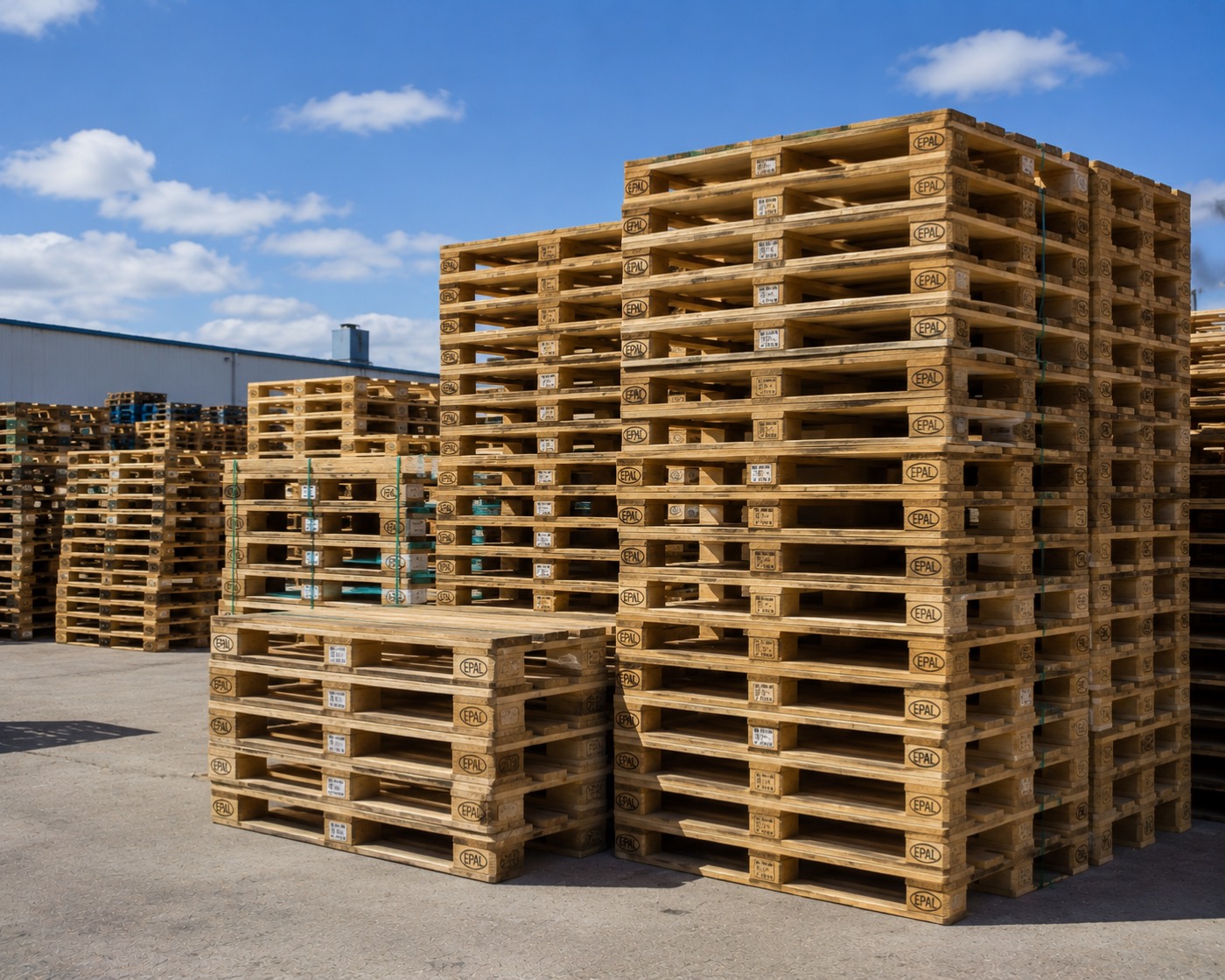
A compliant mark contains four elements:
- The IPPC symbol — a stylised ear of wheat. This is not decorative; a mark without it is not compliant.
- The ISO country code — US for the United States.
- The facility registration number — unique to the treatment provider.
- The treatment code — HT for heat treatment, MB for methyl bromide, DH for dielectric.
The mark must be legible, permanent, and applied to at least two opposite sides of the item. It must not be applied in red or orange, colours reserved for hazard marking.
What a compliant mark does not contain: a date, a batch number, or a company logo as part of the stamp. Marks carrying those are a signal to look more carefully.
What is exempt — and the money this saves
- Domestic US shipments. No ISPM-15 mark required, at all. Buying treated stock for internal distribution is a pure cost with no benefit.
- US–Canada bilateral trade. Largely exempt under a mutual recognition arrangement.
- Engineered wood. Plywood, OSB, particleboard, corrugated, hardboard, veneer. Manufacturing already destroys pests.
- Wood thinner than 6 mm.
- Plastic, metal and presswood packaging. Entirely outside the scope. See plastic pallets.
We regularly find customers paying for treated stock on domestic lanes. It is one of the easiest savings in packaging.
The five ways shipments actually get held
In our experience, almost every hold traces to one of these.
- Untreated blocking and bracing. The pallet is compliant; the 2×4 someone grabbed to brace the load is not. Customs treats the consignment as a whole. Order treated blocking with the pallets.
- Mixed storage. Treated and untreated stock stored together, and eventually the wrong stack gets loaded. Physically segregate.
- Repair after treatment. Replacing a board with untreated wood invalidates the mark. The pallet must be re-treated and re-marked. See pallet repair.
- Illegible or obscured marks. A mark hidden by the load, painted over, or worn off is treated as no mark.
- Bark present. Residual bark beyond tolerance fails inspection even on properly treated wood.
What happens when a shipment fails
The receiving country has three options and all of them are expensive: order fumigation at your cost, require re-export of the entire consignment, or destroy the packaging — sometimes with the goods still on it.
Typical delays run one to three weeks. Demurrage, detention, re-treatment, re-packing and missed delivery windows routinely exceed the value of the pallets by a factor of ten or more.
This is the rare compliance area where doing it properly is genuinely, obviously cheaper than the alternative.
Who is responsible for what
Compliance failures often become disputes because nobody agreed in advance where responsibility sits. It divides cleanly.
The treatment provider is responsible for treating to the standard, applying the mark correctly, and retaining charge records. That is us, for material we treat.
The shipper is responsible for ensuring that all wood packaging in the consignment is compliant — including anything added at the dock. This is the part that surprises people, and it is where nearly every hold originates.
The freight forwarder advises on destination-specific requirements, which vary. Some countries have additional documentation or inspection regimes on top of ISPM-15.
The receiving country decides. There is no appeal to a supplier's records if an inspector judges a mark illegible or finds untreated bracing.
Practically: ask us for records, ask your forwarder about the destination, and control what goes into the container yourself.
Building an internal process that does not depend on vigilance
Vigilance fails on Friday afternoons. Process does not.
- Procure treated blocking timber alongside pallets, in the sections you actually use. This single change eliminates the most common failure.
- Remove untreated scrap from the export area entirely. Not moved to the corner — removed. If it is not there, it cannot be grabbed.
- Segregate physically, not by label. Different bay, ideally a different part of the building.
- Colour-band treated stock so the difference is visible from thirty feet.
- Add one line to the pre-load checklist: 'all timber treated and marked'.
- File treatment records with the shipping documents, not separately, so a question months later has an answer in minutes.
None of that is expensive. All of it survives staff turnover, which is the actual test.
Reference
Treatment codes you will see on a mark
| Code | Method | Status |
|---|---|---|
| HT | Heat treatment to 56°C core for 30 min | Standard and preferred |
| KD-HT | Kiln dried and heat treated | Valid — the HT element is what counts |
| MB | Methyl bromide fumigation | Banned or restricted in many jurisdictions |
| DH | Dielectric (microwave) heating | Approved, uncommon in pallet production |
| SF | Sulphuryl fluoride | Approved in some jurisdictions |
A mark showing KD alone, with no HT, does not satisfy ISPM-15 — kiln drying is a moisture process, not a phytosanitary one.
Avoid these
Mistakes we see
Assuming the pallet supplier owns the whole compliance question
The shipper is responsible for the consignment. A compliant pallet under untreated bracing is a non-compliant shipment, and the pallet supplier is not in a position to prevent it.
Relying on staff to remember
Every failure we have seen involved somebody in a hurry. Design the process so the untreated timber is not physically present rather than relying on it not being chosen.
Filing treatment records separately from shipping documents
Compliance questions arrive months later from a customer's quality team. Records filed with the shipment answer them in minutes; records filed by charge number do not.
Treating a repaired pallet's old mark as still valid
Replacing a board with untreated wood invalidates the mark while leaving it visibly in place. Re-treat and re-mark, or remove the mark.
Checklist
Work through this before you order
Export compliance process
- Treated blocking timber procured with the pallets
- Untreated scrap physically removed from the export area
- Treated stock in a separate bay, colour-banded
- Pre-load checklist includes 'all timber treated and marked'
- Marks checked legible and visible when loaded
- Treatment records filed with the shipping documents
- Destination requirements confirmed with the forwarder
Questions
Before you ask us
What does ISPM-15 stand for?
International Standards for Phytosanitary Measures No. 15, a standard published by the International Plant Protection Convention governing the treatment of wood packaging material used in international trade.
Do I need ISPM-15 for shipping within the United States?
No. ISPM-15 applies to international shipments. Domestic US movements require no mark, and buying treated stock for domestic lanes is unnecessary cost.
Does an ISPM-15 stamp expire?
No. A treated and marked pallet remains compliant indefinitely, unless it is repaired with untreated wood, in which case it must be re-treated and re-marked.
Is heat treatment the same as kiln drying?
No. Kiln drying removes moisture for dimensional stability. Heat treatment is a phytosanitary process defined by core temperature and hold time. Only heat treatment with a registered mark satisfies ISPM-15.
Who is liable if a shipment is held?
Commercially it usually falls on the shipper, because the shipper controls what goes into the container. A treatment provider is responsible for treating and marking correctly and for retaining records, which is a narrower obligation than most people assume.
Do all countries enforce ISPM-15 the same way?
No. The standard is common but enforcement intensity, documentation requirements and inspection rates vary considerably. Your freight forwarder is the right party to confirm destination specifics.
Can a mark be applied by the shipper rather than the treatment provider?
No. The mark identifies the registered treatment facility. Applying it yourself is counterfeiting a compliance mark, which is a serious matter quite apart from the shipment being stopped.
Keep going
Related pages