Products · new build
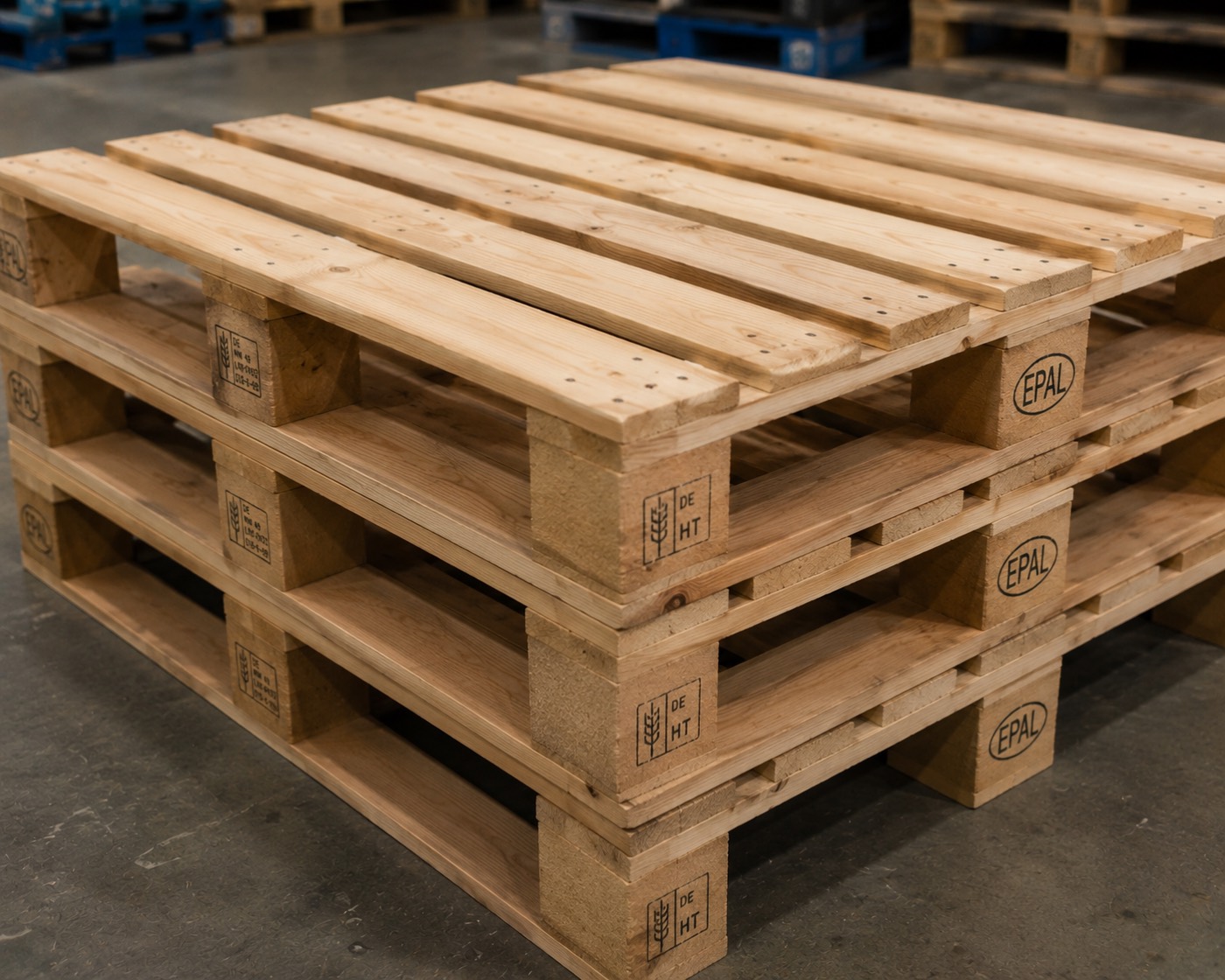
New wood pallets
Sometimes the reclaimed pool cannot give you what the job needs — an unusual footprint, a guaranteed clean deck, a print with tolerances. Then we build it, on our own line, in Columbus.
Request a quote
Tell us what you need
Send this and a real person in the Columbus yard reads it. Most quotes go out the same business day.
In short
New wood pallets are manufactured to order from fresh lumber. We build GMA-spec 48×40s and fully custom footprints in southern yellow pine or mixed hardwood, with configurable deck coverage, stringer or block construction and optional ISPM-15 heat treatment. Lead time on a standard run is five to eight working days; prototypes come off the line in two.
Choose new when you need appearance consistency, a documented clean supply chain, a footprint the reclaimed market does not carry, or a printed spec you can hand to an auditor.
When a new pallet is genuinely the right call
We sell more reclaimed than new and we will tell you when reclaimed is enough. These are the situations where it is not.
- Non-standard footprint. If your load is 52 × 44, the reclaimed pool simply does not contain enough of them. Building is cheaper than hunting.
- Appearance-critical shipments. Retail floor-ready displays and showroom deliveries where the pallet is visible to a customer.
- Audited supply chains. Pharmaceutical, aerospace and some food programs need documented material provenance that a reclaimed core cannot supply.
- Engineered load requirements. When a pallet has to carry a specific rated load in racking with a signed calculation behind it.
- High-volume standing programs. Above a certain annual volume, a purpose-designed pallet that saves an inch of trailer height pays for itself.
If none of those apply, read recycled vs new pallets before you spend the money.
Materials we build from
Southern yellow pine (SYP)
The default for new-build pallets in North America. Strong for its weight, holds a nail well, kiln-dries predictably, and costs less than hardwood. Best when weight matters — air freight, manual handling, high-stack storage.
Mixed hardwood
Oak, maple, poplar, ash and gum, mostly from Ohio and Appalachian mills. Roughly 15–25% heavier than SYP and considerably more resistant to point loading, splitting and repeated handling. Best for heavy loads, drums, machinery and anything that will be handled dozens of times.
Kiln-dried versus green
We build from kiln-dried lumber by default. Green lumber is cheaper on the invoice and expensive everywhere else: it shrinks in service, loosens fasteners, and can grow mold in a shrink-wrapped load. If you have been quoted a surprisingly cheap new pallet, ask about moisture content before you compare prices.
More detail in wood species and materials.
Configuration options
Every one of these is a real choice we make on your build, not a menu of upsells.
- Deck coverage from 5 to 11 top boards, flush or wing
- Stringer or block construction, notched or unnotched
- Two-way, partial four-way or full four-way entry
- Chamfered lead boards for smoother jack entry
- Ring-shank or screw-shank fasteners for high-cycle service
- Stencilled or branded identification, colour-coded corner marks
- ISPM-15 heat treatment and stamping for export
Draw yours to scale on the spec bench and send the numbers with your quote.
Lead times, minimums and pricing logic
Minimum production run is 100 units for a standard footprint and 250 for a fully custom design; below that, prototyping charges start to dominate the unit price. Standard runs ship in five to eight working days. Rush builds are possible and priced honestly rather than punitively.
New pallet pricing is dominated by lumber cost, which moves weekly. We quote firm for fourteen days and we tell you when the market is moving against you, because a customer who orders at the wrong moment does not come back.
For high-volume programs, ask about a blended agreement — new pallets for the appearance-critical lanes, reclaimed for everything else. Most operations discover that only 20–30% of their fleet genuinely needs to be new.
What a new pallet quote actually depends on
New pallet pricing is not a list. It is a calculation, and five inputs dominate it.
- Lumber volume. The single largest factor. Board count, board thickness and stringer section all move it directly. A move from seven to eleven deck boards adds roughly a third to the deck material.
- Species. Hardwood costs more than southern yellow pine and weighs 15–25% more. Both matter — one on the invoice, one on every freight bill afterwards.
- Moisture specification. Kiln-dried costs more than green and performs better. If a competing quote looks unusually cheap, this is the first thing to ask about.
- Run size. Setup is a fixed cost. A 100-unit run carries it across 100 pallets; a 2,000-unit run does not.
- Treatment and marking. ISPM-15, stencils, brands and colour codes are each a real process step.
We quote firm for fourteen days because lumber markets move weekly — the reasoning is in what happens when lumber moves.
Reading a cut list
Every build we do comes with a cut list, and it is yours to keep. It is worth knowing how to read one, because it is the document that makes a pallet reproducible.
A cut list states, for each component: quantity, nominal section, finished length, species, and position. So a GMA top deck reads as two lead boards at 5½″ × 5/8″ × 40″ and five inner boards at 3½″ × 5/8″ × 40″. The stringers read as three at 1⅜″ × 3½″ × 48″, notched, with the notch geometry stated separately.
It also states the fastener schedule — type, length and count per joint — which is the part most cut lists omit and the part that decides service life. See the cheapest part of a pallet.
If you already buy new pallets from someone else and cannot obtain a cut list, that is worth noticing. It means the specification lives in their head rather than in a document, and it will drift.
Prototype, test, then produce
We will push back if you try to skip the prototype, and it is not a sales process — it is the step that prevents an expensive production run of the wrong thing.
- Day 0. You send the load dimensions, weight, handling method, racking or stacking, cycle expectation and any damage history.
- Day 1–2. One prototype built and photographed under your stated load, with the cut list.
- Day 3–5. You test it in your building, on your equipment, with your product. Not once — repeatedly, and including the awkward cases.
- Week 2. Production, priced firm.
Prototypes are quoted at cost and credited against a production order placed within ninety days. Free prototypes get treated as disposable and nobody tests them properly.
Spec sheet
New 48×40 GMA — standard build
| Species | Kiln-dried SYP or mixed hardwood |
| Moisture content | 19% or lower at dispatch |
| Top deck | 7 boards, 5/8" × 3½" nominal, flush or wing |
| Bottom deck | 3 or 5 boards, 5/8" nominal |
| Stringers | 3 × 1⅜" × 3½", four-way notched |
| Fasteners | Helically threaded hardened nails, 2" and 2¼" |
| Static / dynamic capacity | 5,500 lb / 3,000 lb typical |
| Treatment | Untreated, or ISPM-15 HT stamped |
| Minimum order | 100 standard, 250 custom |
| Lead time | 5–8 working days standard |
Reference
Species selection guide
| Species | Rel. weight | Best for | Avoid when |
|---|---|---|---|
| Southern yellow pine | Light | General freight, air freight, manual handling | Heavy point loads, high cycle counts |
| Mixed hardwood | Heavy | Heavy loads, drums, repeat handling, racking | Weight-critical lanes |
| Red / white oak | Heaviest | Machinery, castings, coils, maximum durability | Light product; tannin staining risk |
| Poplar | Medium-light | Clean appearance, low staining risk | Concentrated point loads |
| Maple / beech | Heavy | High-cycle captive fleets | Cost-sensitive one-way lanes |
More detail on each in [wood species and materials](/pallet-sizes/materials).
Reference
Configuration options and what each one costs you
| Option | What it buys | Trade-off |
|---|---|---|
| More deck boards (7 → 11) | Small-item support, point-load spreading | Weight and material cost |
| Hardwood instead of SYP | 15–25% more strength in most modes | 15–25% more weight, higher price |
| Deeper stringers | Substantially better racked capacity | Material cost, deck height |
| Block construction | True four-way entry, no notch to fail | Weight, cost, reclaimed pool unavailable |
| Unnotched two-way stringers | Full beam depth, near block strength | Fork entry from two sides only |
| Chamfered lead boards | Smoother jack and conveyor entry | Small labour cost |
| Ring-shank fasteners | Highest withdrawal resistance | Harder to repair later |
| Wing deck | Sling and strap handling | Exposed deck edges take fork strikes |
| ISPM-15 treatment | International compliance | Cost and lead time; unnecessary domestically |
Avoid these
Mistakes we see
Buying new because the current pallet fails
A failing pallet is usually a specification problem, not an age problem. Notch cracks point at fork entry direction; shed deck boards point at fasteners; racked sag points at stringer depth. Fix the cause and a reclaimed pallet may serve perfectly well.
Comparing quotes without moisture content
Green lumber is cheaper on the invoice and expensive everywhere else — it shrinks in service, loosens fasteners and grows mold in a wrapped load. Two new-pallet quotes are not comparable until you know the moisture specification of both.
Ordering treated stock for domestic lanes
ISPM-15 is only required for international shipment. Treated stock inside the United States is pure cost with no benefit, and it is one of the easiest savings we find in an audit.
Skipping the prototype to save a week
A production run of the wrong pallet costs far more than the week. Every design we build gets one revision on average, and finding that revision on a prototype is the whole point.
Specifying new for the entire fleet
Most operations that examine their lanes honestly find only 20–30% genuinely need new material. The rest is habit. See recycled vs new pallets.
Checklist
Work through this before you order
Information we need to quote
- Outside dimensions of a built load
- Total load weight and whether it is point-loaded
- Racked, floor stacked or block stacked
- Handling method — forklift, jack, clamp, automated
- Expected number of trips per pallet
- Domestic or international destination
- Any known damage history with the current pallet
Specify these explicitly
- Species and moisture content
- Deck board count, top and bottom
- Stringer section and notch geometry
- Entry type — two-way, partial or full four-way
- Fastener type and penetration
- Marking: stencil, brand, colour code, serial
- Treatment: none, or ISPM-15 stamped
Questions
Before you ask us
Can you match a pallet we already use?
Yes. Send one sample pallet or a dimensioned drawing and we will reverse-engineer the build, confirm the cut list back to you, and run a prototype for approval before production.
Do new pallets come heat treated?
Not automatically. ISPM-15 heat treatment is an option we apply when the pallet is leaving the country. Domestic pallets do not need it and paying for it adds cost with no benefit.
What is the difference between stringer and block pallets?
Stringer pallets use three lengthwise boards as the load-bearing spine and offer two-way or notched four-way entry. Block pallets use nine blocks with perimeter runners, allow true four-way entry from any side, and carry higher loads at the cost of extra weight and material.
Is a new pallet stronger than a Grade A recycled one?
Not necessarily. A new SYP pallet is often lighter and less dense than a reclaimed hardwood Grade A. New wins on consistency, appearance and documentation; reclaimed hardwood frequently wins on raw strength per dollar.
Can we get a sample before ordering a full run?
Yes, and we insist on it for custom designs. A prototype is built within 48 hours of confirmed dimensions, quoted at cost, and credited against a production order placed within ninety days.
How long do new pallets last?
Entirely dependent on duty and handling. A new pallet in a closed internal loop with good storage commonly runs for many dozens of cycles. The same pallet handled roughly, entered from the notched side every time and stored outdoors will not. Specification and handling matter far more than newness.
Do you build to a customer's existing drawing?
Yes. Send a dimensioned drawing or one physical sample. A sample removes all guesswork about board thickness and notch geometry, which a photograph cannot, and usually pays for itself in avoided revisions.
Can new pallets be built from reclaimed lumber?
Yes, and for industrial applications it is frequently the better buy. Recovered boards and stringers are dry, dimensionally settled and often hardwood. Where an audit trail requires virgin material we build all-new and document it.
What happens to the cut list after the order?
We keep it so repeat orders are identical, and you keep a copy. If you take it to another supplier later that is your right — we would rather earn the repeat order on price and delivery than by holding a drawing hostage.
Keep going
Related pages