Sizes · international
Euro & import pallet sizes
If you import, you will eventually receive a pallet that fits nothing you own. Here is what it is, why it is that size, and what to do with it.
Request a quote
Tell us what you need
Send this and a real person in the Columbus yard reads it. Most quotes go out the same business day.
In short
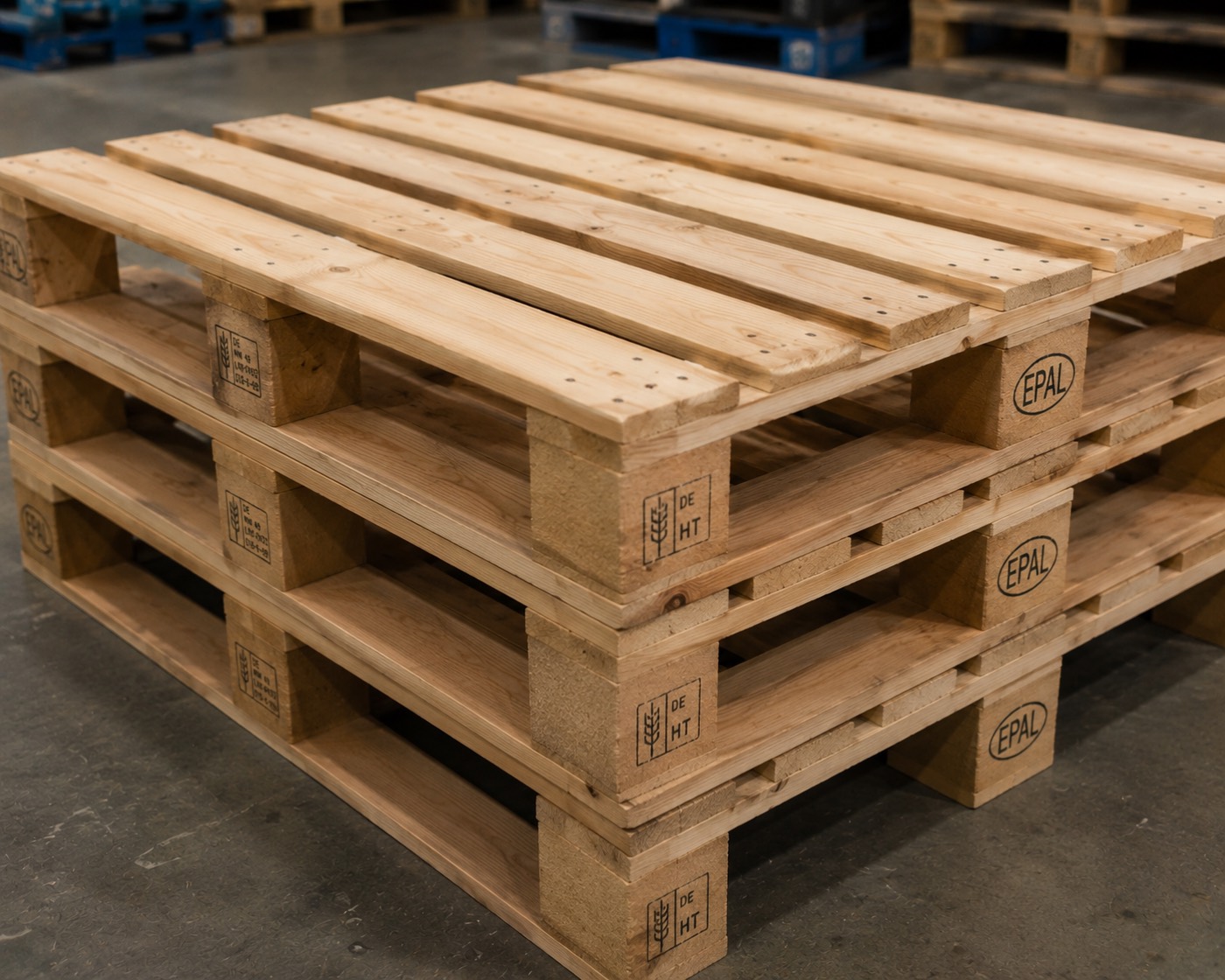
The Euro pallet (EUR-1 / EPAL) is 1200 × 800 mm (47.24″ × 31.5″), a block pallet with true four-way entry, identified by branded corner blocks carrying the EPAL or EUR mark. It exists because European trucks and shelving are sized differently from North American ones.
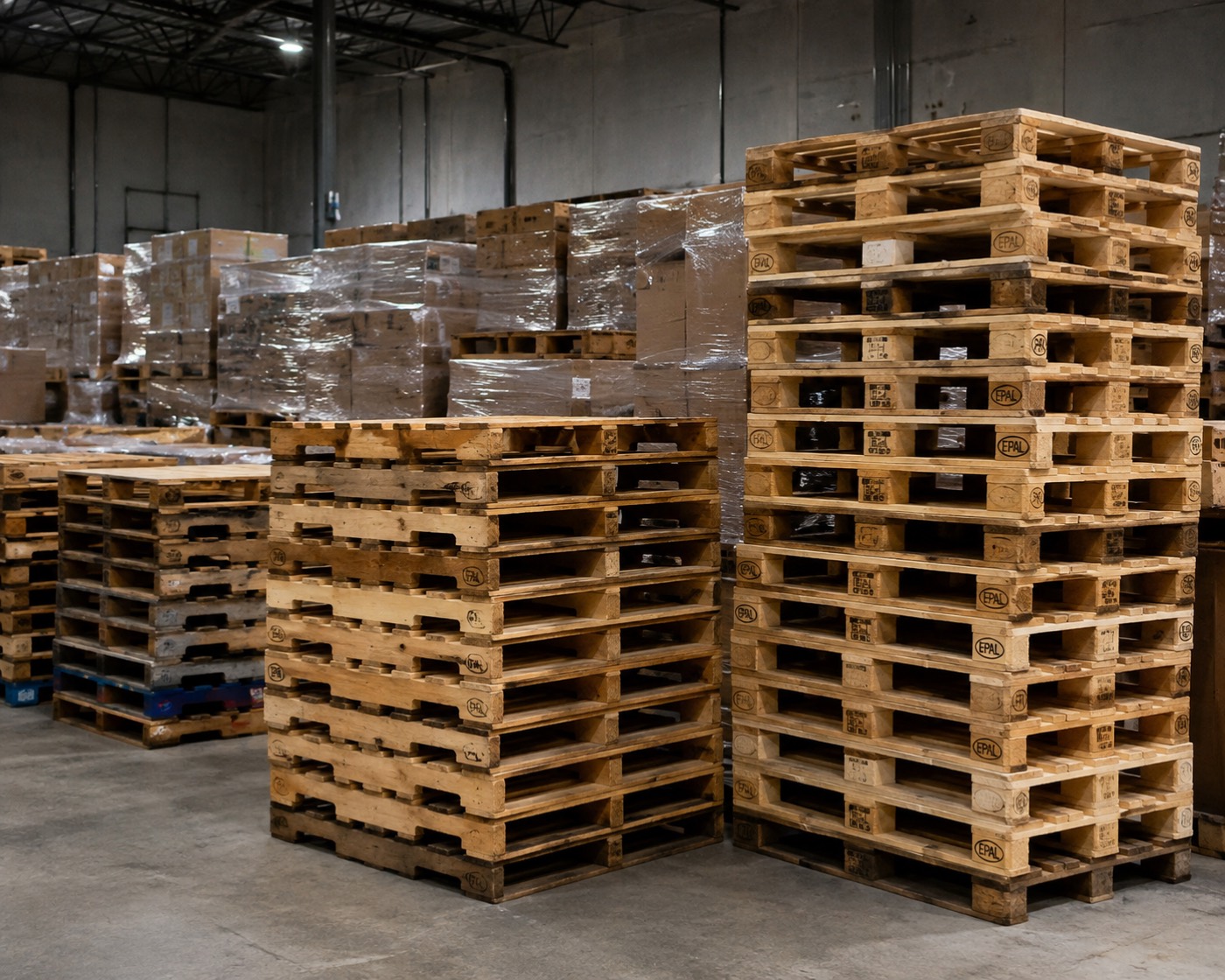
In Ohio, Euro pallets arrive on imports and then create a problem: they do not fit US racking well and load inefficiently in a 53-foot trailer. We buy them, and we can recycle them.
Why the Euro pallet is 1200 × 800
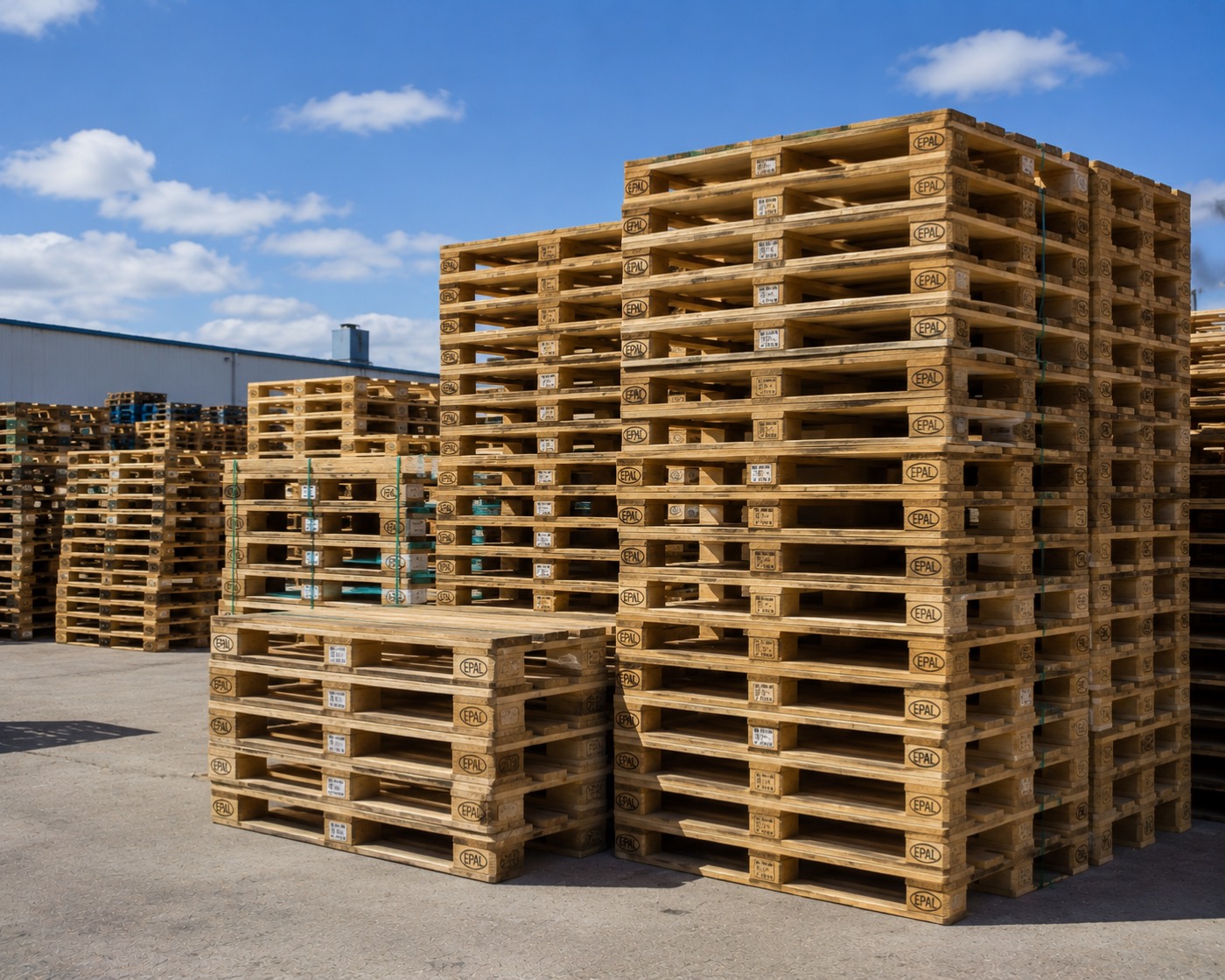
European semi-trailers are internally about 2400 mm wide. Two 1200 mm pallet lengths side by side is 2400 mm — an exact fit. Turn them and three 800 mm widths also make 2400 mm. The footprint was designed so that both orientations fill the trailer completely, which is a more elegant solution than the North American approach and a large part of why it dominates European logistics.
It also matches European shelving modules and the 600 × 400 mm crate module that sits on top of it, four to a layer.
The problem is that none of those dimensions relate to a 98-inch-wide US trailer. Two Euro pallets across is 94.5 inches — fine. But the 31.5-inch width wastes space against US racking designed for 40-inch deck boards, and the mismatch compounds across a warehouse.
EPAL marking and what it guarantees
A genuine EPAL pallet carries specific marks on its corner blocks: the EPAL oval on one side, the country and licence code on another, and an ISPM-15 stamp. The specification is tightly controlled — board thicknesses, nail counts and nail patterns are all defined — which is why EPAL pallets are exchangeable across the European pool at face value.
That exchangeability is the point. A genuine EPAL pallet functions almost as currency within Europe. Counterfeits exist, and they are usually detectable by nail pattern and block quality rather than by the marks themselves.
None of this exchange infrastructure operates in Ohio. An EPAL pallet arriving here is simply a well-built 1200 × 800 pallet with no pool to return to.
CP pallets — the chemical industry family
CP1 through CP9 are a European chemical industry series, each sized to a particular kind of chemical packaging: drums, IBCs, sacks, boxes. CP1 (1200 × 1000) and CP3 (1140 × 1140) are the most common arrivals in North America.
CP pallets are generally single-use or limited-return by design and are built lighter than EPAL stock. If you receive them regularly, they are a good candidate for recycling rather than storage.
What to do with imported pallets in Ohio
You have four options and only one of them is bad.
- Reuse them internally where the footprint suits — 1200 × 1000 is close enough to a GMA to work in many floor-stacked applications.
- Sell them to us. Euro and ISO pallets have genuine resale value, particularly to exporters who need them going the other way. See sell us your pallets.
- Recycle them. Block pallets dismantle into excellent recoverable lumber, and the blocks themselves are reusable.
- Stack them behind the building forever. This is the bad one, and it is the most common.
If you export to Europe, buying reclaimed Euro pallets from us is usually far cheaper than buying new EPAL stock — and it puts imported pallets back into productive circulation instead of into a pile.
Identifying a genuine EPAL pallet
Genuine EPAL pallets are exchangeable at face value within Europe, which makes them worth identifying correctly — and worth money if you are holding some in Ohio.
Corner block marks. A genuine EPAL carries the EPAL oval on one corner block and the country and licence code on another. The marks are branded into the block, not printed.
Nail pattern. The specification defines nail count and pattern precisely. Counterfeits usually get this wrong before they get the marks wrong — it is the more reliable check.
Block quality. EPAL blocks are dense and consistent. Soft, crumbly or visibly composite blocks on an otherwise convincing pallet are a warning.
ISPM-15 mark. Genuine EPAL stock is heat treated and stamped as part of the specification.
Overall build quality. They are heavy, square and tight. A loose, light 1200 × 800 pallet is probably not EPAL even if it carries marks.
What to do with imported pallets you cannot use
This is the practical question for most Ohio operations receiving European or Asian freight, and the default answer — stack them behind the building — is the worst one.
- Reuse internally where the footprint suits. 1200 × 1000 is close enough to a GMA to work in many floor-stacked applications, though not in racking sized for 40-inch depth.
- Sell them to us. Euro and ISO pallets have genuine resale value, particularly to exporters shipping back toward Europe who would otherwise buy new EPAL stock at a premium.
- Recycle them. Block pallets dismantle into unusually good recoverable lumber, and the blocks themselves are reusable.
- Use them for export. If you ship to Europe, reclaimed Euro pallets are far cheaper than new EPAL and are already the right footprint at the far end.
Send a count and photographs and we will tell you which of those applies. See sell us your pallets.
Reference
International pallet standards
| Standard | Size (mm) | Size (in) | Region / use |
|---|---|---|---|
| EUR / EUR-1 (EPAL) | 1200 × 800 | 47.24 × 31.50 | European general standard |
| EUR-2 | 1200 × 1000 | 47.24 × 39.37 | European industrial, chemical |
| EUR-3 | 1000 × 1200 | 39.37 × 47.24 | European, rotated EUR-2 |
| EUR-6 | 800 × 600 | 31.50 × 23.62 | European half-pallet, retail |
| ISO 1 | 1200 × 1000 | 47.24 × 39.37 | International shipping |
| ISO 2 / GMA | 1219 × 1016 | 48.00 × 40.00 | North America |
| Asia standard | 1100 × 1100 | 43.31 × 43.31 | Japan, Korea, much of Asia |
| Australian standard | 1165 × 1165 | 45.87 × 45.87 | Australia, NZ |
| CP1 | 1200 × 1000 | 47.24 × 39.37 | Chemical industry |
| CP3 | 1140 × 1140 | 44.88 × 44.88 | Chemical industry |
Reference
Regional standards and where you meet them
| Standard | Size | Where it arrives from | US racking fit |
|---|---|---|---|
| EUR-1 / EPAL | 1200 × 800 mm | General European freight | Poor — 31.5″ deep |
| EUR-2 | 1200 × 1000 mm | European industrial, chemical | Fair — 39.4″ deep |
| EUR-6 | 800 × 600 mm | European retail half-pallet | Poor |
| ISO 1 | 1200 × 1000 mm | International shipping | Fair |
| Asia standard | 1100 × 1100 mm | Japan, Korea, much of Asia | Fair — square |
| Australian | 1165 × 1165 mm | Australia, NZ | Fair — square |
| CP1 | 1200 × 1000 mm | Chemical industry | Fair |
| CP3 | 1140 × 1140 mm | Chemical industry | Fair — square |
US selective racking is generally configured for 40-inch deck depth, which is why the 800 mm family fits worst.
Avoid these
Mistakes we see
Racking Euro pallets in US racking
A 31.5-inch deep pallet in a bay configured for 40 inches leaves a gap that is both a fall hazard and wasted space. It can be done with rack decking, but it is not a good long-term arrangement.
Assuming 1200 mm is 48 inches
It is 47.24 inches. That three-quarter-inch difference is precisely why the footprints are not interchangeable, and rounding it away in a spreadsheet is how the wrong stock gets ordered.
Stockpiling imported pallets indefinitely
They have resale value now and less of it every month they sit outdoors. Euro and ISO stock is worth money, particularly to exporters shipping the other way.
Buying new EPAL for export from the US
Reclaimed Euro pallets are far cheaper and are the right footprint at the destination. Ask what is available before ordering new.
Treating CP pallets as returnable
The CP series is largely designed for single or limited-return use and built lighter than EPAL. They are better candidates for recycling than for a return programme.
Checklist
Work through this before you order
If you receive imported pallets
- Identify the standard — EPAL, ISO, CP or Asian
- Check for genuine EPAL marks and nail pattern
- Separate them from your domestic stock
- Keep them dry — they lose value outdoors like any pallet
- Count them and photograph a representative stack
- Ask us what they are worth before assuming they are waste
Questions
Before you ask us
What size is a Euro pallet in inches?
The standard EUR-1 Euro pallet is 1200 by 800 millimetres, which converts to 47.24 by 31.5 inches. It is both shorter and considerably narrower than a North American 48 by 40 GMA pallet.
Can Euro pallets be used in US racking?
Poorly. US selective racking is generally configured for 40-inch deck depth, and a 31.5-inch Euro pallet leaves a gap that creates a fall hazard and wastes bay space. It can be done with rack decking, but it is not a good long-term arrangement.
Do Euro pallets need ISPM-15 treatment?
Yes, if they are crossing an international border into a country that enforces the standard. Genuine EPAL pallets are heat treated and stamped as part of the specification.
Do you buy imported Euro pallets in Ohio?
Yes. Euro, ISO and CP pallets all have resale value, particularly to exporters shipping back toward Europe. Send us a count and photographs through the quote form.
Are Euro pallets stronger than GMA pallets?
They are built to a tighter, mandated specification with block construction and defined nail patterns, so they are more consistent and generally more durable. A well-graded hardwood GMA pallet is not necessarily weaker, but it is more variable.
Can I return Euro pallets to Europe?
Not through the EPAL exchange system, which operates within Europe. The practical route is selling them to a yard here that supplies exporters shipping in that direction.
Do Asian 1100x1100 pallets fit US racking?
Better than Euro pallets, because 43.3 inches is closer to the 40-inch depth US racking is configured for, though it overhangs rather than leaving a gap. Check your beam and upright clearances.
Are CP pallets worth keeping?
They have resale value but are built lighter than EPAL and are generally single or limited-return by design. For most Ohio recipients they are better candidates for recycling than for reuse.
Keep going
Related pages