Services · freight
Freight & logistics
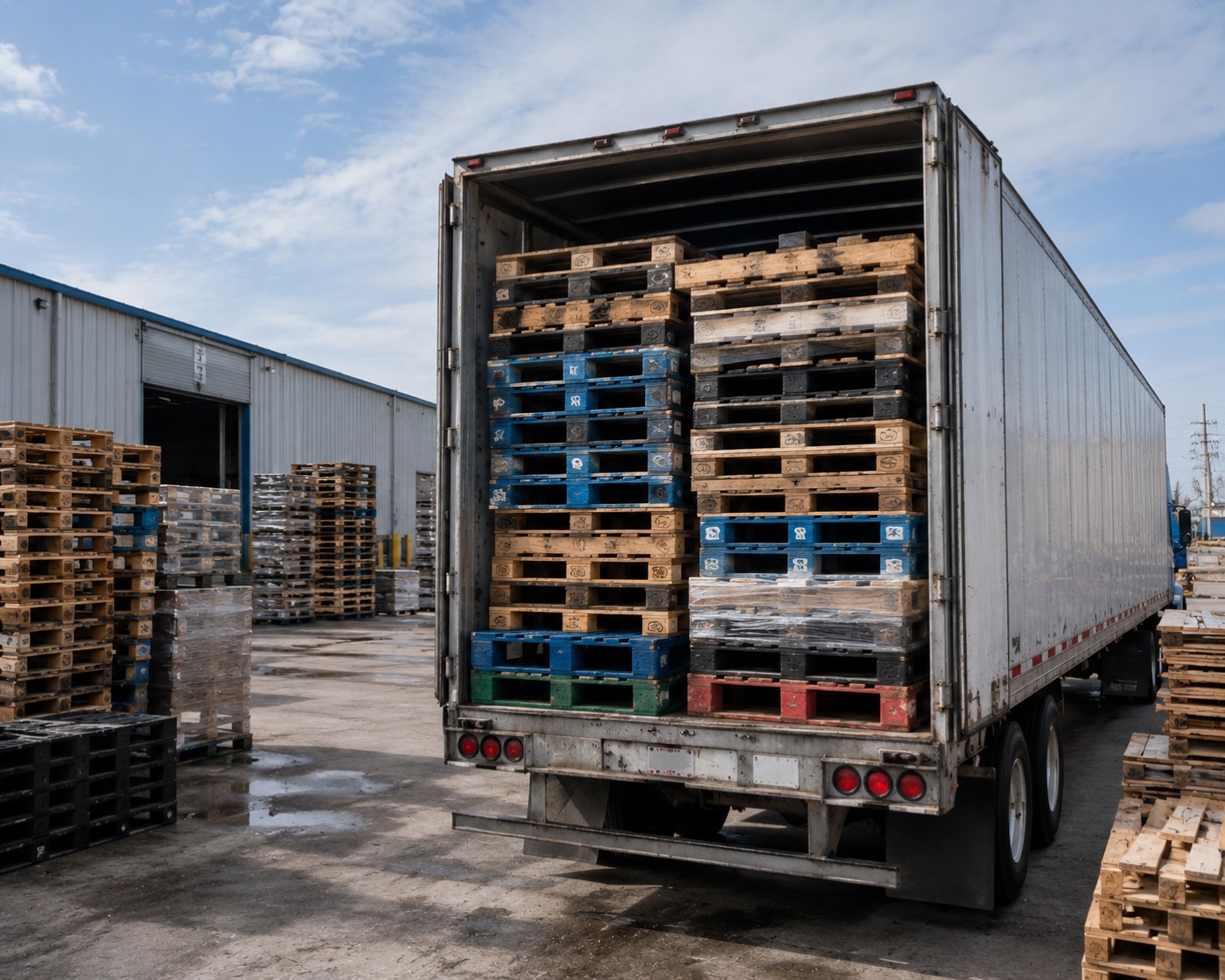
Owning the trucks changes the conversation. We can commit to a window, take cores back on the return leg, and tell you the truth about whether a lane works.
Request a quote
Tell us what you need
Send this and a real person in the Columbus yard reads it. Most quotes go out the same business day.
In short
RePallets Ohio runs its own freight — flatbeds and dry vans out of the Columbus yard. Central Ohio is covered daily; Cleveland, Cincinnati, Dayton, Toledo and Akron run on scheduled lanes. Beyond Ohio we arrange contract freight for truckload quantities.
The important capability is the two-way lane: good stock delivered outbound, your cores collected on the return. One truck, two transactions, materially lower cost on both.
Why the return leg is where the money is
A truck that arrives full and leaves empty has wasted half its journey, and somebody pays for that half whether it appears on an invoice or not.
When we deliver pallets to your dock and collect your cores on the same visit, three costs collapse into one: the outbound freight, the separate collection trip, and the disposal you were paying for. Customers who move to a two-way lane typically see the largest single improvement in their pallet economics — larger than any unit price negotiation.
It requires only that your generation and consumption happen at the same site, or at two sites on the same route. Tell us your geography on the quote form and we will tell you whether it works.
Equipment and load planning
- Dry vans for weather-sensitive and treated stock, and for anything going straight into a food or pharmaceutical facility
- Flatbeds for banded stacks, bulk cores and crates, faster to load and unload with a forklift
- Curtainsides where side access matters
A 53-foot van holds roughly 480–560 48×40 pallets depending on stack height and grade. Odd footprints load worse than people expect: a 42×42 pallet gives you thirty per floor layer against twenty-six for a 48×40, but the load may not fill the height. Our spec bench computes the floor count for any footprint you enter.
We plan loads for weight and cube together. A trailer full of oak Grade A pallets can weigh out before it cubes out, and discovering that at a scale house is expensive.
Scheduling, windows and what we commit to
Standing weekly and biweekly routes get a fixed day and window. Ad-hoc deliveries in Central Ohio typically go out next business day for in-stock items.
We commit to a window and we call before it closes if we are going to miss it. That sounds like a small thing. Anyone who has waited on a delivery that never arrived and never called knows it is not.
Sites with dock restrictions, appointment systems, height limits or narrow turns should tell us at quotation. A truck that cannot turn into your yard is a wasted day for both of us.
Outside Ohio
Our equipment covers Ohio. For adjacent states — Indiana, Kentucky, Pennsylvania, West Virginia, Michigan — we arrange contract freight on truckload quantities, priced through rather than marked up opaquely.
For anything further, we will usually tell you that a local yard serves you better. Long-haul freight on a low-value-density product like pallets rarely makes sense, and pretending otherwise would be selling you something that does not work.
Load planning: weight versus cube
A trailer fills up in one of two ways, and planning for the wrong one is how loads get turned away at a scale house.
Cubing out — the trailer is physically full before it reaches its weight limit. Typical for light product and for empty pallet stacks of softwood.
Weighing out — the trailer hits its legal weight before it is full. Typical for hardwood pallets, dense freight and anything wet.
A trailer of oak Grade A pallets can weigh out with visible space remaining. A trailer of southern yellow pine of the same count may not. This is why we plan for both and why the honest answer to 'how many fit' is a range rather than a number.
It is also why wet pallets are a freight problem as well as a quality problem — absorbed water is weight you pay to move.
Delivery windows and what we commit to
Standing weekly and fortnightly routes get a fixed day and a window. Ad-hoc deliveries of in-stock items in Central Ohio typically go next business day.
We commit to a window, and if we are going to miss it we call before it closes rather than after. That sounds like a small thing. Anyone who has held a dock open for a delivery that never arrived and never called knows it is not.
What helps us hit windows:
- Telling us about appointment systems, gate codes and height restrictions at quotation
- A realistic window rather than an optimistic one
- A nominated person for the count
- Somewhere the trailer can actually turn
Sites with genuinely difficult access are not a problem as long as we know in advance. They become a problem when the driver discovers them.
Reference
Trailer floor counts by footprint
| Footprint | Straight | Turned / pinwheeled | Best |
|---|---|---|---|
| 48" × 40" | 26 | 30 | 30 |
| 42" × 42" | 30 | 30 | 30 |
| 48" × 48" | 26 | 26 | 26 |
| 40" × 48" | 30 | 26 | 30 |
| 48" × 42" | 26 | 30 | 30 |
| 36" × 36" | 34 | 34 | 34 |
| 44" × 44" | 28 | 28 | 28 |
| 48" × 45" | 26 | 28 | 28 |
| 1200 × 800 mm | 39 | 40 | 40 |
| 1200 × 1000 mm | 26 | 32 | 32 |
Assumes a 630″ × 98″ usable dry-van interior. Multiply by achievable stack height for total capacity. Run any footprint through the [spec bench](/pallet-sizes#bench).
Avoid these
Mistakes we see
Not asking for a two-way lane
If you both consume and generate pallets on the same route, one truck should do both. It removes the delivery freight, the separate collection trip and the disposal cost at once.
Discovering dock constraints at delivery
Height limits, appointment systems, gate codes and turning radius all belong in the quotation conversation. A truck that cannot get in is a wasted day for both parties.
Planning for cube and ignoring weight
A full load of hardwood pallets can weigh out before it cubes out. Finding that at a scale house is expensive.
Ordering partial loads long distance
Freight is largely fixed per trip. A partial load to Toledo carries almost the same freight as a full one, spread across a third of the units.
Assuming we can reach anywhere
Our own equipment covers Ohio. Beyond adjacent states, long-haul freight on a low-value-density product rarely makes sense and we will say so rather than sell it.
Checklist
Work through this before you order
Tell us about your site
- Largest vehicle that can enter and turn
- Dock height, leveller, or ground-level loading
- Forklift availability and operator hours
- Appointment system, gate codes, security process
- Delivery windows that genuinely work
- Nominated person for the count
- Whether you also generate pallets for collection
Questions
Before you ask us
Do you charge separately for delivery?
Delivery is quoted into the pallet price for standard Central Ohio drops. For long-distance or partial loads we show freight as a separate line so you can see exactly what it costs.
Can you collect and deliver on the same visit?
Yes, and you should ask for it. Two-way lanes remove the separate collection trip and the disposal cost at the same time, and they typically save more than any unit-price negotiation.
How many pallets fit in a 53-foot trailer?
Roughly 480 to 560 standard 48x40 pallets depending on stack height and grade. Twenty-six fit per floor layer; the rest is stacking height, limited by trailer interior height and stack stability.
Do you deliver outside Ohio?
We arrange contract freight for truckload quantities into adjacent states. Beyond that we will usually recommend a local supplier, because long-haul freight on pallets rarely makes economic sense.
How many pallets fit on a 53-foot trailer?
Twenty-six 48x40 pallets straight-loaded per floor layer, or thirty pinwheeled. Total capacity is that multiplied by achievable stack height, typically giving 480 to 560 pallets for a full load.
Do you deliver to sites without a dock?
It needs planning. Ground-level delivery requires either a forklift on site or a truck equipped to unload, and stack heights may need reducing. Tell us at quotation rather than at delivery.
Can you hold stock and release it weekly?
Yes. A scheduled release programme captures most of the volume benefit of a full load without requiring you to store one, which suits sites that are space-constrained rather than volume-constrained.
Do you run outside Ohio?
We arrange contract freight for truckload quantities into Indiana, Kentucky, Pennsylvania, West Virginia and Michigan, priced through rather than marked up opaquely. Beyond that a local yard usually serves you better.
Keep going
Related pages