Services · compliance
Heat treating & ISPM-15
Compliance that happens in our yard rather than at a third party three counties away. Treated, stamped, documented, loaded.
Request a quote
Tell us what you need
Send this and a real person in the Columbus yard reads it. Most quotes go out the same business day.
In short
ISPM-15 heat treating raises the core temperature of every board to 56°C and holds it there for at least 30 continuous minutes, after which the pallet receives a registered IPPC mark. That mark is what lets solid wood packaging cross an international border without fumigation, quarantine or destruction.
We treat and stamp on site in Columbus. Bring your own pallets, crates and dunnage, or buy pre-treated stock outright.
Two ways to get compliant stock
Buy it treated
Simplest route. Order ISPM-15 pallets from us — new or qualifying reclaimed — and they arrive treated, stamped and ready to load. No scheduling on your side.
Send us yours
If you already own the pallets, crates or dunnage, send them to the yard. We inspect for eligibility (debarked, sound, dry enough to heat evenly, no visible contamination), run the charge, stamp and return.
Treatment is a batch process, so build it into your schedule rather than onto the end of it. Same-day requests cost more and put the sailing at risk.
What we treat
- Pallets — new, reclaimed and customer-owned
- Dunnage, blocking and bracing timber
- Collars and wooden accessories
- Cable drums and reels
The overlooked item on that list is blocking and bracing. A perfectly compliant pallet under a load braced with untreated 2×4 will still be rejected at the border. Order treated blocking with the pallets.
Records, marks and audits
Every charge is logged: date, quantity, temperature trace and hold duration. Records are retained and available on request, which matters when a customer, a freight forwarder or a customs authority asks you to substantiate compliance.
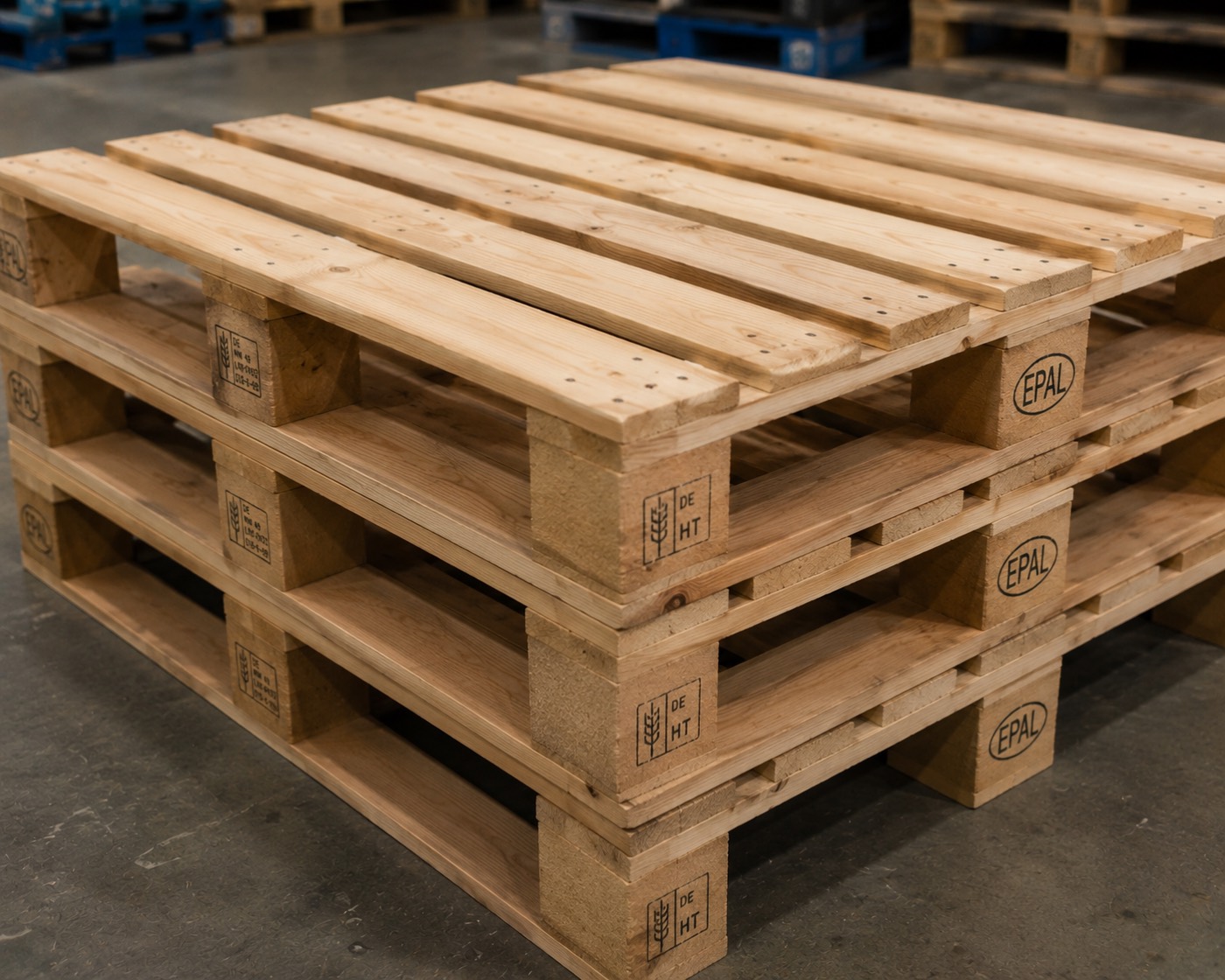
The mark carries the IPPC symbol, the US country code, our registered facility number and the treatment code HT. It goes on two opposite stringers, positioned to stay visible when the pallet is loaded, and it goes on after treatment. Pre-stamping is how counterfeit marks enter circulation and we do not do it.
Full background on the standard, the exemptions and the failure modes: ISPM-15 explained.
Do not pay for treatment you do not need
Treated pallets on domestic lanes are pure cost with no benefit. Shipments inside the United States need no ISPM-15 mark, US–Canada trade is largely exempt, and engineered wood — plywood, OSB, particleboard — is outside the standard entirely.
If you are buying HT stock for domestic distribution, stop. Move those lanes to reclaimed untreated pallets and put the saving somewhere useful.
Sending us your own stock for treatment
If you already own the pallets, crates or dunnage, treatment is straightforward — but eligibility is assessed on arrival and it is worth knowing what we check.
Debarked. Residual bark beyond defined limits fails, and bark is where many target pests live.
Structurally sound. Treatment does not repair anything. A pallet that will fail in service should not carry a compliance mark.
Dry enough to heat evenly. Very wet material takes far longer to reach core temperature and can prevent a charge holding properly.
Free of visible contamination. Chemical staining, paint or unidentified residue is declined.
No existing invalid mark. If a pallet carries a mark and has been repaired with untreated wood, the old mark comes off before re-treatment.
We inspect on arrival and tell you what is ineligible before treating rather than treating it and invoicing you for it.
Records, audits and what to keep on your side
Each charge is logged with date, quantity, temperature trace and hold duration. Those records are retained and available on request.
What is worth keeping on your side:
- The delivery paperwork linking a treated batch to a shipment
- A note of which pallets went on which container, if a customer may ask
- Your segregation arrangement — a photograph of the treated bay is surprisingly useful in an audit
- The treatment records we supply, filed with the shipping documents rather than separately
Most compliance questions arrive months later from a customer's quality team rather than from customs. Records filed with the shipment answer them in minutes.
Reference
Treatment route by situation
| Situation | Best route | Lead time |
|---|---|---|
| Regular export lane, standard footprint | Buy pre-treated stock | Normal delivery lead time |
| Occasional export from existing stock | Send your pallets for treatment | 1–3 working days |
| Export crate or machinery skid | Built and treated together | 3–10 working days |
| Blocking and bracing timber | Ordered treated with the pallets | With the pallet order |
| Repaired pallet with an old mark | Re-treat and re-mark | 1–3 working days |
| Domestic shipment | No treatment required | — |
Avoid these
Mistakes we see
Requesting treatment on the loading day
Treatment is batched and the full cycle runs several hours. Same-day requests either carry a premium or miss the sailing.
Treating the pallets but not the bracing
Customs assesses the consignment as a whole. This is the single most common cause of a hold and the easiest to prevent — order treated blocking with the pallets.
Storing treated and untreated stock together
Two similar-looking stacks a few feet apart will eventually be confused. Segregate physically and band treated stock in a distinguishing colour.
Pre-stamping before treatment
A pre-stamped pallet that fails a charge is a compliance failure waiting to be discovered at a port. Marks go on after the charge, never before.
Treating stock for domestic lanes
No ISPM-15 mark is required inside the United States. It is pure cost with no benefit and one of the easiest savings in a packaging audit.
Checklist
Work through this before you order
Sending stock for treatment
- Debarked and structurally sound
- Dry enough to heat evenly
- No paint, chemical staining or unidentified residue
- Any invalid existing marks flagged
- Quantity and footprint confirmed
- Return date needed, working backwards from the sailing
- Whether you need the charge records
Questions
Before you ask us
How long does heat treatment take?
The hold itself is 30 minutes at 56C core, but the full charge including heat-up and cool-down runs several hours and treatment is batched. Plan on one to three working days from arrival depending on schedule.
Can you treat pallets we already own?
Yes. They must be debarked, structurally sound, free of visible contamination and dry enough to heat evenly. We inspect on arrival and tell you if anything is ineligible before treating.
Does the ISPM-15 mark expire?
No. A treated pallet stays compliant indefinitely unless it is repaired with untreated wood, at which point it must be re-treated and re-marked.
Is kiln-dried the same as heat treated?
No, and confusing the two causes real shipment holds. Kiln drying removes moisture for stability. Heat treatment is a phytosanitary process defined by core temperature and hold time. Only the HT mark satisfies customs.
Can you treat crates and dunnage as well as pallets?
Yes — pallets, crates, boxes, skids, dunnage, blocking, collars, cable drums and reels. Anything solid wood packaging that is debarked, sound and uncontaminated.
How far ahead should we schedule treatment?
One to three working days is comfortable. Treatment is a batch process and charges are scheduled rather than run on demand, so building it into the plan avoids both premiums and missed sailings.
Do you treat material you did not supply?
Yes. Bring or send your existing stock. We inspect for eligibility on arrival and tell you what cannot be treated before we treat anything.
What if a customer disputes our compliance?
Ask us for the charge records for that batch — date, quantity, temperature trace and hold duration. That is what a compliance question is actually answered with.
Keep going
Related pages