Sizes · materials
Wood species & pallet materials
Species is the variable that most buyers ignore and that most often explains why one pallet outlasts another by a factor of three.
Request a quote
Tell us what you need
Send this and a real person in the Columbus yard reads it. Most quotes go out the same business day.
In short
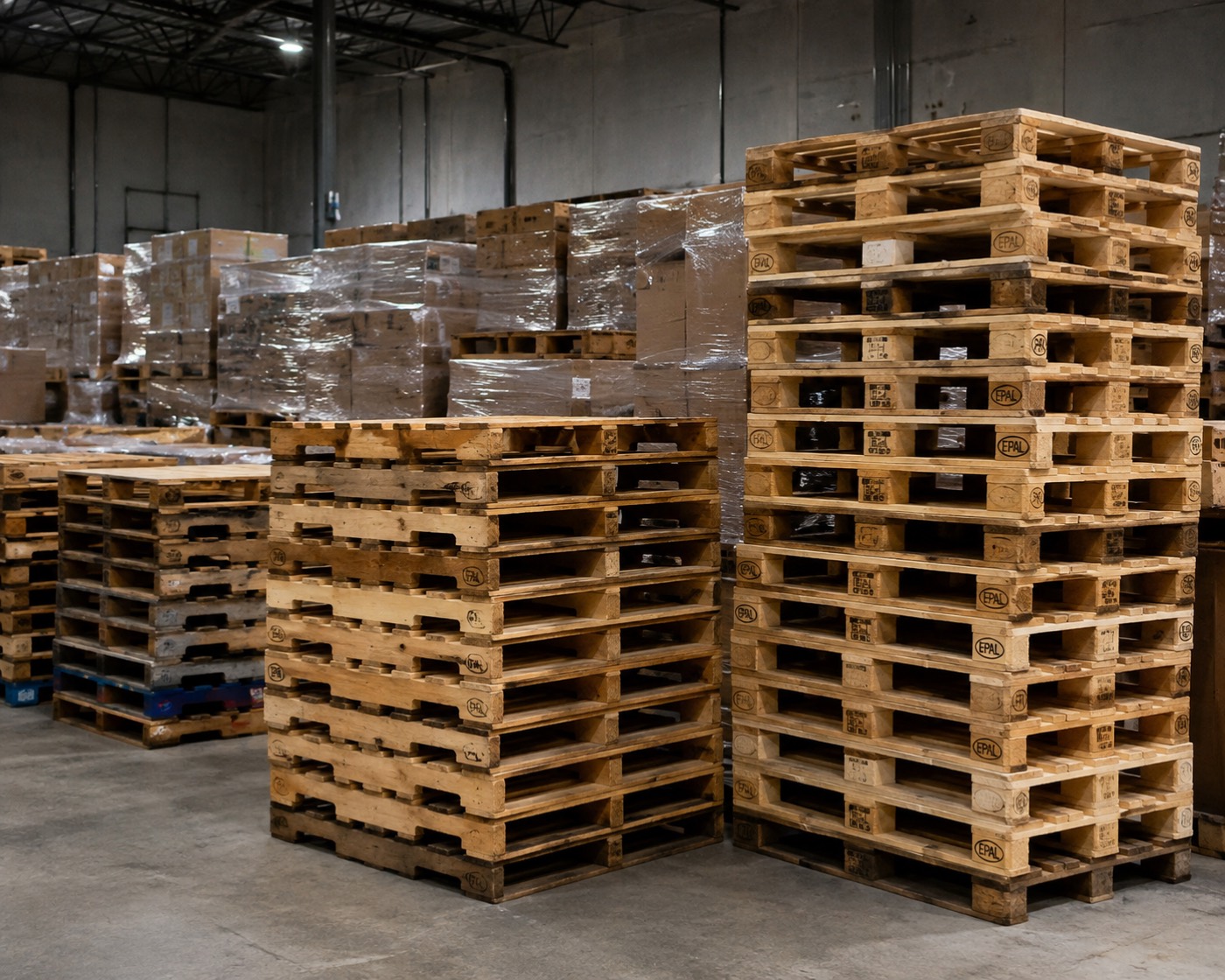
Pallet wood in North America divides into hardwood (oak, maple, poplar, gum, ash — heavier, denser, better under point loads and repeat handling) and softwood (mostly southern yellow pine — lighter, cheaper, easier to nail, dries predictably). Most reclaimed stock in Ohio is mixed hardwood; most new production is southern yellow pine.
Non-wood alternatives — plastic, presswood and metal — occupy narrow but real niches. The rest of this page is which to choose and why.
Hardwood versus softwood, practically
The distinction is botanical, not a strength rating — balsa is technically a hardwood. But for pallets the generalisation holds well enough to plan around.
Hardwood (oak, maple, poplar, gum) is denser. It resists point loading and edge crushing, holds fasteners under vibration, and survives many more handling cycles. It is 15–25% heavier and costs more new. Most of the reclaimed pool in Ohio and Appalachia is hardwood, which is the quiet reason reclaimed stock frequently outperforms expectations.
Softwood (southern yellow pine, spruce, fir) is lighter and cheaper, kiln-dries predictably, and takes a nail without splitting. It is the default for new North American production. For loads under about 2,000 lb handled a handful of times, it is entirely sufficient and the weight saving is real money in freight.
Rule of thumb: if the pallet will be handled more than about fifteen times, or carries concentrated load, specify hardwood. Otherwise pine is fine.
Moisture content — the variable nobody asks about
This matters more than species for most failures we see.
Green lumber, freshly milled, sits at 25–40% moisture. As it dries in service it shrinks across the grain, cups, and loosens around every fastener. A pallet built green and shipped immediately will be measurably looser in three months.
Kiln-dried (KD) lumber is dried to roughly 19% or below before construction. It is dimensionally stable, resists mold in shrink-wrapped loads, and holds fasteners. It costs more.
If you are comparing two new-pallet quotes and one is surprisingly cheap, ask about moisture content before you conclude anything about value. And note that KD is not the same as ISPM-15 heat treatment — different process, different purpose, different mark.
Reclaimed pallets sidestep this entirely: they have already done their drying, in service, on somebody else's time. That is a genuine engineering advantage, not a consolation.
Mold, staining and the blue-stain misunderstanding
Blue stain in pine is a fungal discolouration that penetrates the sapwood. It looks alarming and is structurally irrelevant — it does not weaken the wood. It is cosmetic, and pallets showing it are frequently sold at a discount that has nothing to do with performance.
Mold is different: surface growth caused by moisture, and a genuine problem in food and pharmaceutical environments. It is prevented by dry storage and by using dry lumber, not by treatment after the fact.
Tannin staining occurs when oak gets wet against light-coloured product and leaches dark marks into it. If you ship white cartons or bagged product, ask for poplar or pine decks rather than oak.
We reject visibly moldy or wet stock at intake rather than passing the problem downstream.
Fasteners, and why they matter more than you would think
A pallet fails at its joints far more often than in its boards.
- Smooth shank nails — cheapest, lowest withdrawal resistance, adequate for one-way
- Helically threaded — the industry standard for pallets, good withdrawal resistance, tolerant of wood movement
- Ring shank — highest withdrawal resistance, best for high-cycle and hardwood
- Staples — fast and cheap, and the reason many cheap pallets come apart. We do not use them structurally
Penetration matters as much as type: a nail must pass well into the stringer, not just bite the surface. On repairs we pull protruding fasteners rather than hammering them flush, because a hammered nail works back out under vibration and destroys a stretch wrap in transit.
Engineered and non-wood alternatives
Presswood / moulded pallets are wood fibre and resin pressed into a nesting shape. Very light, very cheap in volume, exempt from ISPM-15 because manufacturing destroys pests, and they nest to almost nothing for return freight. Capacity is low and they dislike moisture. Excellent for lightweight export and display.
Plywood and OSB decks on wooden frames give continuous support for small items and bagged product with no deck gaps at all. Also ISPM-15 exempt as a material, though the frame is not.
Metal pallets are a niche: extreme loads, high heat, and clean-room applications. Heavy, expensive, and outside our range — we will point you elsewhere rather than pretend otherwise.
[Plastic](/products/plastic-pallets) is covered in detail on its own page, including the cases where it is the wrong answer.
How to check moisture without a meter
Moisture content is the variable behind most new-pallet disappointments, and you can assess it roughly at the dock without equipment.
Weight. A green pallet is noticeably heavier than a dry one of identical construction. If a delivery feels heavy for its size, it probably is.
Sound. Set a dry board down on concrete and it rings. A wet one thuds.
End grain. Look at the cut ends. Green lumber often shows visible moisture and a darker colour at the ends. Dry lumber shows fine checking.
Sap. Fresh resin bleed on pine is a green-lumber indicator.
Fastener heads. On green-built pallets the wood shrinks away from the heads within weeks, leaving them standing slightly proud. If a new pallet already has proud fasteners, it was built wet.
None of these replaces a meter, but together they will tell you whether a supplier's kiln-dried claim is plausible.
Species availability and what it costs you in Ohio
Ohio and Appalachia are hardwood country, and that shapes the market here in ways that are worth knowing.
Reclaimed stock skews hardwood — oak, gum, maple, poplar — because that is what was built here over decades. This is why reclaimed pallets in this region frequently out-test new softwood ones.
New production skews southern yellow pine, because it is cheaper, lighter and kiln-dries predictably. SYP is shipped in from the south.
Oak is available but priced accordingly. For heavy repeat-use fleets it is worth it; for one-way freight it is money spent on durability you will never use.
Poplar is the underrated option. Hardwood, lighter than oak, clean-looking and low staining risk. Good where appearance and moderate strength both matter.
The practical consequence: if your application wants hardwood, reclaimed is usually the cheapest route to it here. If it wants light weight, new SYP is.
Reference
Species comparison
| Species | Type | Rel. weight | Best at | Watch for |
|---|---|---|---|---|
| Red / white oak | Hardwood | Heaviest | Point loads, repeat cycles, racking | Weight; tannin staining on light product |
| Southern yellow pine | Softwood | Light | New builds, air freight, manual handling | Green lumber shrinkage; resin bleed |
| Poplar | Hardwood | Medium-light | Clean appearance, low staining | Softer than oak, dents under point load |
| Maple / beech | Hardwood | Heavy | High-cycle service, hard wear | Cost and availability |
| Gum / mixed hardwood | Hardwood | Medium-heavy | General reclaimed stock | Species mix varies load to load |
| Spruce / fir | Softwood | Lightest | European imports, light loads | Low fastener holding strength |
| Presswood | Engineered | Very light | Export, nesting, one-way | Low capacity; poor in wet conditions |
| HDPE plastic | Polymer | Varies | Hygiene, closed loops, automation | Cost; fire load; creep under heat |
Reference
Fastener types compared
| Type | Withdrawal resistance | Use | Note |
|---|---|---|---|
| Smooth shank | Lowest | One-way, low-cost builds | Loses grip as wood dries and shrinks |
| Helical (twisted) | Good | Industry standard for pallets | Tolerates wood movement well |
| Ring shank | Highest | Hardwood, high-cycle fleets | Harder to drive and to extract for repair |
| Screw shank | High | Heavy-duty and specialty builds | Slower to drive |
| Staples | Poor under vibration | Non-structural only | Not used structurally in our builds |
Penetration into the receiving member matters as much as shank pattern, and it is invisible at delivery. See [the cheapest part of a pallet](/blog/nails-that-hold).
Reference
Defects: what matters and what does not
| Defect | Structural? | What to do |
|---|---|---|
| Blue stain in pine | No | Cosmetic — often discounted, good value |
| Knots, sound and tight | Minor | Acceptable away from fastener positions |
| Knots, loose or missing | Yes | Reject in load-bearing positions |
| Wane (bark edge) | Minor, but ISPM-15 relevant | Must be debarked for export |
| Surface checking | No | Normal in dried wood |
| Splits running with the grain | Yes | Repair or dismantle |
| Rot, soft or crumbly | Yes | Reject entirely |
| Mold | No, but hygiene critical | Reject for food and pharmaceutical use |
| Tannin staining from oak | No | Avoid oak decks under light product |
Avoid these
Mistakes we see
Comparing new-pallet quotes without moisture content
Green lumber is cheaper on the invoice and expensive in service. Two quotes are not comparable until you know the moisture specification of both.
Confusing kiln dried with heat treated
KD removes moisture for stability; HT is a phytosanitary process defined by core temperature. Only HT satisfies ISPM-15, and the confusion causes real shipment holds.
Rejecting blue-stained stock
Blue stain fungi consume sap sugars, not cellulose. Strength is essentially unaffected, and discounted blue-stained stock is one of the better value buys available.
Specifying oak under light-coloured product
Oak tannins leach dark marks into white cartons and bagged goods under moisture. Poplar or pine decks avoid it entirely.
Choosing hardwood for a weight-critical lane
Hardwood buys strength you may not need at 15–25% extra weight, which you pay for on every mile. Air freight and manual handling favour pine.
Checklist
Work through this before you order
Assessing a new-pallet delivery
- Does it feel heavy for its construction?
- Do the boards ring or thud on concrete?
- Any fresh resin bleed on pine?
- Any fasteners already standing proud?
- Knots sound and away from fastener positions?
- Any wane or bark, if the stock is for export?
- Any soft or crumbly areas at board ends?
Questions
Before you ask us
Are hardwood pallets better than pine pallets?
For heavy loads, point loading and repeat handling, yes. For light loads handled a few times, pine is sufficient and lighter, which saves freight. Species should follow the application rather than a general preference.
What wood are most pallets made from?
In North America, new pallets are predominantly southern yellow pine, while the reclaimed pool skews heavily toward mixed hardwood — oak, gum, maple and poplar. In Ohio specifically the reclaimed stream is hardwood-rich.
Does blue stain weaken a pallet?
No. Blue stain is a cosmetic fungal discolouration of pine sapwood with no meaningful effect on strength. Pallets showing it are often discounted for reasons that have nothing to do with performance.
What is the difference between kiln dried and heat treated?
Kiln drying removes moisture for dimensional stability and mold prevention. Heat treatment is a phytosanitary process defined by reaching 56C core for 30 minutes. Only heat treatment satisfies ISPM-15 for export.
What moisture content should a new pallet have?
19 percent or below for kiln-dried stock, which is what we build to by default. Green lumber at 25 to 40 percent shrinks in service, loosens fasteners and can grow mold inside a shrink-wrapped load.
Are hardwood pallets always better?
No. Hardwood buys point-load resistance, fastener retention and durability at a 15 to 25 percent weight penalty. For light loads handled a few times, softwood is sufficient and the weight saving is real money in freight.
Can you specify a particular species?
Yes on new builds — southern yellow pine, mixed hardwood, oak or poplar. Reclaimed stock is sorted by grade rather than by species, so a specific species there is a request rather than a specification.
Do pallets need to be treated against insects domestically?
No. ISPM-15 applies to international shipment. Domestic pallets need no phytosanitary treatment, and paying for it inside the United States is unnecessary cost.
Keep going
Related pages