Reference · glossary
Pallet glossary
Every term used on this site, defined the way we would explain it standing next to the pallet. Seventy-plus entries covering construction, grading, compliance, handling and recovery.
Request a quote
Still not sure what something means?
Ask. We would rather explain a term than have you buy the wrong thing because of it.
- Base
- The lowest structural layer of a pallet — bottom deck boards or, on a skid, the runners themselves.
- Bearer
- A load-bearing member running perpendicular to the deck boards. On a block pallet, the perimeter runner.
- Block pallet
- A pallet built on nine blocks with perimeter runners, giving true four-way entry and higher capacity than a stringer pallet.
- Board foot
- A unit of lumber volume: 144 cubic inches, or a piece 12″ × 12″ × 1″. A 48×40 GMA pallet contains roughly 12 board feet of lumber.
- Bottom deck
- The lower deck boards. May be full coverage, partial, or absent entirely on a skid.
- Butted deck board
- A deck board fitted tight against its neighbour with no gap, used where small items would otherwise fall through.
- Chamfer
- A bevelled edge on a lead deck board that eases forklift and pallet-jack entry and reduces board damage.
- Combo
- A deliberate mix of Grade A and Grade B pallets in an agreed ratio, priced between the two.
- Companion stringer
- A repair stringer glued and nailed alongside a cracked original along its full length.
- Core
- An unsorted used pallet as received from a generator, before grading. The raw material of a pallet yard.
- Corner board
- A vertical angle board placed at the corners of a wrapped load to transfer strap tension away from the cartons.
- CP pallet
- One of a European chemical-industry series, CP1 to CP9, each sized to a particular kind of chemical packaging.
- Cube
- The volume a load occupies, as distinct from its weight. A trailer can cube out before it weighs out, or vice versa.
- Debarking
- Removal of bark before treatment. Required under ISPM-15 because bark harbours pests.
- Deck board
- A horizontal board forming the load-bearing surface of a pallet.
- Deck spacing
- The gap between adjacent deck boards. Wide spacing saves material; narrow spacing supports small items.
- Dismantling
- Cutting a pallet apart to recover usable deck boards and stringers, usually on a band saw.
- Double-face pallet
- A pallet with both top and bottom decks. Reversible if both decks are identical.
- Drive-in racking
- Racking where the forklift enters the bay. Imposes higher demands on pallet strength than selective racking.
- Dunnage
- Loose timber used to brace, block and protect freight in transit. Falls under ISPM-15 for export.
- Dynamic load
- The weight a pallet can carry while being moved. Typically half the static rating.
- Entry
- How a forklift or pallet jack can get into the pallet: two-way, partial four-way or full four-way.
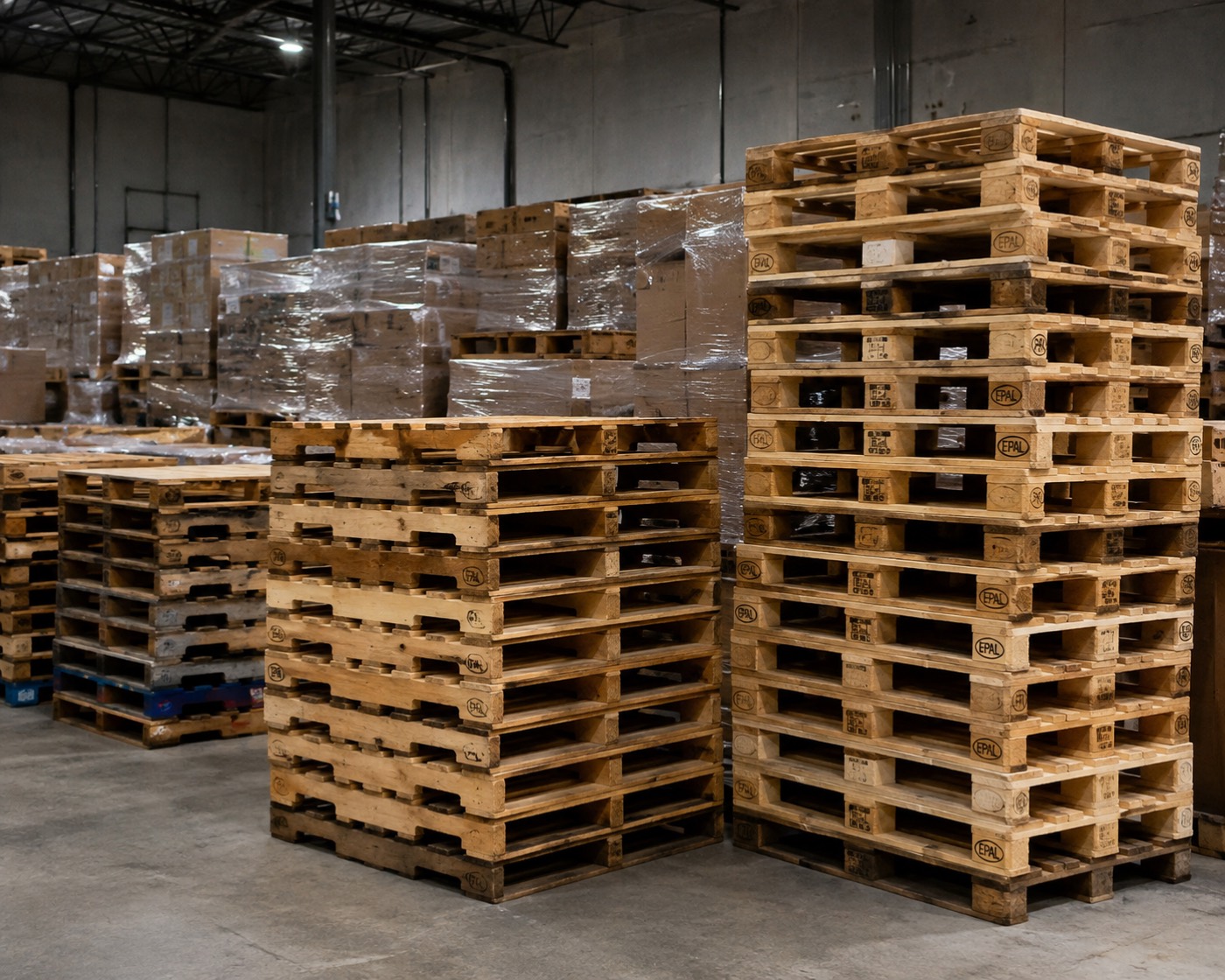
- EPAL
- The European Pallet Association, whose mark certifies genuine exchangeable Euro pallets.
- Euro pallet
- The 1200 × 800 mm European standard pallet, also called EUR-1 or EPAL.
- Flush pallet
- A pallet where deck boards end flush with the stringers, with no overhang.
- Four-way entry
- Fork access from all four sides. Full four-way also admits a pallet jack from all four sides; partial four-way does not.
- Frame
- A heavily worn pallet retaining structural soundness but minimal deck. Sometimes called Grade 3.
- Fumigation
- Chemical pest treatment, historically methyl bromide, now largely replaced by heat treatment under ISPM-15.
- GMA pallet
- The 48″ × 40″ North American standard, named after the Grocery Manufacturers Association.
- Grade A
- A used pallet with original unrepaired stringers, seven or more top deck boards and no significant damage. Also called #1.
- Grade B
- A used pallet that may have one repaired or companion stringer and replaced boards. Also called #2.
- Green lumber
- Freshly milled wood at 25–40% moisture content, which shrinks and loosens as it dries in service.
- Hardwood
- Wood from broadleaf trees — oak, maple, poplar, gum. Denser and more durable than softwood for pallet use.
- Heat treatment (HT)
- Raising wood core temperature to 56°C for 30 continuous minutes to satisfy ISPM-15.
- Helical nail
- A twisted-shank nail, the industry standard for pallet assembly, with good withdrawal resistance.
- IPPC
- The International Plant Protection Convention, which publishes ISPM-15.
- ISPM-15
- The international standard governing treatment and marking of wood packaging in international trade.
- Kiln dried (KD)
- Lumber dried to roughly 19% moisture or below. Improves stability but does not confer ISPM-15 compliance.
- Lead board
- The outermost deck board at each end, usually wider because it takes fork impact and corner load.
- Notch
- A cut in the lower edge of a stringer allowing fork entry from the side. Two per stringer on a GMA pallet.
- Overhang
- Load extending past the deck edge. Reduces carton compression strength at the corners and causes crush damage.
- Pallet jack
- A manual or powered truck that lifts a pallet from within, requiring the wheels to roll the full length of the entry.
- Partial four-way
- Notched stringer construction: forks enter from all four sides, a pallet jack from only two.
- Pinwheel
- A trailer loading pattern where alternate pallets are rotated 90°, often increasing floor count.
- Plug
- A shaped insert repairing a damaged stringer end around the notch.
- Presswood pallet
- A moulded pallet of wood fibre and resin. Very light, nestable, and exempt from ISPM-15.
- Racked load
- The weight a pallet carries spanning open air between two rack beams. The hardest load mode and typically the lowest rating.
- Reverse logistics
- The movement of packaging and materials back up the supply chain — the recovery half of a pallet programme.
- Ring-shank nail
- A nail with annular rings for maximum withdrawal resistance. Used in high-cycle and hardwood construction.
- Runner
- A lengthwise support member under a load or a skid deck, providing fork clearance.
- Selective racking
- The most common warehouse racking type, supporting pallets on two beams with an unsupported span between.
- Skid
- A pallet with a top deck only, sitting on runners. Easier to drag, not compatible with a standard pallet jack.
- Slip sheet
- A thin fibreboard or plastic sheet used with a push-pull attachment in place of a pallet.
- Softwood
- Wood from coniferous trees — pine, spruce, fir. Lighter and cheaper than hardwood; southern yellow pine dominates new pallet production.
- Static load
- The weight a pallet can hold at rest on a flat supporting surface. The highest of the three ratings.
- Stringer
- A lengthwise structural member, typically 1⅜″ × 3½″, forming the spine of a stringer pallet.
- Stringer pallet
- The dominant North American pallet type, built on three stringers rather than nine blocks.
- SYP
- Southern yellow pine, the most common species in new North American pallet manufacture.
- Tannin staining
- Dark marks leached from oak into light-coloured product when the pallet gets wet.
- Top cap
- An inverted shallow pallet used to close and load-spread the top of a collared unit.
- Top deck
- The upper load-bearing surface of a pallet.
- Two-way entry
- Unnotched stringer construction admitting forks from only two opposing sides.
- Two-way lane
- A route where a truck delivers pallets and collects used cores on the same visit.
- Unit load
- The pallet plus its load, wrap and accessories, handled as a single object.
- Wing pallet
- A pallet whose deck boards overhang the stringers, giving a lip for slings and straps.
- Withdrawal resistance
- How firmly a fastener resists being pulled out. The property that determines how long a pallet stays together.
- Zero landfill
- A recovery route where no material is disposed of to landfill — the standard our yard operates to.
Where these terms get used
Questions
Common questions
What is a pallet core?
An unsorted used pallet as received from a generator, before grading. Cores are the raw material of a pallet yard.
What is a board foot?
A unit of lumber volume: 144 cubic inches, or a piece twelve inches square and one inch thick. A 48×40 GMA pallet contains roughly 12 board feet.
What is the difference between a block pallet and a stringer pallet?
A block pallet is built on nine blocks with perimeter runners, which gives true four-way fork entry and higher capacity than a stringer pallet.
What does a combo pallet mean?
A deliberate mix of Grade A and Grade B pallets in an agreed ratio, priced between the two.
What is a chamfer on a pallet?
A bevelled edge on a lead deck board that eases forklift and pallet-jack entry and reduces board damage.