Yard notes
How to stack pallets outdoors so they are still worth something
Fifteen minutes of housekeeping routinely moves a load from 'we will remove this for free' to 'we will pay you for this'.
Request a quote
Talk to the people who wrote this
Same form, same inbox. Technical questions get answered whether or not there is an order attached.
In short
An outdoor pallet stack holds its value if it is stacked square, kept off the ground, covered properly, sorted by footprint, and accessible to a forklift. Get those five right and the same pallets are worth materially more when collected.
The single largest factor, though, is time. A stack that is collected weekly never has the chance to degrade at all.
1. Stack square, and not too high
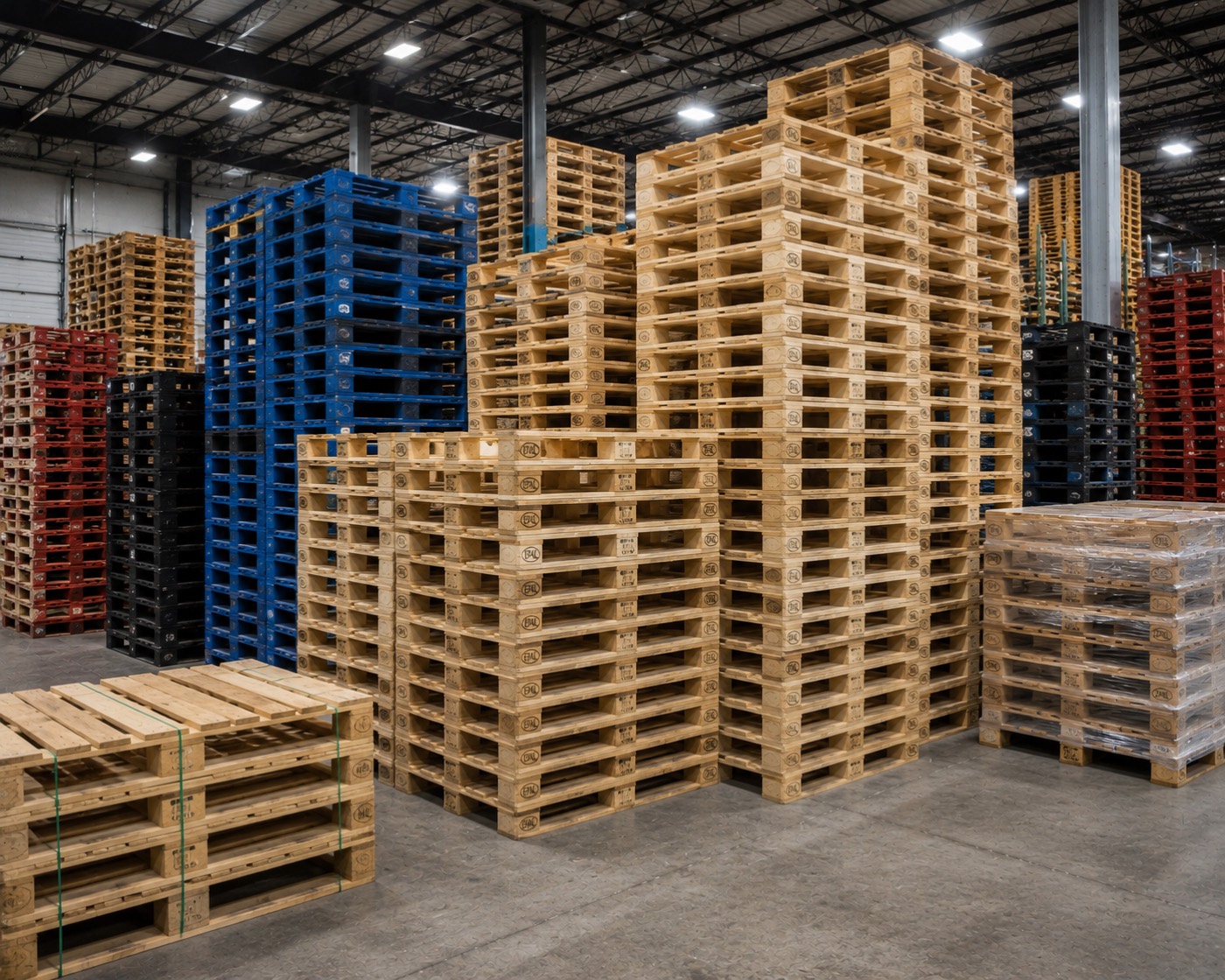
A square stack sheds water. A leaning one holds it in every horizontal gap between deck boards, and those gaps are where rot starts.
Square stacks are also safer to break down and faster to load, which matters because loading time is a real cost that shows up in what a collection is worth.
On height: high enough to use the ground efficiently, low enough to stay stable in Ohio wind and to stay within whatever your fire code allows for outdoor idle storage. See the fire engineer's view of your pallet stack.
2. Get it off the ground
The bottom pallets in a pile sitting on bare ground are almost always the first write-off. They wick moisture upward continuously, so they are the wettest part of the stack even in dry weather.
Put the stack on runners, on a hard standing, or on a couple of sacrificial pallets laid flat. The sacrificial option costs nothing — you are already going to lose those two — and it protects everything above them.
On mud or gravel this single measure changes the condition of a whole pile over a season.
3. Cover it properly or not at all
Half-covering is close to useless and occasionally worse than nothing. A tarp that covers the top but not the sides lets water run down inside the stack and then prevents it drying, which is exactly the condition mold wants.
If you are going to tarp, cover the top and the upper sides, secure it against wind, and leave the bottom open so air moves through.
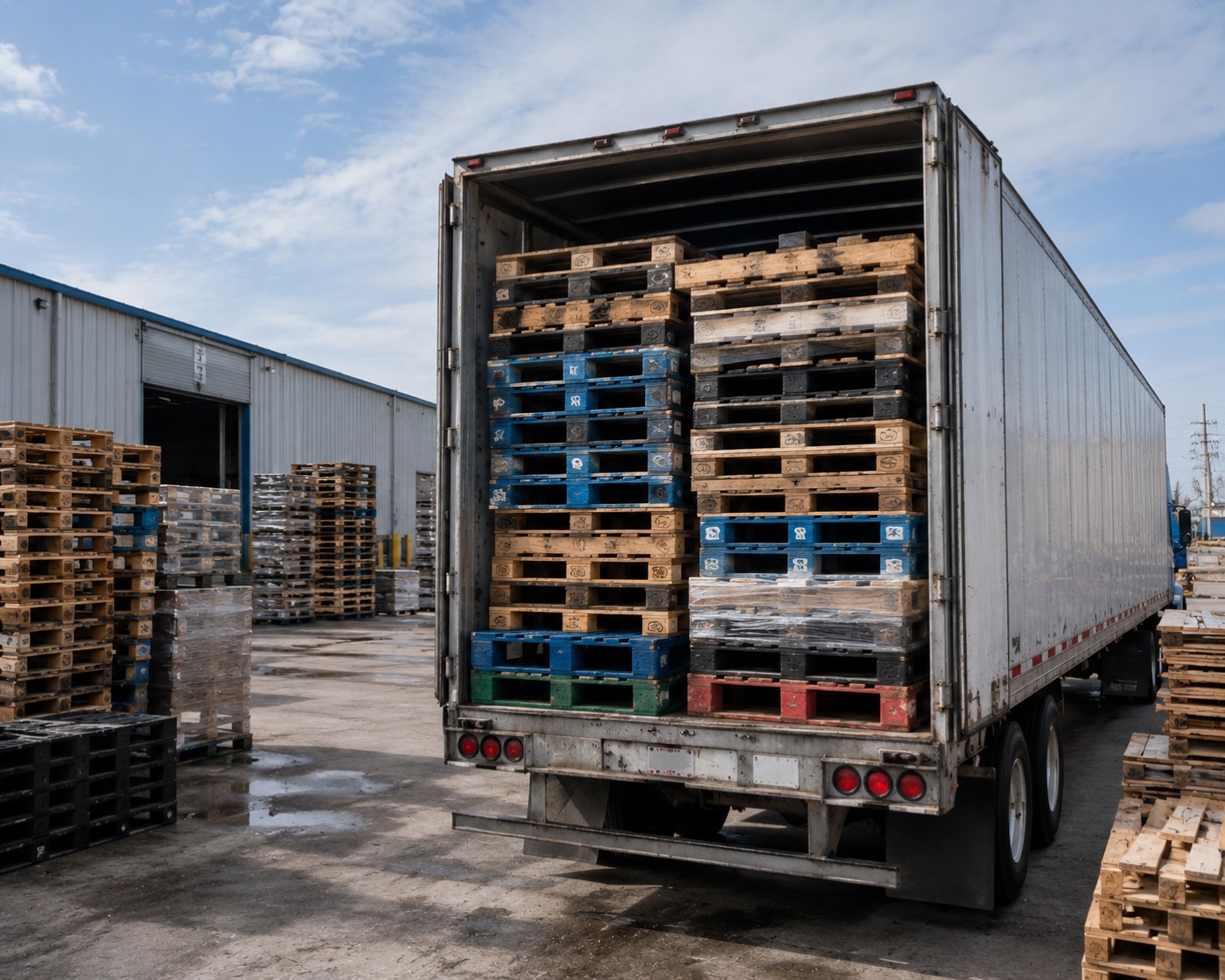
A roof, an open-sided shelter or an empty trailer is far better. If you have a spare trailer standing, it is the cheapest pallet store you will ever have.
4. Sort while you stack
This is the one that most directly changes the price.
- 48×40 GMA in its own stack. It is the highest-value footprint and mixing it into a pile of odd sizes drags down the assessment of the whole load.
- Broken pallets separately. Mixed in, they make the load look worse than it is.
- Odd sizes together. They are worth something, usually for lumber recovery, but they are priced differently.
- Anything wet or contaminated out of the way entirely. It has no outlet and it contaminates the assessment — see what zero landfill actually requires.
Sorting as you stack costs nothing. Sorting a mixed pile afterwards costs an afternoon.
5. Leave room for the truck
Access is not an afterthought, it is part of the price. A forklift needs to reach the stack, and a 53-foot trailer needs somewhere to turn and to park while loading.
A stack wedged against a fence behind three parked trailers takes twice as long to load, and that time is charged somewhere whether or not it appears as a line item.
The best answer is not to have a stack at all. A scheduled collection matched to your generation rate means the pile never reaches a size anybody has to manage — which solves the fire question, the pest question, the degradation question and the space question simultaneously.
Takeaways
- Square stacks shed water; leaning ones hold it in every deck gap.
- Two sacrificial pallets underneath protect everything above them, for free.
- Half-covering traps water and is worse than leaving it open.
- Sorting while you stack costs nothing and directly changes what the load is worth.
Questions
Asked and answered
Should I cover pallets stored outside?
Yes, but properly. A tarp over the top only lets water run down inside and then prevents drying. Cover the top and upper sides, secure against wind, and leave the bottom open for airflow.
How can I get more money for my used pallets?
Stack them square, keep them dry and off the ground, separate 48x40 GMA from odd sizes and broken units, keep film and waste out, and make sure a forklift can reach them.
Written by
Dale Whitmer
Yard Manager
Runs the grading line and the repair bay. Has graded more pallets than he can estimate and still argues about deck coverage.
Disagree with something here? That is genuinely useful to us — several of these articles exist because a customer told us we had it wrong. Use the form at the top of the page or write to the yard directly.
Terms used here
Definitions live in one place so they cannot drift. Full list in the pallet glossary.
- Deck board
- A horizontal board forming the load-bearing surface of a pallet.
- Runner
- A lengthwise support member under a load or a skid deck, providing fork clearance.
- Zero landfill
- A recovery route where no material is disposed of to landfill — the standard our yard operates to.
Keep reading
Related notes
What an Ohio winter does to a pallet stack
A pile worth real money in October is worth a fraction of it by April. The mechanism is entirely predictable and almost entirely preventable.
ComplianceThe fire engineer's view of your pallet stack
Wood pallets are close to an ideal fuel array. That is not rhetoric — it is why they get their own commodity classification.
Buying & costThe two-way lane, and why it beats any price negotiation
A truck that arrives full and leaves empty has wasted half its journey. Somebody pays for that half whether or not it appears on an invoice.