Yard notes
The economics of dismantling
Two operators, the same pallet, the same saw. One recovers six usable boards and the other recovers three. That gap is the business.
Request a quote
Talk to the people who wrote this
Same form, same inbox. Technical questions get answered whether or not there is an order attached.
In short
Dismantling separates a pallet into recoverable deck boards and cut stringers. How much usable lumber comes out depends heavily on technique — where the cut falls, how the board is supported, and whether the operator is working to length or to speed.
That recovery rate is one of the few genuine margin levers in a pallet yard, and it decides whether dismantling is a value-recovery step or a disposal step wearing a better name.
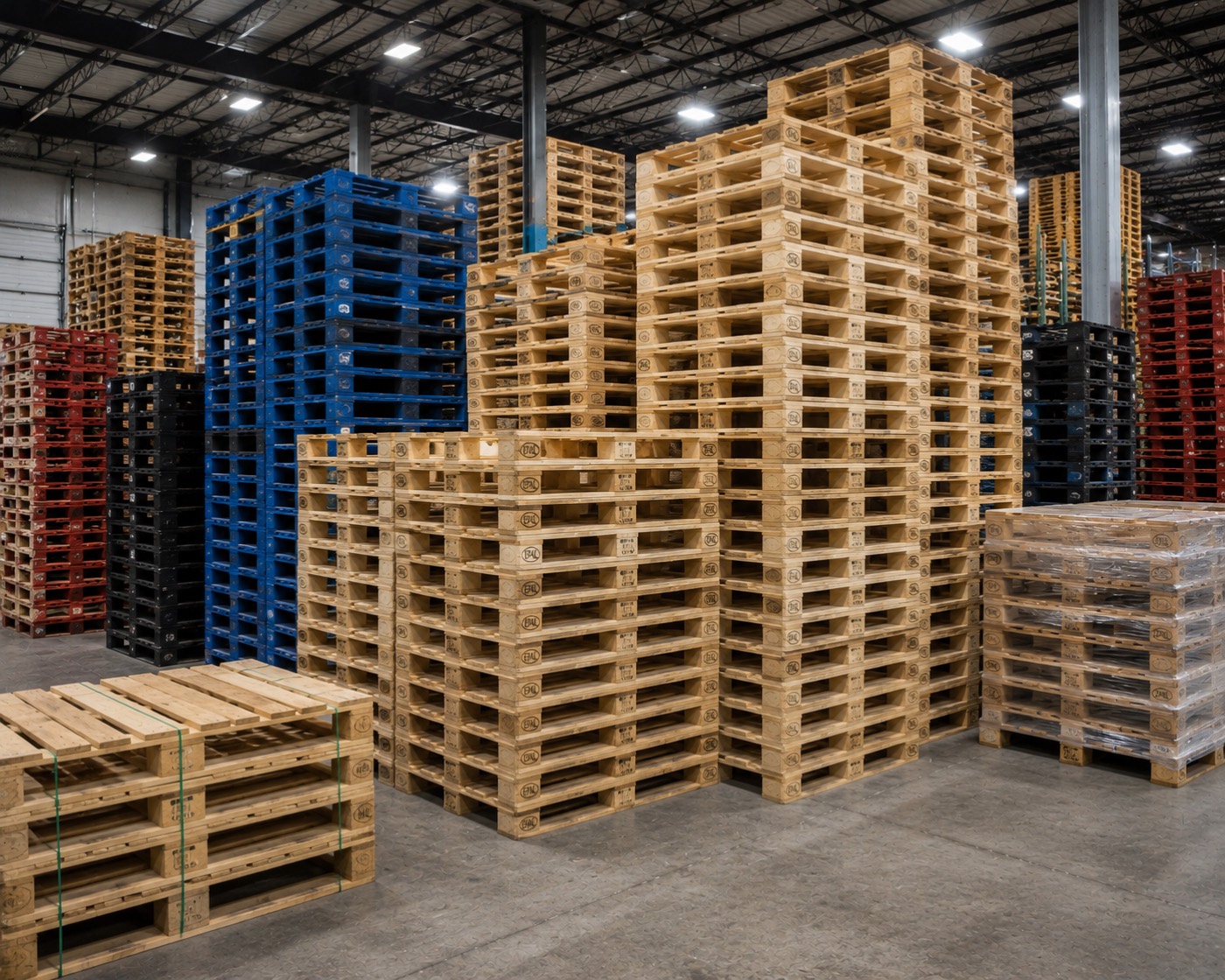
Why the cut placement decides everything
A band saw dismantler cuts between the deck board and the stringer, severing the nails. Where that blade runs determines what survives.
Run it tight to the stringer and the deck board comes off nearly full length, with the nail shanks left in the stringer. That board is a repair board or a saleable reclaimed board.
Run it a half inch high and the board comes off short, with nail heads and splits at both ends. That board is now firewood-length offcut, and its value has dropped by an order of magnitude.
The pallet, the saw and the time taken are identical in both cases. Only the recovery differs.
Where recovered material goes
Three destinations, in descending value:
- The repair bay. Full-length replacement deck boards for repairs. Highest value, because it substitutes directly for purchased lumber.
- Reclaimed-content custom builds. Sorted by length and grade, this pool feeds custom pallets and crates at a real discount to all-new construction.
- Direct sale. Deck boards and cut stringers sold as reclaimed lumber to makers, fabricators and construction crews.
Below all three sits the grinder, which is where material goes when it has no other outlet. Every board that moves up one level is margin.
When dismantling is the right call at all
Dismantling is step three on the waste hierarchy, below reuse and repair. A pallet should only reach the saw when repair is genuinely uneconomical.
Our thresholds:
- More than one cracked or previously repaired stringer
- Stringer failed at the notch on both sides
- Rot, mold or delamination anywhere in the structure
- More than roughly 40% of deck boards needing replacement
- Chemical contamination — this one goes straight past dismantling
- Odd footprint with no resale market, regardless of condition
That last category is the interesting one. A structurally perfect 53×37 pallet with no buyers is worth more as lumber than as a pallet nobody wants.
Why this matters to a buyer
It looks like an internal operational detail. It is not, because it sets the price you pay.
A yard with a high recovery rate can afford to pay more for cores and charge less for finished pallets, because more of every inbound pallet becomes a saleable product. A yard that grinds what it cannot easily repair has a narrower spread and has to take it out of the price on one side or the other.
It also affects availability of odd sizes. A yard with a good dismantling operation and a sorted lumber pool can build you a 52×44 from reclaimed material at a cost a new-lumber shop cannot match — which is frequently the answer when a standard footprint does not fit.
Takeaways
- Half an inch of cut placement decides whether a board is stock or scrap.
- Recovered lumber has three outlets, and each step up is margin.
- Odd footprints with no resale market are worth more as lumber than as pallets.
- A yard's recovery rate shows up in what it can pay for cores and charge for pallets.
Questions
Asked and answered
When should a pallet be dismantled rather than repaired?
When more than one stringer is cracked or previously repaired, when rot or mold is present, when more than about 40 percent of deck boards need replacing, or when the footprint has no resale market.
Can you build custom pallets from reclaimed lumber?
Yes, and it is usually the better buy for industrial applications. Recovered boards and stringers are dry, settled and frequently hardwood, and reclaimed-content builds cost meaningfully less than all-new.
Written by
Owen Kessler
Custom Build Shop
Prototypes and production runs. Draws the cut lists, tests them against real loads, then argues with the cut lists.
Disagree with something here? That is genuinely useful to us — several of these articles exist because a customer told us we had it wrong. Use the form at the top of the page or write to the yard directly.
Terms used here
Definitions live in one place so they cannot drift. Full list in the pallet glossary.
- Core
- An unsorted used pallet as received from a generator, before grading. The raw material of a pallet yard.
- Deck board
- A horizontal board forming the load-bearing surface of a pallet.
- Dismantling
- Cutting a pallet apart to recover usable deck boards and stringers, usually on a band saw.
- Notch
- A cut in the lower edge of a stringer allowing fork entry from the side. Two per stringer on a GMA pallet.
- Stringer
- A lengthwise structural member, typically 1⅜″ × 3½″, forming the spine of a stringer pallet.
Keep reading
Related notes
The anatomy of a repair decision
Repair too little and you destroy inventory. Repair too much and you ship pallets that fail. The line between is narrower than it looks.
SustainabilityWhat zero landfill actually requires
We did not achieve zero landfill by deciding to. We achieved it by buying four things and signing one contract.
SustainabilityPallet mulch: what it is, and what we will not sell it for
It is an excellent landscaping product and a poor vegetable garden product, and we would rather say so than sell you the wrong thing.