Sustainability
Reuse beats recycling, and the gap is bigger than you think
Any recycler can move you from landfill to mulch and call it a programme. Getting to reuse is the actual work.
Request a quote
Talk to the people who wrote this
Same form, same inbox. Technical questions get answered whether or not there is an order attached.
In short
The waste hierarchy is an ordering by retained value and avoided energy, not a slogan. Reuse retains the whole object. Repair retains it minus one board. Remanufacture retains the lumber. Recycling to material destroys the structure and keeps the fibre. Energy recovery keeps neither.
Grinding a repairable pallet into mulch is technically recycling and practically the destruction of most of the object's remaining value.
The six steps, and what each one costs
- Reuse. No processing energy at all. Inspect, and it goes back out. Everything retained.
- Repair. One board and four nails — roughly two percent of the object replaced. Almost everything retained.
- Remanufacture. Dismantle and rebuild from recovered components. The lumber keeps working; the original object does not.
- Recycle to material. Grind for mulch or fibre. Structural value gone, material value retained.
- Energy recovery. Burn for heat. Material value gone, some energy recovered.
- Landfill. Everything lost, plus decomposition emissions.
Each step down destroys something the step above kept. That is the whole argument, and it is why the word 'recycled' on a supplier's website tells you almost nothing on its own.
Why the industry drifts downward
Reuse and repair are labour. Grinding is capital.
A grinder runs continuously, needs one operator and produces a saleable output at a predictable rate. A repair line needs skilled people making judgements, and its throughput depends on the condition of what arrived that morning.
So the economically easy path for a wood recycler is to grind more and sort less. The material still leaves as a product, the landfill number still reads zero, and the sustainability page still says 'recycled'.
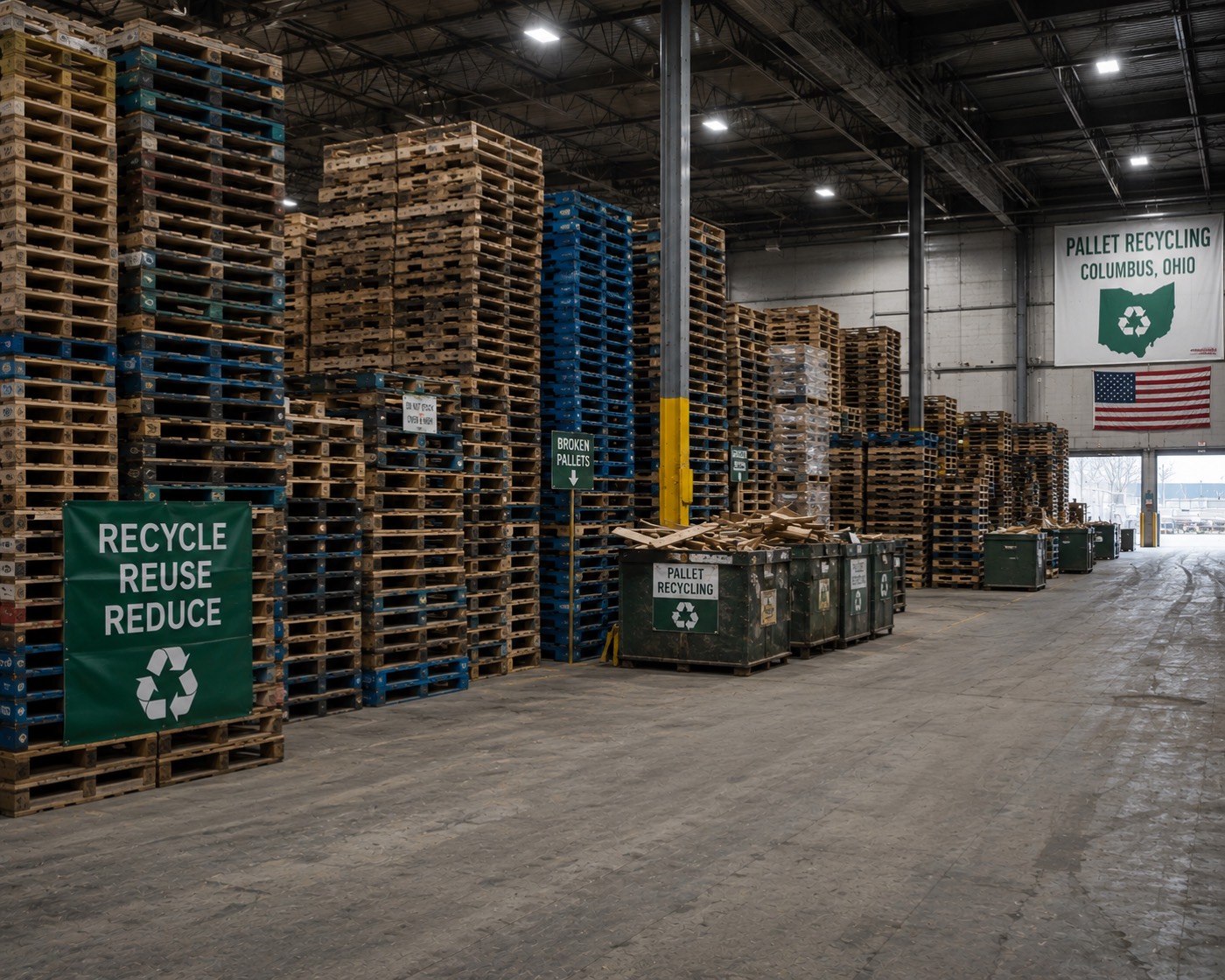
The only visible difference is the ratio — and that is why we publish ours. Roughly 80% of inbound cores leave as whole pallets, about 14% are dismantled with most of that mass recovered as usable lumber, and roughly 6% of inbound mass leaves as mulch, fuel or recovered steel.
Questions worth asking your recycler
- What proportion of inbound pallets leave as whole pallets? If they do not know, they are not measuring the thing that matters.
- Do you have a repair line? A recycler without one cannot operate above step four.
- What is your landfill tonnage? Should be zero, and should be a records figure rather than an estimate.
- How do you calculate the CO₂e number on your website? If the coefficients are proprietary, treat the number as marketing.
- Can I see the sorting line? A yard that will not show you the grading operation is telling you something.
What this means for a buyer
It means the environmental and the commercial arguments point the same way, which is unusual and worth exploiting.
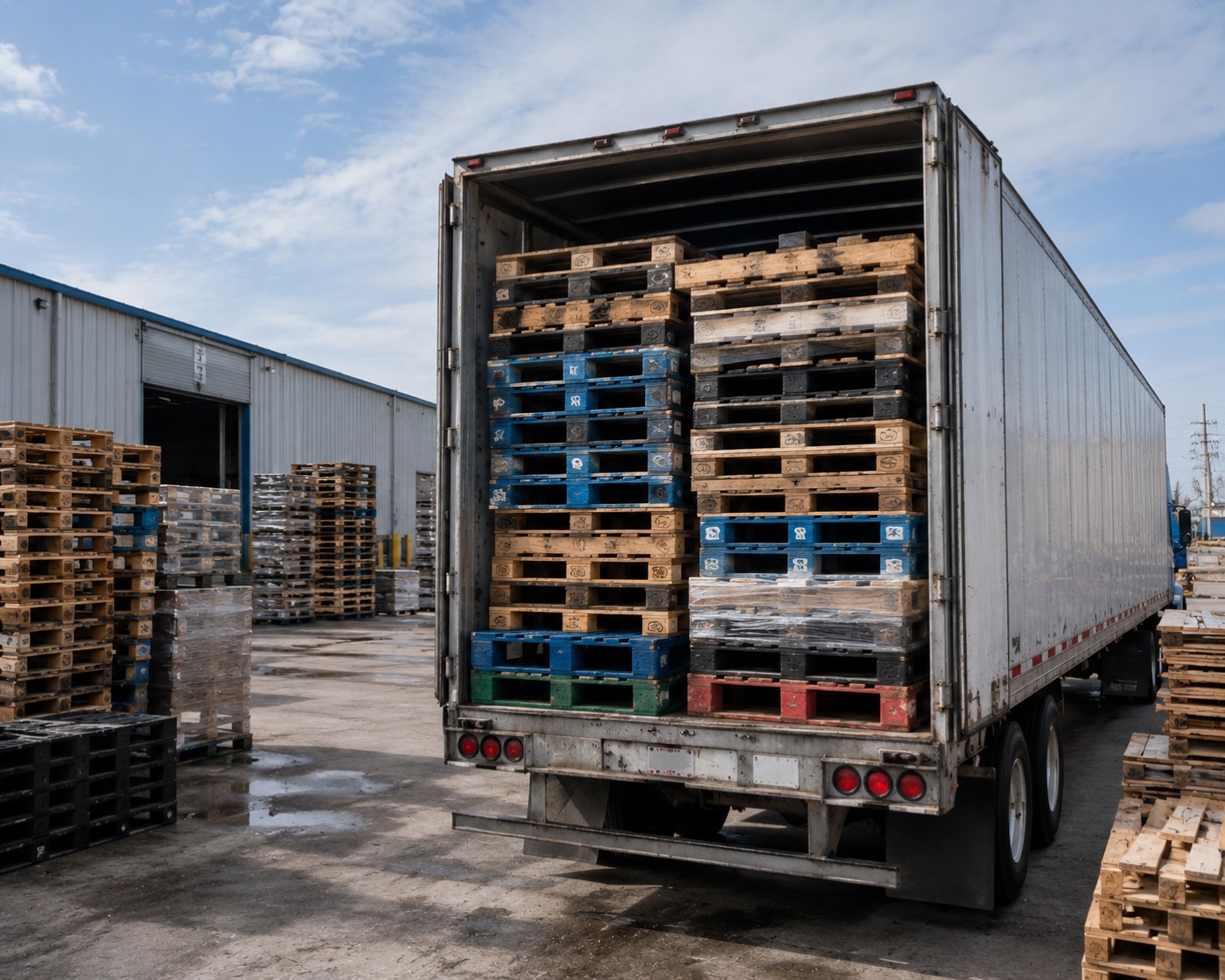
Buying reclaimed rather than new keeps an object at step one. Selling your cores rather than discarding them keeps somebody else's at step one. A two-way lane does both on the same truck.
None of that requires a trade-off against cost. Reclaimed is cheaper. The core value is income. The reduced disposal is a removed cost. The carbon benefit is a side effect of a decision you would make on the numbers alone — which is the only kind of sustainability programme that survives a bad quarter.
Takeaways
- Each step down the hierarchy destroys value the step above retained.
- Grinding is capital-efficient and sorting is labour-intensive, so the industry drifts downward.
- Ask for the proportion that leaves as whole pallets, not the landfill figure.
- For pallets the environmental and commercial arguments point the same way.
Questions
Asked and answered
Is recycling a pallet a good outcome?
It is the third-best outcome, after reuse and repair. Grinding a repairable pallet recovers the fibre and destroys the structure, which is most of the remaining value.
What should I ask a pallet recycler?
What proportion of inbound pallets leave as whole pallets, whether they operate a repair line, what their landfill tonnage is, and how any published carbon figure is calculated.
Written by
Priya Raghunathan
Operations & Programs
Builds the multi-site pallet programmes and does the baseline audits. Keeps the spreadsheets everybody else quotes from.
Disagree with something here? That is genuinely useful to us — several of these articles exist because a customer told us we had it wrong. Use the form at the top of the page or write to the yard directly.
Terms used here
Definitions live in one place so they cannot drift. Full list in the pallet glossary.
- Core
- An unsorted used pallet as received from a generator, before grading. The raw material of a pallet yard.
- Two-way lane
- A route where a truck delivers pallets and collects used cores on the same visit.
More in Sustainability
Keep reading
Related notes
The embodied carbon of a pallet, worked through
Most published pallet carbon figures cannot be checked. Here is ours, with the arithmetic shown so you can disagree with it.
SustainabilityWhat zero landfill actually requires
We did not achieve zero landfill by deciding to. We achieved it by buying four things and signing one contract.
Yard notesThe economics of dismantling
Two operators, the same pallet, the same saw. One recovers six usable boards and the other recovers three. That gap is the business.