Sustainability
The embodied carbon of a pallet, worked through
Most published pallet carbon figures cannot be checked. Here is ours, with the arithmetic shown so you can disagree with it.
Request a quote
Talk to the people who wrote this
Same form, same inbox. Technical questions get answered whether or not there is an order attached.
In short
The embodied carbon of a new wood pallet comes from harvesting, sawmilling, kiln drying, assembly and primary distribution. Reusing an existing pallet avoids essentially all of that — we use a planning figure of 5.2 kg CO₂e avoided per reuse, drawn from the mid-lower end of published pallet life-cycle studies.
Separately, the wood itself stores carbon for as long as it stays in solid form, so a pallet reused twenty times keeps that carbon locked up twenty times longer.
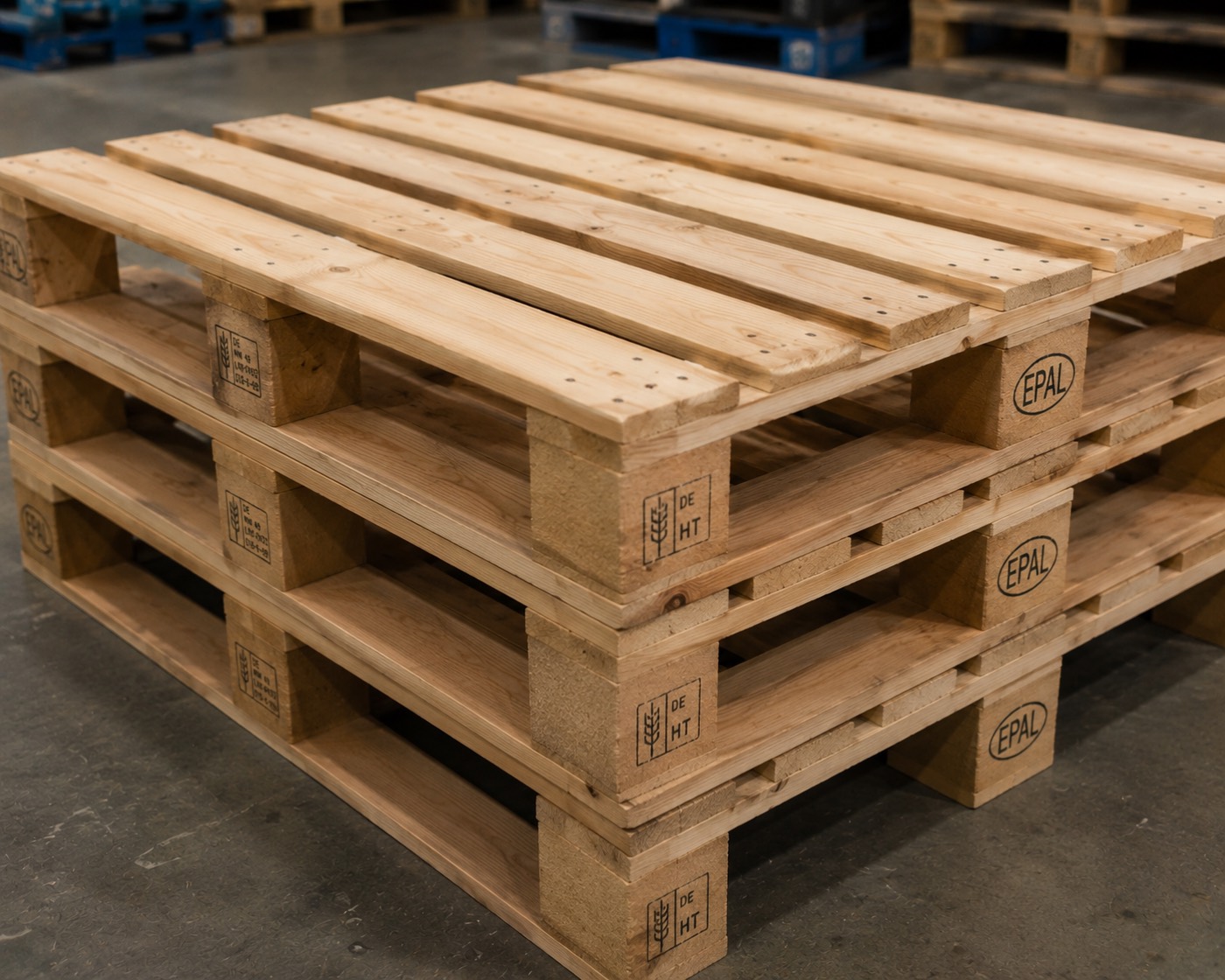
Where the emissions actually sit
For a new wood pallet the footprint is dominated by process energy rather than by the material itself, because the material is a renewable that grew using sunlight.
- Harvesting. Diesel for felling, extraction and forwarding.
- Sawmilling. Electricity for breakdown, edging and trimming, plus the losses.
- Kiln drying. Frequently the single largest energy input, and the reason green-built pallets look cheaper on paper while performing worse.
- Assembly. Comparatively small — nailing is not energy intensive.
- Distribution. Moving a low-value-density product from mill to build shop to customer.
Reuse skips all five. That is the whole argument, and it is why reuse sits two steps above recycling on the waste hierarchy.
The two different carbon claims
These get conflated constantly and they are not the same thing.
Avoided emissions. The emissions that did not happen because a new pallet was not manufactured. This is the 5.2 kg figure, and it is the number we use in the Repallet Ledger.
Stored carbon. Wood is roughly half carbon by dry mass. A 46 lb pallet holds a meaningful quantity of it, and that carbon stays out of the atmosphere for as long as the wood stays solid.
We report the first and mention the second. We do not add them together, because doing so double-counts in a way that would not survive scrutiny — and a green number that does not survive scrutiny eventually becomes a retraction.
Why we publish the coefficients
Almost every supplier in this industry publishes an environmental claim. Almost none publish the arithmetic behind it.
The result is a market where two claims cannot be compared, so the most confident claim wins rather than the most accurate one. That is bad for buyers and, in the long run, bad for suppliers who are telling the truth.
So every coefficient behind every environmental figure on this site is on the methodology page: the source, the value, and how uncertain we think it is — including the weakest one, which is board feet per mature tree, a figure that varies enormously by species and site.
If your sustainability team disagrees with any of them, substitute your own. The model still works, and we would rather be corrected than believed.
What we deliberately exclude
- Your freight. It depends on your lanes, load factors and equipment. An average would make the output look complete and be less true.
- Your handling energy. Forklift fuel, wrapping film, warehouse conditioning.
- Loss rate. A pallet that leaves and never returns still had to be manufactured. If your loop leaks, your real figure is lower than the model shows.
- End-of-life energy credits. We do not claim carbon credit for biomass recovery, because that accounting is contested and we would rather leave it out than argue about it.
- Offsets. We have not bought any, so none appear.
That last one is worth stating plainly. We run trucks, a grinder and a heat treatment chamber. All three burn fuel. We are not carbon neutral and we do not claim to be.
Takeaways
- Kiln drying is often the largest single energy input in a new pallet.
- Avoided emissions and stored carbon are different claims and should not be summed.
- We publish every coefficient so the figures can be challenged.
- Freight, handling, loss and offsets are deliberately excluded from the model.
Questions
Asked and answered
How much carbon does reusing a pallet save?
We use 5.2 kg CO2e per reuse as a planning figure, drawn from the mid-lower end of published pallet life-cycle studies. The derivation and its uncertainty are published on our methodology page.
Do you claim to be carbon neutral?
No. We run trucks, a grinder and a heat treatment chamber, all of which burn fuel, and we have not purchased offsets to describe that away.
Written by
Priya Raghunathan
Operations & Programs
Builds the multi-site pallet programmes and does the baseline audits. Keeps the spreadsheets everybody else quotes from.
Disagree with something here? That is genuinely useful to us — several of these articles exist because a customer told us we had it wrong. Use the form at the top of the page or write to the yard directly.
Terms used here
Definitions live in one place so they cannot drift. Full list in the pallet glossary.
- Heat treatment (HT)
- Raising wood core temperature to 56°C for 30 continuous minutes to satisfy ISPM-15.
More in Sustainability
Keep reading
Related notes
Reuse beats recycling, and the gap is bigger than you think
Any recycler can move you from landfill to mulch and call it a programme. Getting to reuse is the actual work.
SustainabilityWhat zero landfill actually requires
We did not achieve zero landfill by deciding to. We achieved it by buying four things and signing one contract.
Specs & engineeringReclaimed hardwood usually beats new pine
The instinct is that new beats used. In wood packaging the species difference usually outweighs the age difference.