Specs & engineering
Reclaimed hardwood usually beats new pine
The instinct is that new beats used. In wood packaging the species difference usually outweighs the age difference.
Request a quote
Talk to the people who wrote this
Same form, same inbox. Technical questions get answered whether or not there is an order attached.
In short
In North America, the reclaimed pallet pool skews heavily toward mixed hardwood — oak, gum, maple, poplar — while new pallet production skews toward southern yellow pine. Hardwood is denser, resists point loading and edge crushing better, and holds fasteners better under vibration.
Combined with the fact that reclaimed wood has already completed its seasoning, a well-graded reclaimed hardwood pallet frequently outperforms a new softwood one at a fraction of the price.
Why the pools differ
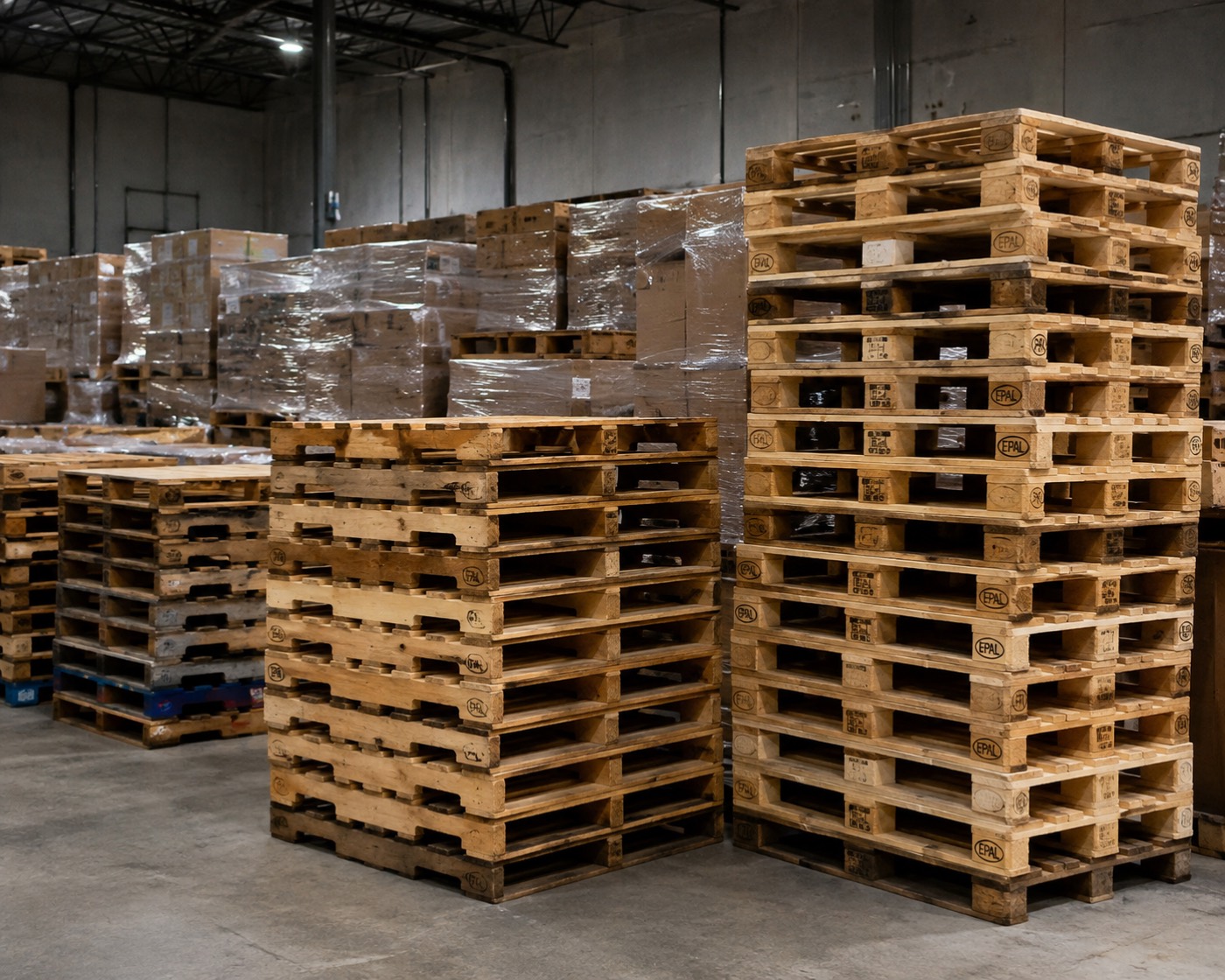
The reclaimed pool reflects what was built decades ago and what circulates through this region. In Ohio and Appalachia that is hardwood-rich, because hardwood mills are here and hardwood pallet stock was the norm.
New production skews to southern yellow pine for straightforward reasons: it is cheaper, lighter, kiln-dries predictably, and takes a nail without splitting. For a manufacturer building to a price, it is the sensible default.
So the comparison people actually face is rarely 'new oak versus used oak'. It is 'new pine versus used mixed hardwood', and that is a different question with a different answer.
What density buys
- Point load resistance. A drum foot or a machine leg concentrates load onto a few square inches. Hardwood dents; softwood punches through.
- Fastener retention. Denser fibre grips a nail harder and holds it through more vibration cycles. See the cheapest part of a pallet.
- Edge and corner durability. Fork strikes land on deck board ends. Hardwood shrugs off strikes that split pine.
- Repeat handling. The cumulative damage that eventually retires a pallet accumulates more slowly.
The trade is weight. Hardwood pallets run roughly 15–25% heavier, and you pay for that on every mile of freight. On air freight or manual handling lanes, pine's lightness is a genuine advantage rather than a compromise.
The seasoning argument
This is the part that surprises people most.
New pallets are frequently built from green lumber at 25–40% moisture content. As that wood dries in service it shrinks across the grain, cups, and loosens around every fastener. A pallet built green and shipped immediately is measurably looser three months later.
A reclaimed pallet has completed that entire process, in service, on somebody else's time. It sits at ambient equilibrium. Its nails have set. Its dimensions have stopped moving.
That is a real engineering advantage and it is why an experienced racking engineer will happily specify a well-graded reclaimed hardwood pallet over an unknown new softwood one.
Where new still wins
Being fair about this matters, because overselling reclaimed is how a supplier loses an account.
- Consistency. New pallet strength is specified and repeatable. Reclaimed strength is good on average and variable in detail. If you need a number to put in a document, that is new.
- Appearance. Reclaimed stock is stained and mismatched, and no amount of grading changes that.
- Documented provenance. Audited supply chains that require traceable material cannot use reclaimed.
- Engineered ratings. A certified capacity for a specific design requires a controlled build.
- Weight-critical lanes. Air freight and manual handling favour lighter pine.
The full comparison, including the cost figures, is in recycled vs new pallets.
Takeaways
- The real comparison is new pine against used mixed hardwood, not like against like.
- Density buys point-load resistance, fastener retention and edge durability.
- Reclaimed wood has finished shrinking; green new lumber has not.
- New wins on consistency, appearance, provenance and weight — not usually on strength.
Questions
Asked and answered
Are recycled pallets weaker than new ones?
Often the opposite, because the reclaimed pool skews hardwood while new production skews softwood, and reclaimed wood has already completed its seasoning. The genuine trade-off is variability rather than average strength.
How much heavier is a hardwood pallet?
Roughly 15 to 25 percent over a comparable softwood build. That weight costs freight on every trip, which is why pine is genuinely better on air freight and manual handling lanes.
Written by
Owen Kessler
Custom Build Shop
Prototypes and production runs. Draws the cut lists, tests them against real loads, then argues with the cut lists.
Disagree with something here? That is genuinely useful to us — several of these articles exist because a customer told us we had it wrong. Use the form at the top of the page or write to the yard directly.
Terms used here
Definitions live in one place so they cannot drift. Full list in the pallet glossary.
- Deck board
- A horizontal board forming the load-bearing surface of a pallet.
- Green lumber
- Freshly milled wood at 25–40% moisture content, which shrinks and loosens as it dries in service.
- Hardwood
- Wood from broadleaf trees — oak, maple, poplar, gum. Denser and more durable than softwood for pallet use.
- Softwood
- Wood from coniferous trees — pine, spruce, fir. Lighter and cheaper than hardwood; southern yellow pine dominates new pallet production.
More in Specs & engineering
Keep reading
Related notes
Blue stain is not rot, and rejecting it costs you money
Every year somebody rejects a load of perfectly sound pallets because the pine has gone grey-blue. It is one of the better bargains in this industry.
Specs & engineeringThe cheapest part of a pallet decides how long it lasts
Pallets rarely fail because a board broke. They fail because a joint let go, and the joint is the cheapest thing in the build.
SustainabilityThe embodied carbon of a pallet, worked through
Most published pallet carbon figures cannot be checked. Here is ours, with the arithmetic shown so you can disagree with it.