Specs & engineering
Why an AS/RS rejects a pallet a forklift would not notice
A driver looks at a pallet and decides. A shuttle measures it and refuses. Those are different standards and only one of them is written down.
Request a quote
Talk to the people who wrote this
Same form, same inbox. Technical questions get answered whether or not there is an order attached.
In short
An automated storage and retrieval system typically checks a pallet at an inbound station for height, width, squareness, bottom deck condition, overhang and weight distribution before allowing it into the rack. Failing any check means a rejection at the station — which is inconvenient — or a jam inside the rack, which is expensive.
The checks are geometric. A pallet that a forklift driver would use without a second thought can fail all of them.
The six checks
1. Profile and height
A light curtain or scanner measures the loaded pallet against the bay envelope. A pallet a quarter inch taller than expected, or a load that bulges, fails here. This is the most common rejection and usually the easiest to fix — it is often the load, not the pallet.
2. Width and squareness
Measured on the diagonals. An out-of-square pallet presents a corner where the system expects an edge.
3. Bottom deck integrity
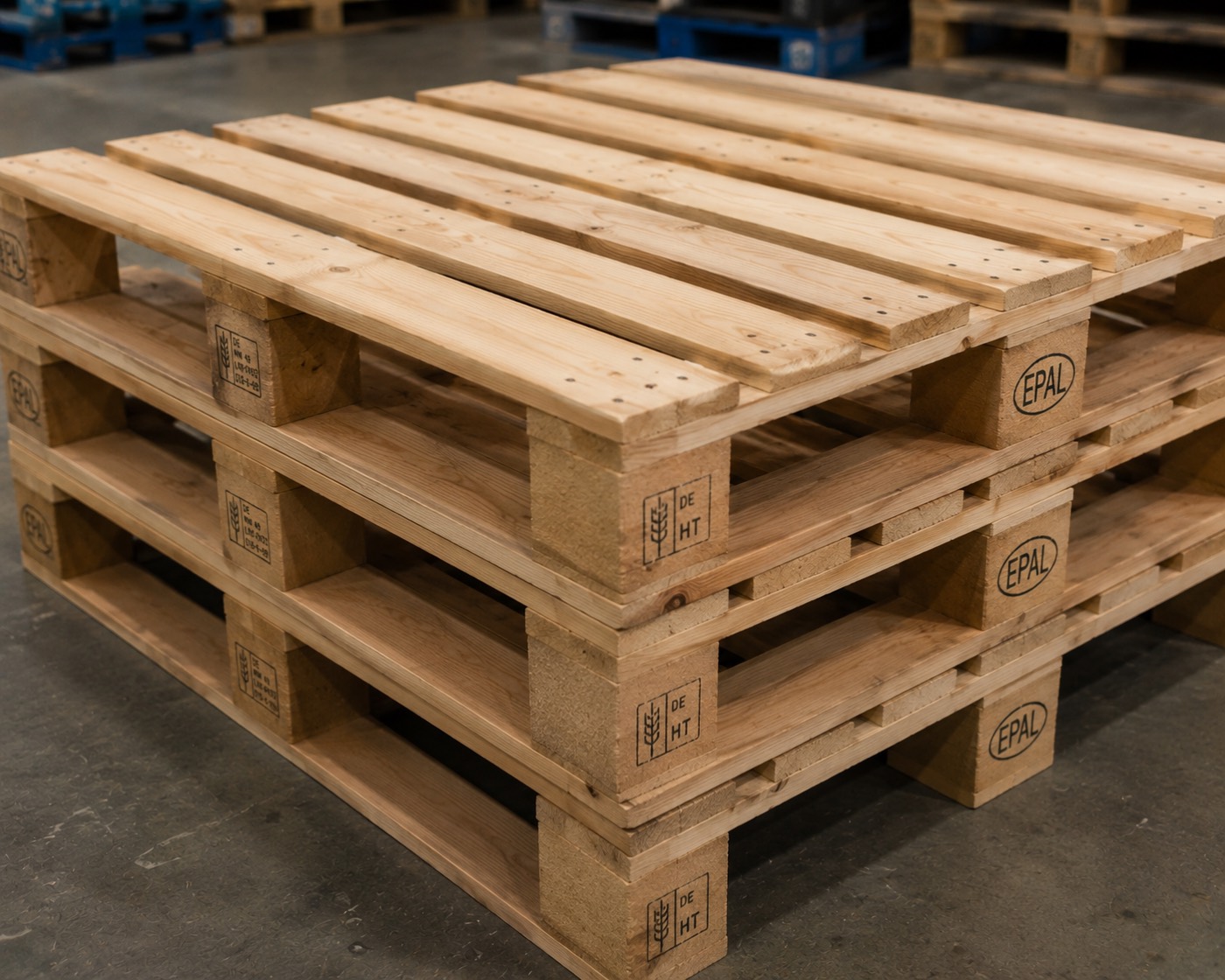
The single most consequential check. The shuttle's forks or the conveyor's rollers engage the bottom deck. A missing, split or hanging bottom board is what causes a jam *inside* the rack rather than a rejection at the station.
4. Overhang
Product past the deck edge fouls the rack upright or the neighbouring load. A driver adjusts; a shuttle does not.
5. Weight and distribution
Total weight against the bay rating, and sometimes distribution across the deck. An off-centre load can tip during transfer.
6. Flatness
A warped pallet rocks. On a scale it mis-weighs; on a transfer it lifts unevenly.
Why bottom deck condition dominates
Of everything on that list, bottom deck condition is the one worth building a process around.
A profile rejection happens at the inbound station. Somebody walks over, sees the problem, fixes or removes the pallet, and the line runs again. Annoying, cheap.
A bottom board that lets go *inside* the rack is a different event. The load is in a bay, twenty feet up, in an aisle the system controls and people do not normally enter. Recovery means shutting the aisle, sometimes the system, and manual intervention at height.
Which is why for AS/RS lanes we grade bottom decks far more strictly than for anything else, and why 'the bottom board is missing but it does not matter' — true for floor stacking — is emphatically false here.
Practical measures
- Grade for the system, not the shelf. Tell us it is AS/RS and the pull changes: full bottom decks, tight dimensional band, no proud fasteners.
- Screen at your inbound dock, not at the station. A quick check as pallets are received catches problems while they are still cheap.
- Fix the load, not just the pallet. Profile failures are frequently a wrap or stacking issue.
- Consider new for these lanes only. AS/RS is usually a small share of total volume; buying new for that share and reclaimed for the rest is often the cheapest overall answer.
- Keep a rejected-pallet route. Somewhere for failures to go that is not 'back into the pool to fail again tomorrow'.
The specification conversation
The most useful thing you can send us is the acceptance envelope from the system manufacturer. Not the pallet you are currently using — the envelope the machine will accept.
From that we can work backwards to a build or a grading band, and tell you honestly whether reclaimed can hit it. Sometimes it can. Sometimes the answer is a new build to tolerance, and saying so early is cheaper for everyone than discovering it during commissioning.
Takeaways
- AS/RS checks are geometric — height, squareness, bottom deck, overhang, weight, flatness.
- A station rejection is cheap; a failure inside the rack is not.
- Bottom deck integrity is the check that matters most and the one floor-stacking habits ignore.
- Send the machine's acceptance envelope, not your current pallet.
Questions
Asked and answered
Why did our AS/RS reject a pallet that looks fine?
Most often profile height or squareness, both of which are frequently caused by the load rather than the pallet. Bottom deck condition is the other common cause and the more serious one.
Do we need new pallets for automated storage?
Not necessarily. Reclaimed stock graded to a dimensional band with full bottom decks works in many systems. For tight-tolerance systems, buying new for those lanes only is usually cheaper than upgrading the whole fleet.
Written by
Owen Kessler
Custom Build Shop
Prototypes and production runs. Draws the cut lists, tests them against real loads, then argues with the cut lists.
Disagree with something here? That is genuinely useful to us — several of these articles exist because a customer told us we had it wrong. Use the form at the top of the page or write to the yard directly.
Terms used here
Definitions live in one place so they cannot drift. Full list in the pallet glossary.
- Bottom deck
- The lower deck boards. May be full coverage, partial, or absent entirely on a skid.
- Grade B
- A used pallet that may have one repaired or companion stringer and replaced boards. Also called #2.
- Overhang
- Load extending past the deck edge. Reduces carton compression strength at the corners and causes crush damage.
More in Specs & engineering
- Marking pallets so you can find them again7 min
- Reclaimed hardwood usually beats new pine7 min
- Blue stain is not rot, and rejecting it costs you money5 min
- The cheapest part of a pallet decides how long it lasts6 min
- Block or stringer: the honest decision8 min
- Overhang is not a packaging detail. It is a damage budget.6 min
Keep reading
Related notes
Designing a pallet for automation
A human driver compensates for a pallet that is half an inch out. A conveyor does not, and it does not tell you either — it just stops.
Specs & engineeringCan you rack a used pallet? The honest answer
This is the question we are asked most often and the one where a supplier is most tempted to give a comfortable answer.
Specs & engineeringDeck coverage is not deck strength
Customers ask for more deck boards when they want more strength. Sometimes that works. Often they have bought the wrong upgrade.