Specs & engineering
Marking pallets so you can find them again
Wood is a hostile surface for anything you want to read later. Most pallet tracking schemes die on that fact.
Request a quote
Talk to the people who wrote this
Same form, same inbox. Technical questions get answered whether or not there is an order attached.
In short
For marking wood pallets, branded or stencilled identification and colour coding survive service; adhesive labels and printed tags usually do not. Barcodes work if they are branded or on a protected plate; RFID works but only earns its cost in a genuinely closed loop.
Before choosing a technology, decide what question you are trying to answer — ownership, routing, or lifecycle. They need different answers.
Why wood defeats most marking
A pallet spends its life being dragged, struck by fork tines, stacked, wrapped, unwrapped, rained on and stored outdoors. It is dusty, splintery and dimensionally unstable.
Adhesive labels lose their bond as the wood takes on and loses moisture, and get torn by handling. Printed paper tags survive a trip and not much more. Ink stamps fade under UV.
What survives is anything that removes or displaces material rather than sitting on top of it: a hot brand, a deep stencil in durable paint, or a routed mark. That is why the ISPM-15 mark is specified as permanent and legible rather than as a label.
The three questions, and their answers
'Whose pallet is this?'
The most common question and the easiest to answer. A branded or stencilled company mark on two opposite stringers. Cheap, permanent, and it does most of the work — a marked pallet is far more likely to come back than an unmarked one, purely because somebody can see whose it is.
'Where should this go?'
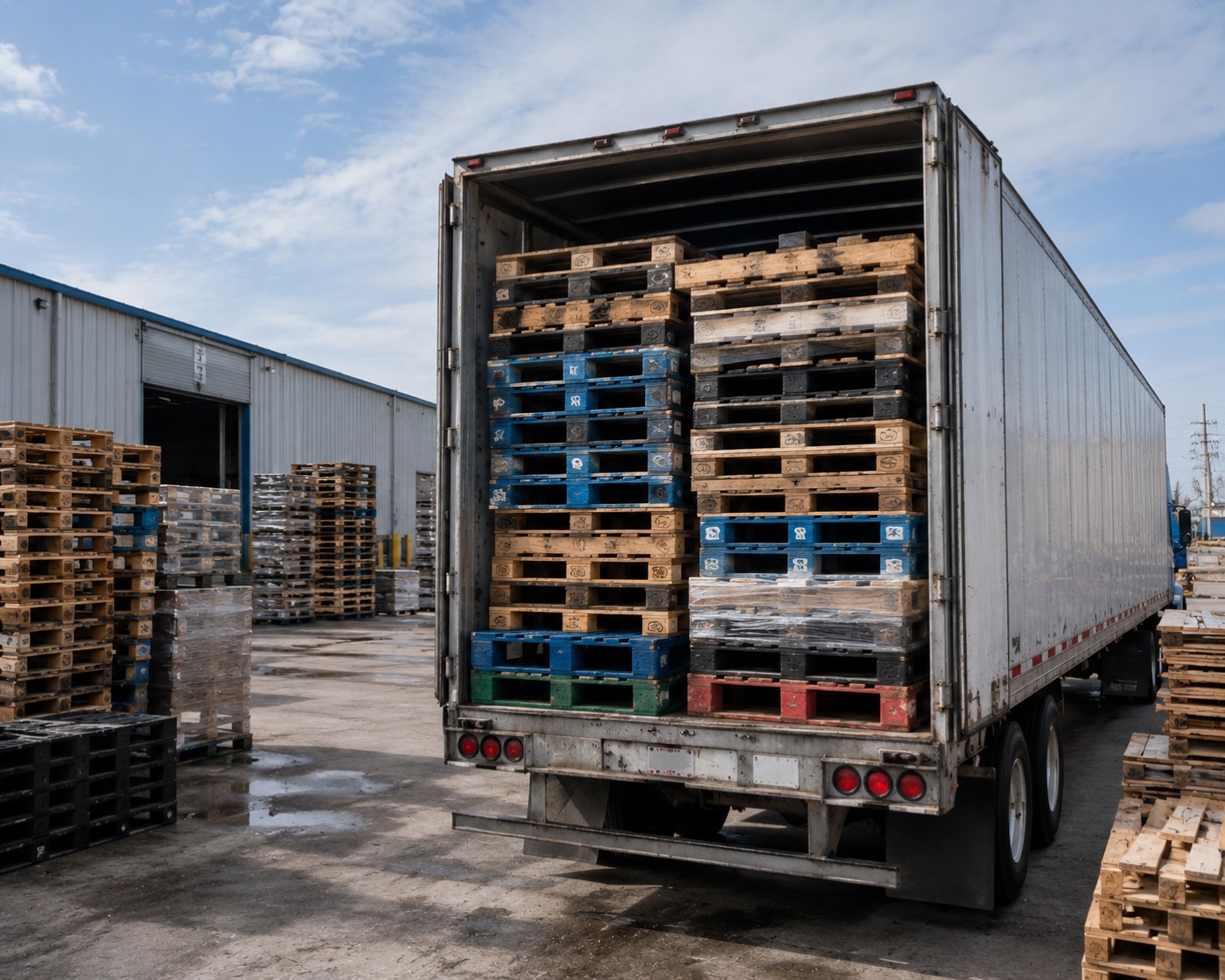
Colour coding. A painted stringer end in a lane-specific colour is readable from across a yard at speed, which a barcode is not. This is genuinely underused and costs almost nothing.
'What has this pallet done?'
This is the expensive one. Trip counts, repair history, treatment records. It needs a unique identifier and a system to read it against — serial numbers, barcodes on a protected plate, or RFID. Only worth it in a closed loop where the same pallets keep returning to you.
RFID: when it earns its place
RFID on pallets works technically. Tags survive if they are recessed and protected, and read ranges are adequate for dock portals.
It earns its cost in three situations: a genuinely closed loop where you see the same pallets repeatedly, high-value assets where loss justifies the tracking, or a regulatory requirement for chain of custody.
It does not earn its cost on one-way outbound shipping, and this is where most disappointed RFID projects have lived. Tagging a pallet you will never see again is paying for information you will never collect.
If the goal is simply reducing loss, a visible brand and a returns process usually deliver more per dollar than a tag.
Practical specification
- Brand or stencil on two opposite stringers, positioned to stay visible when the pallet is loaded — the same logic as the ISPM-15 mark.
- Avoid red and orange, which are reserved for hazard marking in some contexts.
- Keep it clear of the treatment stamp. An inspector should not have to work out which mark is which.
- Colour-code the stringer ends rather than the deck; ends stay visible in a stack.
- If serialising, put the number in the brand, not on a label.
We apply stencils, brands and colour codes on new builds and on custom runs, and we can re-mark existing fleets during a repair cycle.
Takeaways
- Marks that displace material survive; marks that sit on top of it do not.
- A visible ownership brand does most of the work of a tracking system.
- Colour-coded stringer ends are readable at speed and cost almost nothing.
- RFID pays off in closed loops and almost never on one-way lanes.
Questions
Asked and answered
Do labels stay on wood pallets?
Rarely for long. Adhesive bonds fail as wood takes on and loses moisture, and handling tears them. Branded, stencilled or routed marks survive; labels are a single-trip solution at best.
Is RFID worth it on pallets?
In a closed loop where the same pallets return to you, or where loss is expensive enough to justify tracking. On one-way outbound shipping it is paying for data you will never collect.
Written by
Owen Kessler
Custom Build Shop
Prototypes and production runs. Draws the cut lists, tests them against real loads, then argues with the cut lists.
Disagree with something here? That is genuinely useful to us — several of these articles exist because a customer told us we had it wrong. Use the form at the top of the page or write to the yard directly.
Terms used here
Definitions live in one place so they cannot drift. Full list in the pallet glossary.
- ISPM-15
- The international standard governing treatment and marking of wood packaging in international trade.
- Stringer
- A lengthwise structural member, typically 1⅜″ × 3½″, forming the spine of a stringer pallet.
More in Specs & engineering
- Can you rack a used pallet? The honest answer7 min
- Why an AS/RS rejects a pallet a forklift would not notice7 min
- Reclaimed hardwood usually beats new pine7 min
- Blue stain is not rot, and rejecting it costs you money5 min
- The cheapest part of a pallet decides how long it lasts6 min
- Deck coverage is not deck strength6 min
Keep reading
Related notes
Designing a pallet for automation
A human driver compensates for a pallet that is half an inch out. A conveyor does not, and it does not tell you either — it just stops.
ComplianceFive ISPM-15 holds we have watched happen
In every case the pallet was compliant. That was never the problem.
Buying & costPooling or buying outright: which one is actually cheaper?
Pooling is a real answer to a real problem. It is also frequently sold to operations that do not have that problem.