Sustainability
What zero landfill actually requires
We did not achieve zero landfill by deciding to. We achieved it by buying four things and signing one contract.
Request a quote
Talk to the people who wrote this
Same form, same inbox. Technical questions get answered whether or not there is an order attached.
In short
Zero landfill for a pallet yard requires somewhere for every output stream to go: whole pallets to customers, recovered lumber to repair and build, ground wood to mulch and biomass, and fasteners to scrap steel. Remove any one of those outlets and material starts accumulating, and accumulated material eventually goes to a skip.
It is an infrastructure and contracts problem, not a policy problem.
The four outlets
Whole pallets
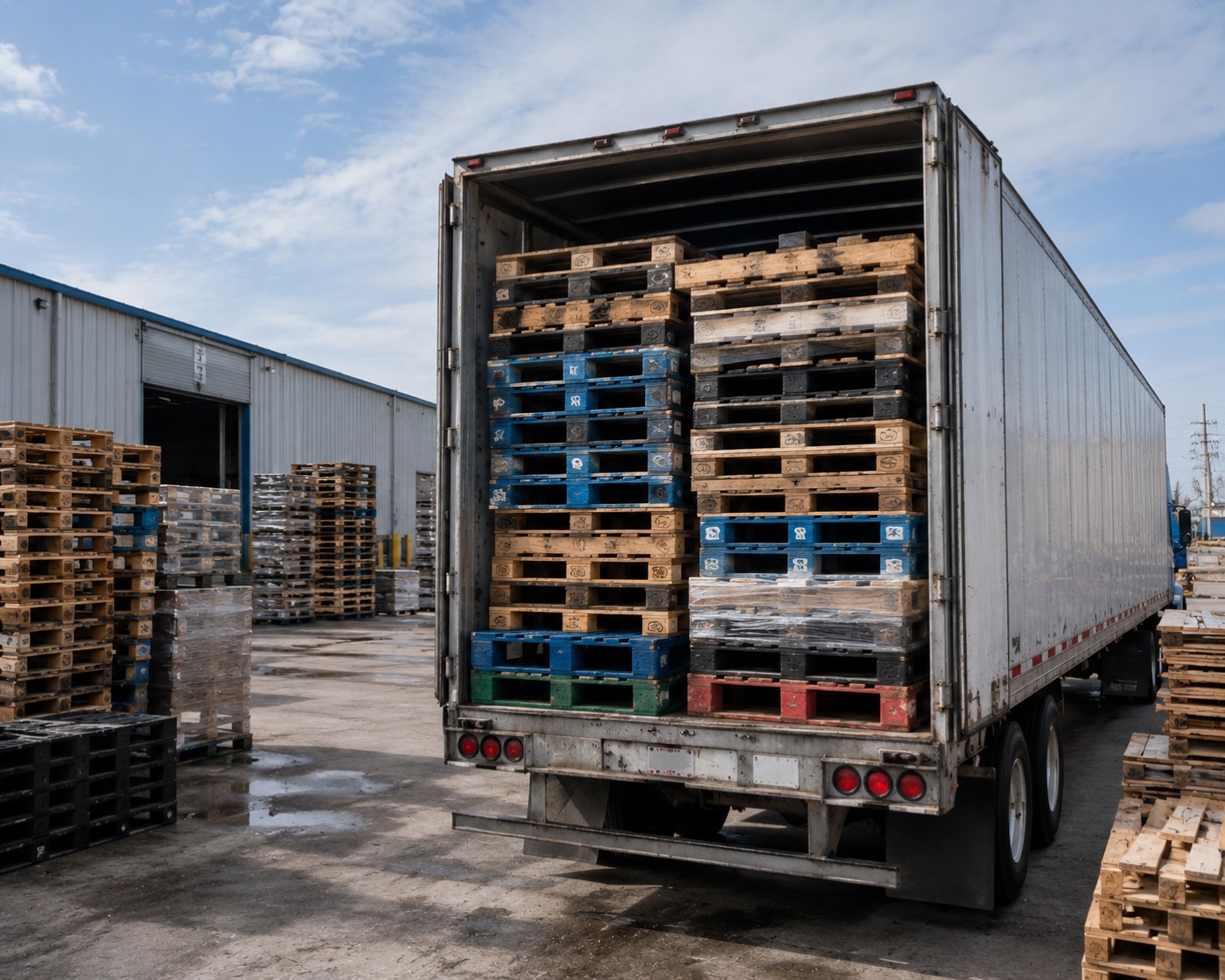
The largest by far and the one that requires no equipment — only accurate grading and customers who will buy reclaimed. Roughly 80% of inbound cores leave this way.
Recovered lumber
Requires a band saw and, more importantly, somewhere for the output to go: the repair bay, reclaimed-content custom builds, and direct sale as reclaimed lumber. A yard that dismantles without those outlets just builds a lumber pile.
Ground wood
Requires a grinder, a screen and a colouring line for landscape mulch, plus a biomass offtake agreement for what is not suitable for mulch. The offtake contract is the part people underestimate — a grinder with nowhere to send the output is a machine that makes a bigger pile.
Steel
Requires magnets on the outfeed and a scrap processor to sell to. Small revenue, disproportionate importance: steel in mulch damages customer equipment and ends the mulch outlet.
Where it breaks
Almost every failure is an outlet failure rather than a sorting failure.
Mulch demand is seasonal. It peaks in spring and collapses in autumn, while inbound volume does not. Without a biomass agreement to absorb the off-season, ground material accumulates through winter and the pressure to skip it builds.
Contamination closes outlets. One load with chemically stained wood mixed in can contaminate a mulch batch. That is why we reject contaminated stock at intake rather than accepting it and dealing with it later — accepting it is how a yard loses its mulch buyer.
Odd-size accumulation. Footprints with no resale market pile up until somebody dismantles them. A yard that keeps buying odd sizes without dismantling capacity is building a future disposal problem.
Why we reject material at the gate
It looks unhelpful to turn a load away. It is the opposite.
A load of soaked, moldy or chemically stained pallets has no outlet. It cannot be resold, it should not be repaired, its lumber is not recoverable, and grinding it risks the mulch stream. Accepting it means paying to handle material whose only remaining destination is disposal.
So we assess at intake, in daylight, with the driver present, and we say no when the answer is no — and we say it before the truck is unloaded rather than after. That is what makes the zero figure a records figure rather than an aspiration.
See why we count on the ground for the same principle applied to quantity.
What to ask a supplier claiming zero landfill
- Is it a measured figure or a target? Ours is a records figure and has been zero for three years.
- Where does the ground material go, specifically? A named mulch outlet and a named biomass user, or it is not a real answer.
- What happens to contaminated inbound loads? If they accept everything, something is being disposed of somewhere.
- What proportion leaves as whole pallets? Zero landfill with a 90% grind rate is technically true and practically poor — see why reuse beats recycling.
Takeaways
- Zero landfill is four outlets and a contract, not a policy statement.
- Biomass offtake covers the seasonal collapse in mulch demand.
- Contamination does not just spoil a load — it can close an entire outlet.
- Zero landfill with a high grind rate is technically true and practically poor.
Questions
Asked and answered
Is zero landfill hard to achieve?
The equipment is straightforward. The difficulty is maintaining outlets for every stream year round, particularly through the autumn collapse in mulch demand, and refusing contaminated material at the gate.
What happens to contaminated pallets?
We decline them at intake. Chemically stained or unidentifiable residue cannot be resold, repaired or safely ground, and accepting it risks contaminating the mulch stream that other material depends on.
Written by
Dale Whitmer
Yard Manager
Runs the grading line and the repair bay. Has graded more pallets than he can estimate and still argues about deck coverage.
Disagree with something here? That is genuinely useful to us — several of these articles exist because a customer told us we had it wrong. Use the form at the top of the page or write to the yard directly.
Terms used here
Definitions live in one place so they cannot drift. Full list in the pallet glossary.
- Core
- An unsorted used pallet as received from a generator, before grading. The raw material of a pallet yard.
- Dismantling
- Cutting a pallet apart to recover usable deck boards and stringers, usually on a band saw.
- Zero landfill
- A recovery route where no material is disposed of to landfill — the standard our yard operates to.
More in Sustainability
Keep reading
Related notes
Pallet mulch: what it is, and what we will not sell it for
It is an excellent landscaping product and a poor vegetable garden product, and we would rather say so than sell you the wrong thing.
Yard notesThe economics of dismantling
Two operators, the same pallet, the same saw. One recovers six usable boards and the other recovers three. That gap is the business.
SustainabilityReuse beats recycling, and the gap is bigger than you think
Any recycler can move you from landfill to mulch and call it a programme. Getting to reuse is the actual work.