Ohio & industry
What the Columbus distribution boom did to pallets
Every square foot of distribution space built in Central Ohio is a square foot that generates used pallets nobody planned for.
Request a quote
Talk to the people who wrote this
Same form, same inbox. Technical questions get answered whether or not there is an order attached.
In short
Central Ohio's growth into a major distribution market — driven by its position within a day's drive of roughly half the US population — created an enormous, continuous stream of used pallets. That supply depth is why reclaimed pricing here is competitive with anywhere in the Midwest.
It also made Columbus one of the best places in the state to find unusual footprints, because everything eventually passes through.
The geography that caused it
The reason is one fact repeated in every site selection deck for thirty years: Columbus sits within a one-day truck drive of a very large share of the US population, and within reach of a substantial share of Canada's.
Layer on the interstate geometry — I-70 running east–west, I-71 running northeast–southwest, I-270 encircling the whole thing — and add an air cargo hub at Rickenbacker with rail access, and you have a location that works for national distribution in a way most Midwestern cities do not.
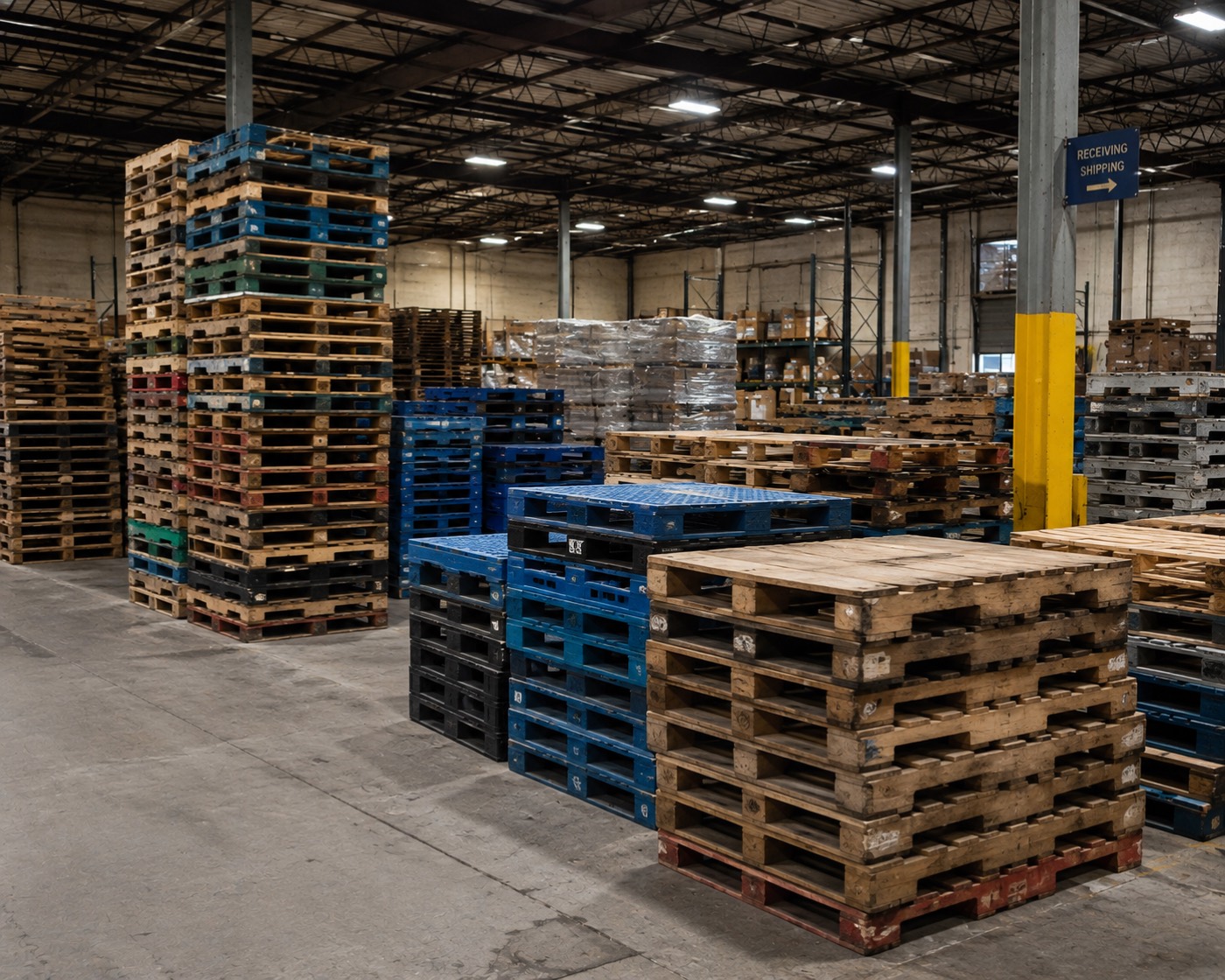
The consequence is millions of square feet of distribution space, concentrated particularly along the southern corridor. Every building of it receives goods on pallets it did not order.
What that means for supply
Distribution centres are net pallet *generators*, and heavily so. Goods arrive palletised from hundreds of suppliers on hundreds of pallet specifications. Some are reused internally; many cannot be, because they are the wrong size, the wrong grade or simply surplus.
So Central Ohio produces recoverable wood packaging at a rate few comparable markets match. Three consequences:
- Reclaimed pricing is competitive here because the input stream is deep and continuous.
- Odd sizes surface constantly. Anything shipped anywhere in North America eventually passes through, so the long tail of footprints is available here in a way it is not in a smaller market.
- Quality is variable. A deep pool is a broad pool. Grading matters more, not less — see ninety seconds on the grading line.
The problem it created
Growth in distribution space outpaced growth in the recovery infrastructure around it, and the gap showed up as pallet piles.
A building designed for throughput does not usually have generous yard space, and a pallet stack is the classic use of space that was not planned for anything. That is a fire-code question, a pest question and a housekeeping question all at once — covered in the fire engineer's view of your pallet stack.
It is also a straightforward economic loss. A site paying a waste hauler to remove pallets is losing twice: the disposal fee, and the core value given away with it. In a market this dense, that is a large aggregate number being left on the ground.
Where it goes next
Two trends are worth watching from a pallet perspective.
Automation. New distribution facilities increasingly include automated handling, which changes the pallet specification from a grade question to a tolerance question. See designing a pallet for automation.
Reporting. Sustainability reporting requirements are pushing operations to account for waste streams they previously ignored. Pallets are an unusually easy win there — the diversion is real, the arithmetic is simple, and it usually saves money rather than costing it.
Both point the same way: toward operations that treat pallets as a managed asset rather than as a consumable. That is what a managed programme is for.
Takeaways
- Central Ohio's one-day-drive position drove the distribution build-out.
- Distribution centres are net pallet generators, which deepens the local reclaimed pool.
- Deep pools are broad pools — grading matters more, not less.
- Recovery infrastructure lagged the build-out, and the gap shows up as pallet piles.
Questions
Asked and answered
Are pallets cheaper in Columbus than elsewhere in Ohio?
Reclaimed stock is generally competitive here because the inbound core stream is deep and continuous, and because freight from our yard to Central Ohio sites is short.
Where can I find unusual pallet sizes in Ohio?
Central Ohio is the best place to look. Because goods from across North America pass through, the long tail of footprints surfaces here more often than in smaller markets.
Written by
Priya Raghunathan
Operations & Programs
Builds the multi-site pallet programmes and does the baseline audits. Keeps the spreadsheets everybody else quotes from.
Disagree with something here? That is genuinely useful to us — several of these articles exist because a customer told us we had it wrong. Use the form at the top of the page or write to the yard directly.
Terms used here
Definitions live in one place so they cannot drift. Full list in the pallet glossary.
- Core
- An unsorted used pallet as received from a generator, before grading. The raw material of a pallet yard.
More in Ohio & industry
Keep reading
Related notes
Rickenbacker, and where the pallets actually go
Three transport modes meet in the same few square miles, and each one wants a different pallet.
Ohio & industryThe pallet year in Ohio
Pallet supply and pallet demand peak at different times of year, which is why prices move even when nothing else does.
ComplianceThe fire engineer's view of your pallet stack
Wood pallets are close to an ideal fuel array. That is not rhetoric — it is why they get their own commodity classification.