Ohio & industry
Why 48×40 won, and what that means for your budget
Standards rarely win on merit. They win on fit, timing and the sheer weight of everything already built around them.
Request a quote
Talk to the people who wrote this
Same form, same inbox. Technical questions get answered whether or not there is an order attached.
In short
The 48″ × 40″ GMA pallet became the North American standard because two 48-inch dimensions fit almost exactly across the 98-inch interior of a US trailer, and because the grocery trade standardised on it while distribution racking was being installed nationwide.
That path dependence is now a commercial advantage to you: the reclaimed pool for 48×40 is deeper than for any other footprint, which makes it the cheapest genuinely good pallet available.

The trailer decided it
A standard US dry van is roughly 98 inches wide inside. Two 48-inch pallet lengths side by side is 96 inches — a fit with two inches of working clearance. Turn them and a 48 plus a 40 makes 88 inches across, leaving room for handling.
That is the whole origin story. The dimension was not derived from a load, an ergonomic study or a strength calculation. It was derived from the box it had to go inside.
Everything else followed. Selective racking beams were specified to suit it. Warehouse aisle widths assumed it. Forklift fork spacing settled around it. Carton dimensions were designed to tie-and-stack neatly onto it. Sixty years later, the footprint is load-bearing in a way that has nothing to do with wood.
Why the standard is worth money to you
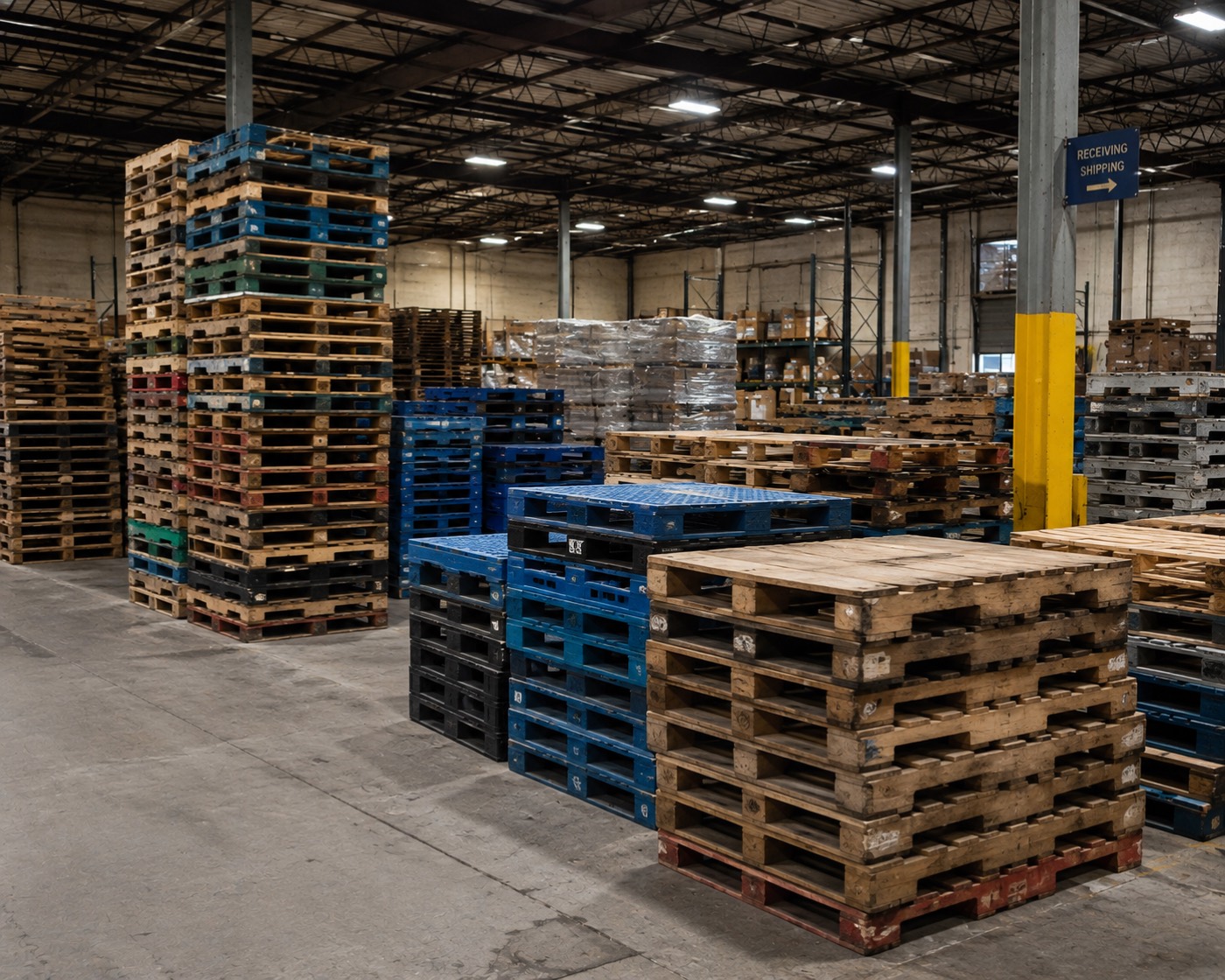
Here is the part that matters commercially. Because 48×40 is used by everyone, it is *returned* by everyone. The reclaimed pool for that one footprint is enormous and continuously replenished.
Deep supply does three things:
- Price. Reclaimed 48×40 costs less than any other reclaimed footprint, and dramatically less than a new build.
- Availability. We hold it in every grade, permanently. Nothing else is a permanent line.
- Stability. Reclaimed 48×40 pricing tracks collection volumes, which move slowly. New pallet pricing tracks lumber markets, which move weekly.
Move an odd footprint to 48×40 where the load permits and you capture all three at once. That is frequently a larger saving than anything a supplier negotiation will produce.
When the standard is the wrong answer
Standards win by ubiquity, not by being optimal for any particular job. Four cases where 48×40 is genuinely wrong:
- Drums. Four 55-gallon drums have a fixed footprint and it is not 48×40. That is what the 48×48 exists for.
- Retail floor-ready. Aisle ends are sized to store fixtures, not to trailers. Hence the 36×36 and the half-pallet.
- Dense product that weighs out. If your trailer hits its weight limit long before it fills, a smaller footprint may build a better load.
- Anything that overhangs. A load that does not fit the deck is not made to fit by ubiquity. See the real cost of pallet overhang.
The metric question
Europe standardised differently and, on the pure geometry, arguably better. The 1200 × 800 mm Euro pallet fills a 2400 mm European trailer exactly in both orientations, which is a more elegant solution than 96-inches-in-a-98-inch-box.
It is also irrelevant here, because the trailers are different. A Euro pallet in a US warehouse is a 31.5-inch-deep object in racking designed for 40 inches — it leaves a gap, wastes bay space and creates a fall hazard.
If you import and keep receiving them, they are worth money to somebody rather than worth stacking behind the building. See Euro and import pallet sizes.
Takeaways
- 48×40 was chosen to fit a trailer, not to be structurally optimal.
- Its deep reclaimed pool is why it is the cheapest good pallet available.
- Reclaimed 48×40 pricing is more stable than new-build pricing.
- Drums, retail displays and weigh-out freight are the honest exceptions.
Questions
Asked and answered
Is the 48x40 pallet the strongest size?
No, and it was never chosen for strength. It was chosen because two 48-inch dimensions fit across a US trailer. Its advantages today are supply depth, price and compatibility with everything built around it.
Should we switch an odd footprint to 48x40?
If the load fits the deck without overhang, almost certainly yes. The supply depth alone usually beats what any negotiation on your current size will achieve.
Written by
Priya Raghunathan
Operations & Programs
Builds the multi-site pallet programmes and does the baseline audits. Keeps the spreadsheets everybody else quotes from.
Disagree with something here? That is genuinely useful to us — several of these articles exist because a customer told us we had it wrong. Use the form at the top of the page or write to the yard directly.
Terms used here
Definitions live in one place so they cannot drift. Full list in the pallet glossary.
- Euro pallet
- The 1200 × 800 mm European standard pallet, also called EUR-1 or EPAL.
- GMA pallet
- The 48″ × 40″ North American standard, named after the Grocery Manufacturers Association.
- Overhang
- Load extending past the deck edge. Reduces carton compression strength at the corners and causes crush damage.
- Selective racking
- The most common warehouse racking type, supporting pallets on two beams with an unsupported span between.
Keep reading
Related notes
Overhang is not a packaging detail. It is a damage budget.
Cartons carry their load in the corners. Hang a corner over the edge and you have removed the part that was doing the work.
Buying & costAudit your pallet spend in an afternoon
The most common finding is not a bad price. It is one site buying pallets while another pays to throw the same pallets away.
Buying & costWhat happens to your pallet price when lumber moves
The two halves of this business respond to completely different signals, which is why the gap between them widens and narrows.