Ohio & industry
Rickenbacker, and where the pallets actually go
Three transport modes meet in the same few square miles, and each one wants a different pallet.
Request a quote
Talk to the people who wrote this
Same form, same inbox. Technical questions get answered whether or not there is an order attached.
In short
The Rickenbacker corridor south of Columbus combines air cargo, intermodal rail and road freight in one cluster. Each mode imposes different pallet requirements — air rewards light weight, intermodal rewards durability and compliance, road rewards cube efficiency.
That mix is why our yard holds a broader range of footprints and grades than a purely road-served market would need.
Air: weight is the constraint
Air freight is charged on chargeable weight, so every pound of packaging displaces a pound of revenue cargo.
That changes the calculus entirely. A hardwood pallet that is the right answer for a warehouse is the wrong answer in an aircraft hold, where the same strength in a lighter package is worth paying for.
The options are lightweight softwood construction, presswood or moulded pallets which are very light and nest for return, or plastic nestable pallets. Presswood has an additional advantage on international air freight: as engineered wood, it is outside ISPM-15 entirely.
Air freight also tends to be international, so anything solid wood needs treatment and marking.
Intermodal rail: durability and compliance
Intermodal containers get lifted, stacked, and set down harder than a truck trailer ever does. Loads sit longer. Temperature and humidity swing more.
That rewards durability — hardwood, sound bottom decks, good fastener specification — and it punishes marginal packaging that would survive a short road trip.
It also concentrates compliance risk, because intermodal freight is disproportionately international. Every solid wood component needs to be treated and marked, and the bracing inside the container is where that most often fails. See dunnage: the compliance blind spot.
Road: cube is king
For road freight the binding constraint is usually trailer cube rather than weight, and that puts the emphasis on footprint efficiency.
A 53-foot van gives roughly 630 inches of usable length and 98 of usable width. Whether your footprint yields 26, 30 or 34 pallets per floor layer is the difference between sending four trucks a week and sending five.
This is where the spec bench earns its keep — enter a footprint and it computes the floor count for both orientations. On dense product that weighs out before it cubes out, the calculation flips and a smaller footprint can build a better load.
What we hold because of the mix
A yard serving only road freight could run on 48×40 in three grades and satisfy most customers.
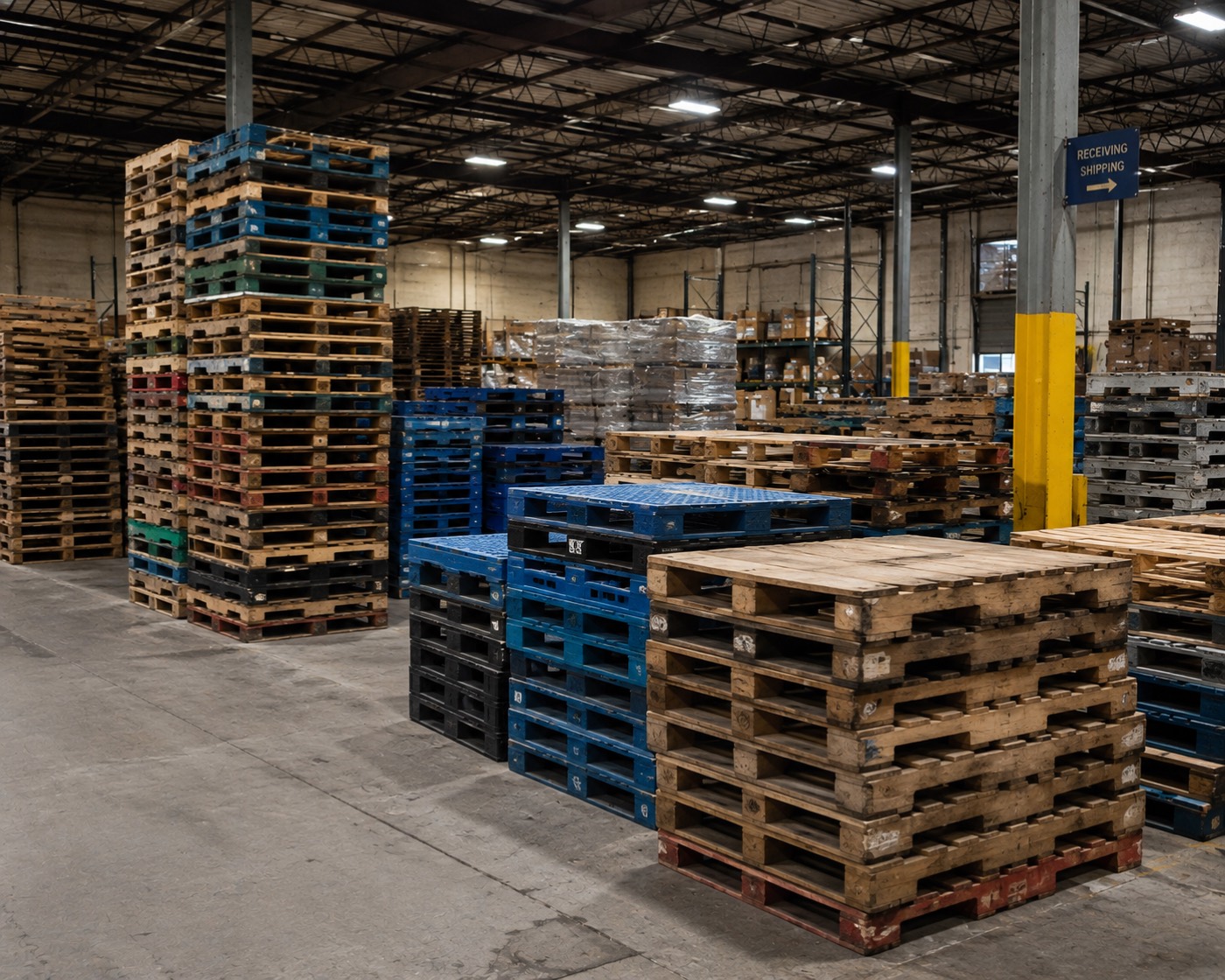
Serving this corridor means holding more: lightweight builds for air, hardwood and treated stock for intermodal, the standard grades for road, and a broader tail of odd footprints because international inbound freight arrives on Euro, ISO and Asian standards that fit nothing locally.
That last category is worth flagging if you receive imports. Those pallets have real resale value — particularly to exporters shipping back toward Europe — rather than being something to stack behind the building. Send a count and photographs and we will tell you what is worth money.
Takeaways
- Air freight rewards light weight; presswood also sidesteps ISPM-15 entirely.
- Intermodal rewards durability and concentrates compliance risk in the bracing.
- Road freight is usually cube-constrained, making floor count the key number.
- Imported Euro and Asian pallets have resale value rather than being a disposal problem.
Questions
Asked and answered
What pallet is best for air freight?
The lightest one that will do the job — lightweight softwood, presswood or nestable plastic. Presswood has the added advantage of being outside ISPM-15 as an engineered wood product.
Do intermodal shipments need different pallets?
Generally more durable ones. Containers are lifted, stacked and set down harder than trailers, loads sit longer, and conditions swing more. Compliance also matters more because intermodal freight skews international.
Written by
Dale Whitmer
Yard Manager
Runs the grading line and the repair bay. Has graded more pallets than he can estimate and still argues about deck coverage.
Disagree with something here? That is genuinely useful to us — several of these articles exist because a customer told us we had it wrong. Use the form at the top of the page or write to the yard directly.
Terms used here
Definitions live in one place so they cannot drift. Full list in the pallet glossary.
- Bottom deck
- The lower deck boards. May be full coverage, partial, or absent entirely on a skid.
- Cube
- The volume a load occupies, as distinct from its weight. A trailer can cube out before it weighs out, or vice versa.
- Dunnage
- Loose timber used to brace, block and protect freight in transit. Falls under ISPM-15 for export.
- Hardwood
- Wood from broadleaf trees — oak, maple, poplar, gum. Denser and more durable than softwood for pallet use.
- ISPM-15
- The international standard governing treatment and marking of wood packaging in international trade.
- Softwood
- Wood from coniferous trees — pine, spruce, fir. Lighter and cheaper than hardwood; southern yellow pine dominates new pallet production.
Keep reading
Related notes
What the Columbus distribution boom did to pallets
Every square foot of distribution space built in Central Ohio is a square foot that generates used pallets nobody planned for.
ComplianceYour first export container: the packaging checklist
The goods are the easy part. It is the wood around them that decides whether the container moves or sits.
ComplianceDunnage: the compliance blind spot
Everybody knows the pallet needs a stamp. Almost nobody thinks about the offcut wedged against the load to stop it sliding.