Buying & cost
How to buy pallets when there are not enough of them
In a tight market the buyer who gets supplied is rarely the one paying most. It is the one who is easiest to supply.
Request a quote
Talk to the people who wrote this
Same form, same inbox. Technical questions get answered whether or not there is an order attached.
In short
When the reclaimed core stream tightens, availability rather than price becomes the binding constraint. The buyers who stay supplied are the ones who are predictable, flexible on grade, flexible on footprint, and who return cores into the pool themselves.
Paying more helps at the margin. Being easy to supply helps considerably more.
What a shortage actually looks like from the yard
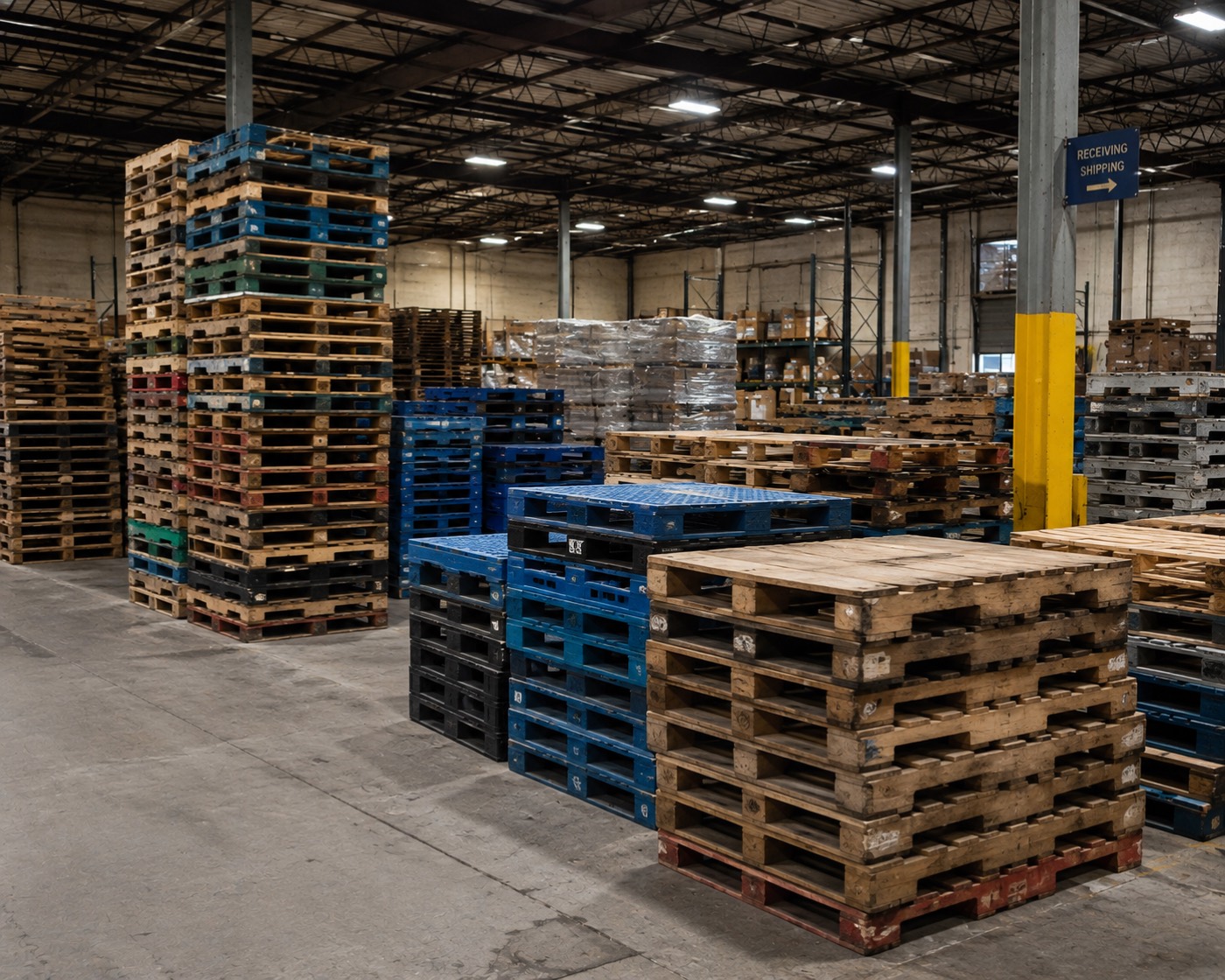
A yard in a tight market is not sitting on stock waiting for the best offer. It is allocating a thinner inbound stream across standing commitments.
The decisions that get made are mostly about certainty. A customer who takes the same volume every week, accepts the grade that fits their application, and can flex a day on delivery is easy to plan around. A customer who orders erratically, insists on Grade A for one-way shipping, and needs it tomorrow is expensive to serve at any price.
None of that is punitive. It is what happens when a business allocates a scarce input.
Six things that work
1. Commit to a schedule
A standing weekly or fortnightly volume is worth more to a yard than a higher spot price, because it lets us plan collection against it. This is the single most effective move.
2. Loosen the grade where you can
If half your volume is one-way outbound running on Grade A, moving that half to Grade B roughly doubles the pool we can pull from. Most operations discover the grade was never a requirement, just a habit — see audit your pallet spend.
3. Accept a second footprint
If your load fits a 48×40 and also fits a 48×42, saying so gives us two pools instead of one. Tell us your tolerance rather than your preference.
4. Return cores into the pool
A customer who supplies cores is not just a buyer, they are part of the supply. In a tight market this changes the conversation completely. See the two-way lane.
5. Give more lead time
Two weeks instead of two days moves you from the scramble list to the plan.
6. Take a partial early rather than a full load late
Splitting a delivery is often possible when a full load is not. Ask.
What does not work
Spreading across five suppliers. It feels like risk management and it functions as the opposite: you become a small, unpredictable account at five yards instead of a planned one at a single yard. In a shortage, small unpredictable accounts are exactly what gets deprioritised.
Demanding contractual guarantees on a variable input. Any supplier who guarantees unlimited reclaimed supply at a fixed price in a tight market is either about to disappoint you or about to substitute something you did not order.
Switching to new without checking. Sometimes right, often not — a new build has its own lead time, and in a lumber squeeze that lead time can be worse than the reclaimed wait.
The honest version
We will tell you when we cannot supply you, and we will tell you early rather than at the delivery window. That is not a service feature, it is the only workable way to run a business on a variable input.
We will also tell you when the right answer is a new build, a different footprint, or another supplier closer to you. Losing an order and keeping the account is a straightforward trade.
If you are short right now, send the volumes, the footprints and the tolerances on the quote form — including where you can flex. The flexibility is what we can work with.
Takeaways
- In a shortage, availability is the constraint and predictability is the currency.
- Loosening grade on one-way lanes roughly doubles the pool available to you.
- Returning cores makes you part of the supply, not just a claim on it.
- Spreading across five suppliers makes you a small account at all five.
Questions
Asked and answered
Should we stockpile pallets when supply is tight?
Modest buffer stock is sensible; large stockpiles are not. Stored pallets occupy space that costs money, degrade if stored outdoors, and create the idle-storage fire load question covered elsewhere on this blog.
Will paying more get us supplied first?
At the margin. Being predictable, flexible on grade and footprint, and supplying cores back into the pool all matter more than the unit price.
Written by
Priya Raghunathan
Operations & Programs
Builds the multi-site pallet programmes and does the baseline audits. Keeps the spreadsheets everybody else quotes from.
Disagree with something here? That is genuinely useful to us — several of these articles exist because a customer told us we had it wrong. Use the form at the top of the page or write to the yard directly.
Terms used here
Definitions live in one place so they cannot drift. Full list in the pallet glossary.
- Core
- An unsorted used pallet as received from a generator, before grading. The raw material of a pallet yard.
- Grade A
- A used pallet with original unrepaired stringers, seven or more top deck boards and no significant damage. Also called #1.
- Grade B
- A used pallet that may have one repaired or companion stringer and replaced boards. Also called #2.
- Two-way lane
- A route where a truck delivers pallets and collects used cores on the same visit.
Keep reading
Related notes
What happens to your pallet price when lumber moves
The two halves of this business respond to completely different signals, which is why the gap between them widens and narrows.
Buying & costThe two-way lane, and why it beats any price negotiation
A truck that arrives full and leaves empty has wasted half its journey. Somebody pays for that half whether or not it appears on an invoice.
Buying & costPooling or buying outright: which one is actually cheaper?
Pooling is a real answer to a real problem. It is also frequently sold to operations that do not have that problem.